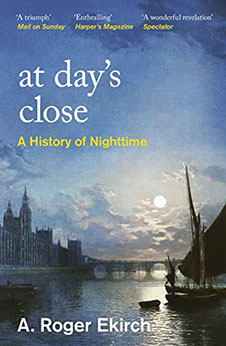
At Day’s Close: A History of Nighttime
“For all these my hard & laborious employments, I never slighted or disregarded my books, ye study of which augmented my understanding, stealing an opportunitie by day, but more by night and that when all was safe in bed, sitting up late”. – John Cannon (1705)
Dear Both,
In recent months, I have dedicated much thought to the “solitary tenant”, described in The Pickwick Papers, who “might be seen poring, by the light of a feeble tallow candle, over a bundle of soiled and tattered papers, yellow with dust and dropping to pieces from age, writing, for the hundredth time, some lengthened statement of his grievances, for the perusal of some great man whose eyes it would never reach, or whose heart it would never touch”. Though relating to this character in many ways, we differ regarding the usage of animal-derived products for light, though not in our continued futile attempts to achieve some recognition from the uncaring powerful. Naturally, this anecdote is a perfect introduction to an unsolicited book report on a text that explores night in preindustrial times and has been one of interest to me since I first learned of the theory of segmented sleep it proposes in the spring of 2018.
“Come, thick night, and pall thee in the dunnest smoke of heck”.
– Adapted from Macbeth
At Day’s Close: A History of Nighttime
8/10
“Darkness endows the small and ordinary ones among mankind with poetical power”
– Thomas Hardy
To briefly summarise this book, it opens by describing environmental conditions and the extent of criminality in preindustrial times, both of which were causes of fear for people. Attention is then devoted to the impact of the church and state on people’s lives and their activities and routines when not at work. Next, descriptions are offered of work that was conducted during hours of darkness and what both the wealthy and poor did to enjoy themselves during their downtime. Following an exploration of night-time rituals, the book presents its most fascinating revelation, that of segmented sleep patterns by our preindustrial ancestors.
The purpose of this report is not to condense this text, but rather to relate aspects that might be of interest or amusement. Now, on with the show.
The first thing that must be understood about the world in preindustrial times, is that it was wild, chaotic, and filled with danger. It was a very different place from today with far less land cleared than is at present. This landscape is described as treacherous and attention is given to the percentage of forest cover in countries, i.e. approximately 50% in Italy in 1500 vs. 21% in modern Italy. Even areas that had been cleared for agriculture or habitation, tree stumps, trenches, ditches from where peat was cut, or “abandoned collieries, quarries and coal-pits pocked the ground” exposed people of the time to real danger. Unfortunately, roads were not much better, and quote recounted by Sir John Parnell complains that “There is scarce any journey can be undertaken without some remarkably inconvenient not to say dangerous spots of roads intervening even in the flattest parts of England”.
Even lovers of murder, such as the recipients of this report, would agree that things were out of control in that regard during preindustrial times. “The incidence of murder during the early modern era was anywhere from five to ten times higher than the rate of homicides in England today… While no social rank was spared, the lower orders bore the brunt of brutality, often from the blows of kith and kin”.
Alcohol was a large factor in all this violence, cited as a contributor in approximately 60% of all homicides in early seventeenth-century Stockholm. Particularly, in the “overwhelmingly male atmosphere of drinking houses, violence could follow quickly on the heels of political disputes, ill-chosen words, or cheating at cards”.
Compounding these matters and making life more unpleasant for preindustrial persons, many of the comforts readers of this report are used to, did not exist during preindustrial times. Frigid beds were often warmed with “copper pans of coals or, in modest dwellings, with hot stones wrapped in rags” and nobody had yet thought of ‘electric blankets’ or ‘hot water bottles’. Beds were cold as the objective of residents was not to accidently burn their house down through fires that had not properly been ‘banked’, or left smouldering in a manner that emitted reduced heat.
Light was important for more reasons than writing lengthened statements grievances, and tallow candles were an inexpensive lighting option. Their shaft was made of “animal fat, preferably rendered from mutton that was sometimes mixed with beef tallow”. However, it is reported that these candles gave off a rancid smell due to all the impurities in the fat. It is for this reason that Shakespeare writes in Cymbeline (ca. 1609), of the “Base and unlustrous as the smoky light that’s fed with stinking tallow”. Other disadvantages of candles of this type are that the quality of their light deteriorated as they burned, and they required continual attention in the form of ‘snuffing’ or trimming every fifteen minutes to avoid wasting the dripping molten fat. Further problems were that they required careful storage “so that they would neither melt nor fall prey to hungry rodents”. Their low melting point meant that this class of candles were not suitable in warmer climates and oil lamps were a preferred option in Mediterranean countries, a form of lighting that risked congealing in northern climes during the winter months.
One of my favourite Christian holidays each year is Candlemas (preceded only by Martinmas and Michaelmas). The text provided new insights into this special day, clarifying that it was established in 496 of the common era by Pope Gelasius, where it was intended illumination of the dark by blessed candles would symbolise “God’s dominion over the invisible world” and the “Church’s continual struggle against darkness”.
This book is filled to the brim with fascinating and interesting nuggets of information.
For instance, on the topic of curfews, enforced in many towns, the term ‘curfew’ is reported as originating from the French word couvre-feu, meaning ‘cover-fire’, as families repaired to bed when fires were covered.
A claim by William Harrison is reported that the dog, the ‘mastiff’, used to guard against thieves, derived its name from ‘master-thief’ due to its perceived prowess against intruders.
The word ‘Goodnight’ is derived from “God give you good night”. This is similar to ‘Goodbye’, which from my own reading elsewhere, is derived from ‘God be with ye’.
Whale hunting in the North Atlantic was prevalent during the early eighteenth century for, among other whale-derived products, “a rose-colored liquid wax” found in the head of sperm whales and used to make spermaceti candles. Obtaining this expensive wax was the objective of “Captain Ahab’s vessel, the Pequod, in Moby-Dick (1851)”.
In addition to improvements in human eyesight in the dark in under an hour due the expansion of the iris, “the nocturnal sight of preindustrial populations benefited from consumption of leafy green vegetables and fresh fruit, rich in vitamin A, though availability was largely limited to late spring and summer”. Often though, this was negated by the excess consumption of alcohol.
Benjamin Franklin, coined the phrase “Early to bed and early to rise makes a [hu]man healthy, wealthy, and wise”. It appears to have been based on prevailing wisdom at the time, originally transcribed in the more long-winded form, “By going early to asleep [sic] and early from it [sic], we rise refreshed, lively and active” by the author of An Easy Way to Prolong Life (1775).
Above are recounted what I found, on first reading, to be the most interesting little factoids in the book. There are far more, such as the tradition of ‘bundling’ for young courting couples, which got relegated from the final version of this report.
The topic of reading is given a moderate level of attention in the text, highlighting that, while many people remained unlettered, modern literacy was more prevalent that one might imagine. Indeed, though it was usual that only the clergy could read and write during the late Middle Ages, by the seventeenth century, “a large majority of yeomen and skilled artisans in the English countryside were literate, as were many urban males”. Unfortunately, women had fewer opportunities to learn and were glad of a Protestant movement called pietism during the 1700s that demanded personal study of the bible and, hence, literate females.
Prior to the fifteenth century, reading was generally conducted aloud. It was revolutionary then that around this time silent reading became popular and allowed “individuals scrutinize books with ease and speed”; “explore texts in isolation, apart from friends and family, or masters”; and for books to become “more personal, as more people pondered books and formed ideas on their own”.
Due to feelings of vulnerability, those that lived in preindustrial times were paranoid, suspicious, and superstitious during hours of darkness.
For instance, with regard to the so-called European witch craze from the 15th century onwards, witch hunts are regarded by historians as more likely to occur in areas that were undergoing rapid changes as the feudal system began to collapse around them. “[W]ar, famine, natural disasters, and plague” all intensified the feelings of distress felt by citizens in regions such as these, and, feeling “[m]ore helpless than ever…, increasingly personified their woes by blaming Satan and his minions, many of whom were discovered among the destitute poor roaming the countryside. Caught in the grips of despair, early modern communities projected their anxieties onto society’s most vulnerable members”. It could be argued that human behaviour of this type persists.
The levels of superstition and fear of the supernatural were so great among people, that this was often exploited by thieves and “some rogues masqueraded as demons”; impersonated the devil; or masqueraded as ghosts, wearing white shirts and coating their faces with flour. Seemingly, it was an effective strategy as a pastor in Zürich, Lewes Lavater, is reported as saying in 1572, that criminals of this type “have many times robbed their neighboures in the night time, who supposing they heard the noyse of walking spirites, never went about to drive the theeves away”.
You may recall, from careful reading of previous reports (i.e. The Legend of Sleepy Hollow), the “rustic character Brom Bones and his gang of ‘rough riders’ [who] vandalize Ichabod Crane’s schoolhouse one night ‘so that the poor schoolmaster began to think all the witches in the country held their meetings there’”.
Ever since the, now infamous, ‘who goes there?’ incident of 2015, it has been suggested that I missed my calling as a night-watchman. Even back-in-the-day, a vocation of this type was not desirable, with the text revealing that night-watchmen were generally held in contempt. “These men were not the swashbuckling guards, resplendent in ruffles and silk, portrayed in Rembrandt’s famous painting of Captain Frans Banning Cocq’s militia company, later misnamed The Nightwatch” and did not wear fancy uniforms. Instead, they wore tattered hats, heavy cloaks to keep them warm in the night air, and rags around their head like scarves. Frequently, they were a target for derision by playwrights and poets, including by Shakespeare who takes aim with his representation of the constable Dogberry character in Much Ado About Nothing.
Discouragingly, this book reveals that, unfortunately, some things never change. “Among the hardest workers—night in, night out—were women. Unlike men of middling or plebeian rank, who mostly worked outside the home, many urban wives and daughters confined their days to the domestic realm, except for running errands, performing outdoor chores, or visiting a close neighbour”. Unlike men who worked a limited number of hours, women were always on, and “most… rose earlier than their husbands… [and] had less opportunity during the day to rest”. “’Some respit to husbands the weather may send’, wrote Thomas Tusser in the sixteenth century, ‘but huswives affaires have never an ende’”.
Interestingly, the book shows another side to prostitution, an angle that I had never considered before.
Other than work as seamstresses or servants, there were few opportunities for needy young women with little training, besides prostitution. Though “victimized by violence and venereal disease, prostitutes found a rare measure of autonomy in a trade that defied patriarchal authority”. Indeed, the text argues that workers in this sector were free from the tyranny of parents or husbands and able to do as they pleased, controlling their own bodies and labour, providing they operated independently to the strictures of brothels.
Within the confines of marriage, women did have the power to torment selfish men. In the diary of John Eliot, written in Connecticut, he claimed that his wife gave him “curtain lectures” that were “very frequent, severe & long (every other night almost to the keeping both awake great part of the night [sic] & sometimes every night or night after night) with the most vile & scurrilous language . . . raking up the old stories about a first & second wife, first & second children etc”. Other than reprimanding Eliot for his previous marriages and “spurning his bedtime advances, sometimes his wife insisted that he sleep in another room”.
I could really get behind the Puritans who operated in England and America in the sixteenth century. This crew hated “unnecessary sluggishness” and many “condemned immoderate slumber for its sinful association with idleness and sloth”. Further, they believed that excessive sleep was dangerous to a person’s health causing a “heightened propensity for lechery”, “damaged digestion”, blood that was not properly nourished, and “troubled spirits”. According to the The Schoole of Vertue in 1557, “Much slep ingendereth diseases and payne, / It dulles the wyt and hurteth the brayne”. It was for this reason, an English Puritan, Ralph Thoresby, devised an early alarm clock so that he could rise each morning at five.
It appears, however, that it was not just the eyebrows of Puritans that were raised by excessive time bed. Common adages during the sixteenth century were, “Six hours’ sleep for a man, seven for a woman, and eight for a fool”; and “Nature requires five, custom takes seven, laziness nine, and wickedness eleven”. Wickedness? If you were sleeping eleven hours a night, I’d get some medical help.
While much of the historical documentation supporting this text is weighted towards wealthier and upper class individuals, this is acknowledged when suggesting that “the standard bedtime fell between nine and ten o’clock” for most persons. Comically, bed time was referred to as “Breeches-off time” in Germany.
There are an abundance of references to the Irish throughout the text. One example recounts four men in Castlelyons in the late eighteenth century being charged “with unearthing the recently interred corpse of a woman and removing her fat for a thief’s candle”.
One illuminating portion of the text described how Irish families embraced the occult and folk magic in parallel to Christianity, failing to see any contradiction. Indeed, an eighteenth century poem reads:
“St. Bridget’s cross hung over door,
Which did the house from fire secure . . .
And tho’ the dogs and servants slept,
By Bridget’s care the house was kept.
Directly under Bridget’s cross
Was firmly nail’d the shoe of horse [did Father write this poem?]
On threshold, that the house might be
From witches, thieves, and devils free”.
“In the Irish village of Dereen, probably few residents were as cautious as John ‘of the moon’ O’Donoghue when picking times to tread abroad. He was well known for going home after nightfall by moonlight— ‘I’ll go home with the light of the moon’, he frequently declared. But returning from a tavern on an October night, he stumbled into a ditch and drowned. For earlier that evening John had indulged another habit, drinking large quantities of whiskey and beer”. I know it’s hard to believe, but it appears that an Irish person at some point in history drank too much.
Arthur Young says of the Irish poor, “They steal every thing they can lay their hands on”. It was no wonder then that many historical records describe “anti-Irish mobs”, with one onlooker in 1736 London reporting, “Late that night assembled many hundred disturbers of the peace, proclaiming thro’ the streets a law of their own making, viz. that every Englishman should put out lights in their windows; and then the cry run, Down with the Irish”.
Turning our attention to mentions of Holland in the text, instances are described of Dutch burglars tunnelling under doors and cutting holes in roofs to access their plunder. However, burglaries tended to be more violent in rural areas of The Netherlands, where often families were assaulted, and their house ransacked.
It is stated, too, that there were over five hundred alehouses in Amsterdam during the seventeenth century, nearly as many as an Irish village at that time, presumably, where a “a fatal dispute occurred among four drunken friends over which tavern to visit next”.
At this point in a report, it is usual for me to outline the humour contained in a text. Rather than being a dry and boring piece, At Day’s Close was surprisingly funny and described numerous amusing and comical historical incidents.
For instance, an incident in Geneva is described where a burglar stole items from a bedroom where two persons slept, “not once but twice after an interval of just two hours—even though the victims had awakened to pursue him after the first theft”.
How about having your ears cut off for not acting as a fireman? A comical regulation in France described where “members of the watch had the power to enlist passersby for fire-fighting… [and] [a]ny who refused to help were subject to arrest and, if convicted, having their ears cut off”.
On the subject of the reluctance of, particularly rural households, to opening their doors to unknown visitors, Edward Burt writes, “Upon the trampling of my horses before the house, the lights went out . . . and deafness, at once, seized the whole family”.
Wasting candlelight was judged critically during preindustrial times. “Such was the outrage of the Virginia planter William Byrd II upon discovering his slave Prue with ‘a candle by daylight’ that he ‘gave her a salute’ with his foot”. Relatedly, of the mathematician William Oughtred, it was written that his wife was, “a penurious woman” that would “not allow him to burne candle after supper, by which means many a good notion is lost”.
When attacked at night, it was usual for victims to loudly and repeatedly shout ‘Murder! Murder!’, no matter the severity of the assault. However, responses to these cries began to cease when shouters were often discovered unharmed. This is because a single act of crime did not imperil the wider village or neighbourhood and possibly was a risk to “civic-minded samaritans who ran to the aid of victims”. Consequently, it was little wonder that “street-savvy victims of crime knew at night to shout, ‘Fire! Fire!’ when assaulted in public” as an unchecked fire could result in a neighbourhood being burned along with people in their beds.
On evenings where the moon was full or nearly full, without clocks, people would wake in the middle of the night, and believe that it was daybreak. This truly was a ‘false dawn’, of which, during one, an anecdote is recounted of a Pennsylvanian in 1762 that “Arrose & drest but after rousing the family & getting a light found it was not 2 o’clock”. Similarly, a Cologne student, Herman Weinsberg, in 1529 “wakened and left home for school, unaware that it was barely past midnight”, nearly freezing to death outside the locked door of the family home.
It was interesting to note the evolution of night time activities in the text, from individuals merely returning to home to sleep, to the beginnings of nocturnal labour. “Despite persistent fears of fire, guilds and municipal authorities adopted less stringent regulations [than formerly]. In Sweden, for example, such was the importance of beer production that breweries remained in operation overnight”. Interesting priorities.
I wasn’t certain whether to include this item under the comedy or Irish section of the report, but it describes the designated bed positions for family members in Irish households in the early nineteenth century. An observer at the time wrote, “They lie down decently and in order, the eldest daughter next the wall farthest from the door, then all the sisters according to their ages, next the mother, father and sons in succession, and then the strangers, whether the travelling pedlar or tailor or beggar”. This protected the females from both “invited guests and unexpected intruders”.
Louis XIV must have been a nightmare to share a bed with. His brother, Philippe d’Orléans, confided to his wife, “When His Grace slept in my bed I had to lie so close to the edge that I sometimes fell out of bed in my sleep, for His Grace did not like to be touched, and if perchance I happened to stretch a foot in my sleep and to touch him, he would wake me up and scold me for half an hour”. Thanks for your discretion, Mrs. d’Orléans.
The jewel in the crown of this book is the novel theory of preindustrial segmented sleep that it proposes. Indeed, the text argues that sleep has long been neglected by historians and seeks to remedy this by consulting all available evidence, “diaries, medical books, imaginative literature, and legal depositions” etc. Though descriptions of sleep are contained in these primary sources, “So routine was [the] nightly interruption that it provoked little comment at the time”. The below passage summarises this document’s novel contention.
“Until the close of the early modern era, Western Europeans on most evenings experienced two major intervals of sleep bridged by up to an hour or more of quiet wakefulness… The initial interval of slumber was usually referred to as ‘first sleep’, or, less often, ‘first nap’ or ‘dead sleep’… The succeeding interval of sleep was called ‘second’ or ‘morning’ sleep, whereas the intervening period of wakefulness bore no name, other than the generic term ‘watch’ or ‘watching’… Both phases of sleep lasted roughly the same length of time, with individuals waking sometime after midnight before returning to rest. Not everyone, of course, slept according to the same timetable. The later at night that persons went to bed, the later they stirred after their initial sleep; or, if they retired past midnight, they might not awaken at all until dawn”.
It was usual for preindustrial households to begin to stir after midnight, or their first sleep, simply to urinate. The physician Andrew Boorde advised, “Whan you do wake of your fyrste slepe make water if you fele your bladder charged”. Other popular activities during this interval were smoking tobacco, checking the time, tending to fires, making a hot drink, taking medicines, praying, conversing, and intimacy between couples. For the poor, this was an opportunity “to commit petty crimes: filching from dockyards and other urban workplaces, or, in the countryside, pilfering firewood, poaching, and robbing orchards”.
In several of my reports since learning of this theory, I have noted instances of characters waking from their first or second sleep and would encourage you to keep your eyes peeled for similar indications of this theory’s veracity in your own reading.
The legitimacy of the theory is further supported by medical books between the fifteenth and eighteenth centuries which advise sleepers that their digestion and restfulness can be improved by lying on their right side during “the fyrste slepe” and “after the fyrste slepe turne on the lefte side”.
The National Institute of Mental Health in Bethesda have conducted sleep research that attempted to recreate sleeping conditions in preindustrial times. This discovered that depriving human subjects of artificial light for several weeks, resulted in them exhibiting “a pattern of broken slumber —one practically identical to that of preindustrial households. Without artificial light for up to fourteen hours each night, [the lead researcher’s] subjects first lay awake in bed for two hours, slept for four, awakened again for two or three hours of quiet rest and reflection, and fell back asleep for four hours before finally awakening for good”. It is noted, too, in the text that this natural segmented sleep pattern is followed in some remote villages in Africa, Tiv, Chagga, and G/wi, that are similar to the Western world during preindustrial times.
There is no mystery as why humans no longer sleep in this manner. Chronobiologist Charles A. Czeisler has remarked, “Every time we turn on a light we are inadvertently taking a drug that affects how we will sleep”, referring to changes in levels of the brain hormone melatonin. Modern forms of lighting allowed people to lengthen their days and the habit of divided slumber became less and less common. However, while later bedtimes and improved illumination clearly have a huge impact on our collective sleep cycles, I would ask you to think about how often you awake in the night and find you are able to sleep restfully again.
“Today we inhabit a nonstop culture characterized by widespread electric lighting both within and outside homes and businesses. Never before, in our everyday lives, have we been more dependent upon artificial illumination, arguably the greatest symbol of modern progress… Not surprisingly, sleep, too, has fallen prey to the hurried pace and busy schedules of modern life. In the United States today, perhaps 30 percent of adults average six or fewer hours of rest a night, with that portion rising as more persons stretch their waking hours”.
The book closes on a grim note, saying, “Increasingly, rather than render nighttime more accessible, we are instead risking its gradual elimination. Already, the heavens, our age-old source of awe and wonder, have been obscured by the glare of outdoor lighting. Only in remote spots can one still glimpse the grandeur of the Milky Way. Entire constellations have disappeared from sight, replaced by a blank sky. Conversely, the fanciful world of our dreams has grown more distant with the loss of segmented sleep and, with it, a better understanding of our inner selves. Certainly, it is not difficult to imagine a time when night, for all practical purposes, will have become day—truly a twenty-four/ seven society in which traditional phases of time, from morning to midnight, have lost their original identities”.
The Gipper