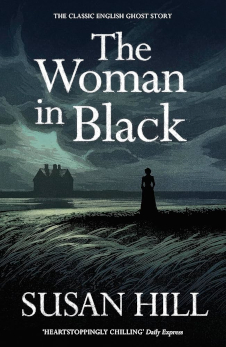
The Woman in Black
“No, no, you have none of you any idea. This is all nonsense, fantasy, it is not like this. Nothing so blood-curdling and becreepered and crude – not so … so laughable. The truth is quite other, and altogether more terrible.”
The Woman in Black
4/10
“I have already stated that I had no more believed in ghosts than does any healthy young man of sound education, reasonable intelligence and matter-of-fact inclinations”
Overall, I’ve got to say that I found this novel kind of boring. I was expecting big things from it, and it ended up just being competently written, though unsurprising and not very spooky.
This novel was published in 1983, though it is written in the style of an older book and set in the Edwardian period. It tells the story of Arthur Kipps, who, at the beginning, is spending time with his wife Esmé, four stepchildren, and stepgrandchildren on Christmas Eve. Arthur is a lawyer and has worked with another lawyer, Mr Bentley, for his whole adult life. We learn that he was widowed at 35, prior to marrying Esmé.
Though they’re having a lovely family Christmas, Arthur and Esmé are cutting the back off of one of Esmé’s daughters, Isobel, who they wish was “a little less staid, a little more spirited, even frivolous”. Say it to her face then. But the roasting of Esmé’s children doesn’t stop there. Arthur says of her youngest, Edmund, that he “felt uneasy in his presence”. Maybe that’s because he is fifteen?
The family begin telling ghost stories with the lights out. “Just the thing for Christmas Eve. It’s an ancient tradition!”. This sounds like a great laugh and some of the stories sound like they’re even better and scarier than this novel.
“They outdid one another in the far extremes of inventiveness, piling agony upon agony. They told of dripping stone walls in uninhabited castles and of ivy-clad monastery ruins by moonlight, of locked inner rooms and secret dungeons, dank charnel houses and overgrown graveyards, of footsteps creaking upon staircases and fingers tapping at casements, of howlings and shriekings, groanings and scuttlings and the clanking of chains, of hooded monks and headless horsemen, swirling mists and sudden winds, insubstantial spectres and sheeted creatures, vampires and bloodhounds, bats and rats and spiders, of men found at dawn and women turned white-haired and raving lunatic, and of vanished corpses and curses upon heirs.”
Arthur doesn’t like the recounting of ghost stories and leaves sulking. He feels guilty about this, but it is due to some supernatural event that happened to him. “Yes, I had a story, a true story, a story of haunting and evil, fear and confusion, horror and tragedy. But it was not a story to be told for casual entertainment, around the fireside upon Christmas Eve.” The ghost story has troubled Arthur for years and he says that he has had “no rest from it, that I should lie awake in a chill of sweat, going over that time, those events, those places. So it had been night after night for years”. He decides that he will write down his ghost story. “Then perhaps I should finally be free of it for whatever life remained for me to enjoy”.
The ghost story describes a business trip he made years ago one November to a town called Crythin Gifford when he was 23 year’s young. He is instructed to attend the funeral of a deceased client of his law firm, Mrs Alice Drablow, and to sort through “her private papers … whatever they may be. Wherever they may be …’… ‘And to bring them back to [the] office.’” Alice Drablow was a reclusive woman who lives in a strange spot called Eel Marsh House, where access to the house is cut off at certain times of day when the tide is high. There is also an ancient looking burial ground close to the property. Very spooky.
Drablow’s funeral is quiet affair, attended “by no blood relative or heart’s friend, but only by two men connected by nothing more than business, one of whom had never so much as set eyes upon the woman during her life”. That’s Arthur. Towards the end of the service, Arthur observes another mourner, who we later come to learn is the titular The Woman in Black. This poor The Woman in Black isn’t looking too great and appears to be “suffering from some terrible wasting disease, for not only was she extremely pale… it seemed, only the thinnest layer of flesh was tautly stretched and strained across her bones”. When Arthur asks the other funeral attendee, Mr Jerome, about “The young woman with the wasted face”, we get the first creepy moment of the book. “For a few seconds, in that quiet, empty lane, in the sunshine, there was such a silence as must have fallen again now inside the church, a silence so deep that I heard the pulsation of the blood in the channels of my own ears. Mr Jerome looked frozen, pale, his throat moving as if he were unable to utter… At last he said in a low voice, ‘I did not see a young woman.’”
The first time Arthur visits Eel Marsh House, he spots The Woman in Black again. This time hanging out in the ancient burial ground. He gets a better look at her wasted face and “the dreadfulness of her expression began to fill me with fear. Indeed, I had never in my life been so possessed by it, never known my knees to tremble and my flesh to creep, and then to turn cold as stone… It was as though I had become paralysed.” And paralysed with fear he remains until The Woman in Black disappears. Arthur believes that something supernatural is going down and, even though he doesn’t believe in ghosts, cannot think of another explanation for what he experienced. He is freaked out and decides that he’s going to walk back to Crythin Gifford, instead of being collected by his driver Keckwick.
The walk back to the town doesn’t go very well and Arthur experiences horrifying noises that convince him he “was hearing, beyond any doubt, appalling last noises of a pony and trap, carrying a child in it”. He believes that he is hearing the echo of some past pony and trap that “lost the causeway path and [had] fallen into the marshes and was… dragged under by the quicksand and the pull of the incoming tide”. Arthur responds like any normal person and returns to Eel Marsh House, has an old beverage or two, and goes for a nap. He’s convinced that ghosts exist now. “…coming to this place had already changed me and that there was no going back… I had seen things I had never dreamed of seeing and heard things too… the woman by the graves had been ghostly”.
Arthur gets collected by Keckwick from Eel Marsh House and doesn’t want to return. Afterall, he “had been as badly frightened as a man could be”. He concludes that he hadn’t seen anything that was horrifying, it was the vibes being off that distressed him. “It was true that the ghastly sounds I had heard through the fog had greatly upset me but far worse was what emanated from and surrounded these things and arose to unsteady me, an atmosphere, a force – I do not exactly know what to call it – of evil and uncleanness, of terror and suffering, of malevolence and bitter anger.”
Arthur has a leisurely day while deciding whether or not to return to Eel Marsh House, just doing normal people activities like going for a cycle, eating bread and cheese, and sleeping in some random farmer’s barn “for an hour”. Hang on. What is Arthur smoking? This is not conventional behaviour. This was your day off. You could have had a lie in. You didn’t have to cycle for “four hours and thirty-odd miles” if you suspected that you’d need a nap. And just like that, all of Arthur’s credibility disappears. This guy is crazy.
Samuel Daily, another odd character, invites Arthur around for dinner. Samuel Daily believes that Arthur should not return to Eel Marsh House alone and gives him a doggie called ‘Spider’. With his new canine companion, Arthur gets back to work sorting out Mrs Drablow’s paperwork at the house. His “main sensation was one of tedium and a certain lethargy, combined with a desire to finish the job and be back in London” with his fiancée Stella. He goes to sleep in Eel Marsh House and is awoken with the dog acting funny. He hears a noise somewhere in the house. Arthur and Spider start exploring for the source of the noise and identify it as coming from behind a “door without a keyhole”, which cannot be opened.
The next day, Arthur stocks up on food and returns to work in the spooky house. While sorting through some old letters, he finds that they contain some juicy historical gossip from about 60 years ago. They are correspondence between a character called ‘Jennet Humfrye’ to the recently deceased Alice Drablow to whom she is related. Shock horror! Jennet had a child out of wedlock, and she was being encouraged to give it up. Nobody cares in 2025 but it was a big deal then. There is also a document confirming the adoption of this child born out of wedlock by Alice Drablow and her husband.
Another repetitive and spooky night ahead for Arthur. He’s hearing the sounds of “pony’s hooves and the rumbling and creaking of the trap” on the marsh again. He feels sure that a “pony and trap with whoever was its driver, together with a child passenger, had been swallowed up and drowned within a few moments” at some point in the past. Inside, he observes that the mysterious door without a keyhole is now open and it’s a child’s nursery! It’s seriously creepy in there and it contains clothing for a “small boy of six or seven years old”. Again, Arthur is completely out of pocket. If you thought sleeping in some random farmer’s barn was bad, now he “picked things up, stroked them, even smelled them”. Are we supposed to believe this guy is terrified? He’s going around stroking and sniffing things in a haunted house! “They must have been here for half a century, yet they might have been played with this afternoon and tidied away tonight.” I’ll trust your sense of smell on that one.
There is a really interesting moment where Arthur conjectures that there may be “someone – another human being – living here in this house, a person who hid themselves away in that mysterious nursery and came out at night to fetch food and drink and to take the air. Perhaps it was the woman in black? Had Mrs Drablow harboured some reclusive old sister or retainer, had she left behind her a mad friend that no one had known about?” That would have been a great twist in a very predictable and linear story. Sadly, it was not the case.
Whoops. Arthur has broken his torch(?). As this novel is set during an unspecified time between 1900 and 1910, it was possible that this could be some sort of rudimentary flashlight. To address necessity of having some light, he decides to use the candle he saw earlier in the previously locked nursery. You are wild, Arthur. He uses this creepy candle to “read Sir Walter Scott as best I could by the meagre flame”. That I can relate to. When you love to read, you’ll make it work.
He awakens to the sound of a whistle, “as one whistles to summon a dog. Spider stopped dead in her tracks for a split second and then, before I could restrain her… she set off, as though after a hare, running low and fast away from the house, away from the safety of the grass and out across the wet marshes”. The dog is being sucked into the bog. Oh no! Is this the end of Spider the dog? No. Arthur saves the dog, meaning The Woman in Black and ghostly crew at Eel Marsh House are totally ineffective. As Arthur and the rescued dog walk back to the house, they see the titular The Woman in Black in one of the windows. Arthur faints.
Kind of a cop out move from the novel having Arthur faint and wake up in the home of his friend Samuel Daily. What does an author do when they don’t know how to end a scene? I think it’s really lazy writing. Returning to Eel Marsh House, the nursery has been destroyed and is “in a state of disarray”. While Arthur’s living in the lap of luxury at Samuel Daily’s place, he again turns his attention to the correspondence between Jennet and Alice Drablow. “The difficulty was, of course, that I did not know who the young woman – J for Jennet, who had written the letters – was, whether she might have been a relative of Mrs Drablow, or her husband, or merely a friend”. Hmm. Let’s flashback to a few chapters ago when these letters were being read for the first time. Here is a direct quote. “The writer, a young woman and apparently a relative of Mrs Drablow, was unmarried and with child.” How is Arthur suddenly confused about Jennet? I think Susan Hill or her editor were asleep at the wheel here. He also locates three death certificates in the paperwork. One for a boy, Nathaniel Drablow, who drowned at age six; one for a character called Rose Judd who drowned, age not specified; and one for “Jennet Eliza Humfrye, spinster, aged thirty-six years. The cause of death was given simply as ‘heart failure”. Are you getting what the plot is now?
Just in case you need plot information spoonfed to you, this novel has you covered. “As I walked, my thoughts were all concentrated upon the papers I had just read and the story they had told and which was now becoming clear and complete. I had found out, more or less by chance, the solution – or much of it – to the identity of the woman in black, as well as the answer to many other questions”. You’ll never guess the shocking reveal. “An event, and that a dreadful, tragic one, of many years ago, which had taken place and been done with, was somehow taking place over and over again, repeating itself in some dimension other than the normal, present one. A pony trap, carrying a boy of six called Nathaniel, the adopted son of Mr and Mrs Drablow, and also his nursemaid, had somehow taken a wrong path in the sea mist and veered off the safety of the causeway and onto the marshes, where it had been sucked into the quicksands and swallowed up by the mud and rising waters of the estuary. The child and the nursemaid had been drowned and so presumably had the pony and whoever had been driving the trap. And now, out on those same marshes, the whole episode, or a ghost, a shadow, a memory of it, somehow happened again and again – how often I did not know. But nothing could be seen now, only heard. The only other things I knew were that the boy’s mother, Jennet Humfrye, had died of a wasting disease twelve years after her son, that they were both buried in the now disused and tumbledown graveyard beyond Eel Marsh House; that the child’s nursery had been preserved in that house as he had left it, with his bed, his clothes, his toys, all undisturbed, and that his mother haunted the place.” Any attentive reader could have guessed all of this.
“I was growing more and more sensible of the fact that he was holding something back from me, some explanation or information about Eel Marsh House and the Drablow family and, because I knew that, I would not rest or be quite easy in my mind until I had found out everything there was to know. I decided to urge him strongly to tell it to me.” I was predicting a crazy twist right about now in Samuel Daily’s living room when he is chatting with Arthur but the only extra pieces of information are that Jennet and Alice Drablow were sisters. Yes, that sounds plausible. Keckwick was the father of the boy. I don’t care. The little boy’s dog also drowned in accident. Meh. “‘And Jennet watched. She was at the house, watching from an upper window, waiting for them to return.’” Where were they ‘returning’ from if they were taking the child away from Eel Marsh House to be with his real mother, Jennet? My head hurts.
Bonus information that will be relevant later is recounted by Samuel Daily: whenever The Woman in Black is seen, a child dies. Apparently, this happened to a minor character in the book, Mr Jerome.
Anyway, it seems like all’s well that ends well. Stella the fiancée is real and shows up on the scene. No children have died since the sighting of The Woman in Black and characters in the novel think that the curse is broken.
We flashforward to the present and Arthur reveals that there’s not much communication happening in his marriage to Esmé. Hang on. Stella is was fiancée in story. What happened there? Answers coming soon. Arthur says that Esmé “has watched me and wondered and been too sensitive to ask questions, I have seen the worry and distress on her face and sensed her restlessness, as we have sat together in the late evenings. I have been quite unable to tell her anything at all, she has no idea what I have been going through or why: she will have no idea until she reads this manuscript and at that time I shall be dead and beyond her.” This is hysterical. This marriage is a sham. You’re not talking about the most traumatic thing that ever happened to you with your dang wife?
And the book concludes with that traumatic thing. After they leave Crythin Gifford and return to London, Stella and Arthur are married. They have a child approximately one year later called “Joseph Arthur Samuel, and Mr Samuel Daily was his god-father”. Okay. Weird pick, but you do you. Arthur has spoken to this guy fewer than 10 times in his life. Stella and Arthur take baby Joseph Arthur Samuel to a park, and rides are being offered in a trap pulled by a pony. It can only carry two of their group so Stella and baby Joseph Arthur Samuel have a go. Arthur sees The Woman in Black hiding behind a tree. The pony gets startled and goes nuts. The trap collides with a tree. Baby Joseph Arthur Samuel is killed on impact. Stella dies 10 months later. That’s it. Kind of a sick ending for a very underwhelming book. Also, what was the point of having Stella survive for 10 months after this accident? Weirdly specific and adds nothing.
So that’s the plot. I kept waiting for some big twist or turn and it never came. The book was far too straightforward for my liking. Don’t get me wrong though, it’s very nicely written without being too flowery. There are countless examples of very strong and clear descriptive prose that are very pleasant for readers.
There are a few creepy moments, like “‘She saw no one else. Not –’ his voice trailed away. ‘Not another living soul,’ I put in evenly.”
When Arthur enters the inaccessible nursery for the first time, he says of a rocking chair that “it rocked gently and with gradually decreasing speed, in the way any such chair will continue to rock for a time after someone has just got out of it”. That is creepy stuff.
And when Arthur has a good look at The Woman in Black, the text is horrifying when it reads, “For a second, I simply stared in incredulity and astonishment, then in cold fear. I was paralysed, rooted to the spot on which I stood, and all the world went dark around me and the shouts and happy cries of all the children faded. I was quite unable to take my eyes away from her. There was no expression on her face and yet I felt all over again the renewed power emanating from her, the malevolence and hatred and passionate bitterness. It pierced me through.”
It’s not the best book for burns.
Arthur roasts Tomes, an employee of the legal practice he works for, by writing that he is “a small man, thin as a stick and with the complexion of a tallow candle”. He also roasts country people, compared to city slickers, saying “For I must confess I had the Londoner’s sense of superiority in those days, the half-formed belief that countrymen, and particularly those who inhabited the remoter corners of our island, were more superstitious, more gullible, more slow-witted, unsophisticated and primitive, than we cosmopolitans”. And poor Keckwick, the driver of the pony and trap, gets some serious shade thrown his way. “The pony was a small, shaggy-looking creature, wearing blinkers, and the driver with a large cap pulled down low over his brow, and a long, hairy brown coat, looked not unlike it, and blended with the whole equipage”. And Arthur shows Keckwick no mercy when he notices that his “nose and much of the lower part of his face were covered in bumps and lumps and warts and that the skin was porridgy in texture and a dark, livid red.”
The Spooky Gipper
“‘Well,’ I said, ‘I’m not going to be put out by a ghost or several ghosts, Mr Jerome.”