the hellbound heart
“She knew he was telling the truth; the kind of unsavoury truth that only monsters were at liberty to tell. He had no need to flatter or cajole; he had no philosophy to debate, or sermon to deliver. His awful nakedness was a kind of sophistication.”
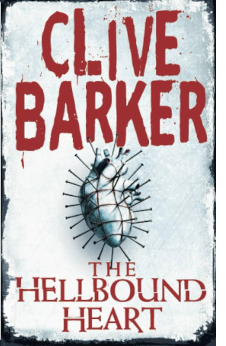
The Hellbound Heart
4/10
“Even if he could remember the words of welcome he’d prepared, his tongue would not have spoken them”
The Hellbound Heart is a novella published in 1986. It is the basis for the Hellraiser film series. It’s quite well written in places, though the plot is very silly and doesn’t make a whole lot of sense. Why is Kirsty?
The book opens with a criminal, Frank Cotton, trying to solve a puzzle box. “The device had been constructed by a master craftsman, and the riddle was this – that though he’d been told the box contained wonders, there simply seemed to be no way into it; no clue on any of its six black lacquered faces as to the whereabouts of the pressure points that would disengage one piece of this three-dimensional jigsaw from another.” He’s been working at it all night. At this time, the book puzzle box seems to be more difficult to solve than the movie version which everyone seems to figure out in about 0.0002 seconds. It is supposed to be so complex, that “a man might toy with it half a lifetime and never get inside”. Remember this for later in the report.
As Frank progresses with opening the box, it begins to play music, and he becomes aware of a bell ringing. Readers learn that he purchased this box as it could ‘open a door to another world’, “a province infinitely far from the room in which he sat.” He is expecting that opening will summon the Cenobites, “theologians of the Order of the Gash… from their experiments in the higher reaches of pleasure, to bring their ageless heads into a world of rain and failure.” Frank is ready to roll out the red carpet for when they arrive and has some gifts readly, like “A jug of his urine – the product of seven days’ collection… [and] a plate of doves’ heads”. These Cenobites are about to be spoiled rotten.
Four glowing blue Cenobites appear and Frank rudely asks where the fifth one is. He expected five. They tell him The Engineer will arrive soon. It is revealed that he summoned the Cenobites for the purposes of pleasure, as there is nothing in the world that does it for him anymore. The Cenobites work their magic and Frank’s senses become extremely sensitive. “It seemed he could suddenly feel the collision of the dust-motes with his skin. Every drawn breath chafed his lips; every blink, his eyes. Bile burned in the back of his throat, and a morsel of yesterday’s beef that had lodged between his teeth sent spasms through his system as it exuded a droplet of gravy upon his tongue.” He can’t take the sensory overload and begs for it to stop.
For one of the Cenobites, “The hood it had worn had been discarded, as had the robes. The woman beneath was grey yet gleaming, her lips bloody, her legs parted so that the elaborate scarification of her pubis was displayed. She sat on a pile of rotting human heads, and smiled in welcome.” It’s a pity that this is not The Engineer because we need more Cenobite women in STEM.
The plot of the book is essentially the same as movie after this. Frank has disappeared and his brother Rory is moving into a house their grandmother bequeathed to them. Rory is married to Julia who is having fond memories of intimate times with Frank (gasp!) on the day of their wedding four years ago. It turns out Frank is the black sheep of the family, and the brothers are estranged. The family did not agree with Frank’s wild lifestyle and whenever he “appeared, once in a blue moon, from whichever corner of the globe he was presently laying waste, he only brought grief. His tales of adventures in the shallows of criminality, his talk of whores and petty theft, all appalled the family.”
One odd difference between the book and movie is the character Kirsty. In the movie she is Rory’s (called Larry’s) daughter. In the book, she is just some weird grown woman who has romantic feelings for Rory and is always hanging around. She doesn’t really make much sense in the story to be honest.
When moving into their new house, Rory gets injured and bleeds on the floor in one of the rooms. Though neither Rory nor Julia clean up the blood, it has disappeared. Hmm. I wonder will this be important later? It is. Later, in this room, Julia sees what looks like a “body [that] had been ripped apart and sewn together again with most of its pieces either missing or twisted and blackened as if in a furnace. There was an eye, gleaming at her, and the ladder of a spine, the vertebrae stripped of muscle; a few unrecognizable fragments of anatomy.” The thing speaks to her and says “‘Julia’ – then, simply: ‘It’s Frank’ – and at the very end the word ‘Blood’”.
“Blood, he’d said. The syllable had been spoken not as an accusation but as an imperative. Rory had bled on the floor of the damp room; the splash had subsequently disappeared. Somehow, Frank’s ghost – if that it was – had fed upon his brother’s spillage, and gained thereby nourishment enough to reach out from his cell, and make faltering contact. What more might be achieved if the supply were larger?” Julia thinks that by feeding Frank more blood, she may be able to have more intimate times with him again. She realises that she has been in love with Frank for years.
Frank has been having a bad time. He was mistaken “that his definition of pleasure significantly overlapped with that of the Cenobites. As it was, they had brought incalculable suffering. They had overdosed him on sensuality, until his mind teetered on madness, then they’d initiated him into experiences that his nerves still convulsed to recall. They called it pleasure; and perhaps they’d meant it.” Sounds like too much of a good thing. He is somewhere between life and death and “found a finger-hold for himself, and a glimpse of strength with which he might haul himself to safety”.
When Rory is at work, Julia picks up a man in a bar and kills him in the room, allowing his body to feed Frank. “It was being drained of every nutritious element, the body convulsing as its innards were sucked out; gases moaning in its bowels and throat, the skin desiccating in front of her startled eyes. At one point the plastic teeth dropped back into the gullet, and the gums withered around them. And in mere moments, it was done.” Frank is becoming more human and fully formed, but he is a little self-conscious. “I don’t want you to see me…don’t want anybody to see me…not like this…” He requests more blood.
Julia obliges and picks up another man at a bar, “His name was Patrick, and he was from Newcastle.” Whey aye! How’s it gannin? Not alreet, it turns out. He is murdered to feed Frank. However, nosey and intrusive Kirsty appears at the door shortly after this murder and sees Patrick’s coat. She suspects that Julia is having an affair. Frank is coming back big time. “Where there had been withered cartilage there was now ripening muscle; the map of his arteries and veins was being drawn anew: they pulsed with stolen life. There was even a sprouting of hair, somewhat premature perhaps given his absence of skin, on the raw ball of his head.”
Meanwhile, Kirsty is acting like a crazy person and staking out the house from a nearby holly hedge. Her patience is rewarded and, after a total of only three and a bit hours of hanging out in this hedge before the invention of smartphones, she observes Julia returning with a middle-aged, stocky, and balding man. She sneaks inside and sees the man being murdered and the monster version of Frank. Monster Frank says, “Come to Daddy”, his classic movie line, and there’s a strike against the patriarchy when she thinks, “In her twenty-six years she had never heard an easier invitation to refuse. ‘Don’t touch me,’ she told it.” You go, gurl! Kirsty finds the magic puzzle box, throws it out the window, and escapes.
Kirsty wakes up in hospital and a nurse offers her the puzzle box. Apparently, she was found with it. While inspecting it in hospital bed, she summons the dang Cenobites. I’ll remind you that this thing is supposed to be borderline unsolvable. The Cenobite who appears alerts her that “‘It’s called the Lemarchand Configuration,’… pointing at the box.” He says that even though Kirsty accidentally opened the box, she will have to come with him. Just at that moment, a nurse walks in. Kirsty thinks she is saved, but the nurse can’t see the Cenobites. “‘You should be in bed,’ the nurse chided. ‘You’ll catch your death.’ The Cenobite tittered.” The Cenobite is exposing how silly and immature it is here. I thought it was supposed to be scary?
Instead of going with the Cenobite, Kirsty tries to make a deal with it. She informs him that Frank is still alive and brings him to Rory and Julia’s house. There, Rory claims that he and Julia killed Monster Frank and it’s all over. Kirsty is about to leave, dejected, and ready to let the Cenobite take her when Rory says “’Come to Daddy,’… The phrase didn’t sound right out of Rory’s mouth. Some boys never grew to be Daddies, however many children they sired. Kirsty put out a hand to the wall to steady herself. It wasn’t Rory who was speaking to her. It was Frank. Somehow, it was Frank –“ What a pathetic, contrived, dead give away. Frank couldn’t stop himself from using his catchphrase for a single interaction? Come on.
There’s a fight between Kirsty, Julia, and Frank. Julia gets stabbed and Frank tries to feed on her. Then the Cenobites come for Frank. The Engineer passes Kirsty the puzzle box. The end.
This is a burn heavy book.
I guess this is sort of a burn on the Cenobites, saying that they stink? “Was it the smell of vanilla they brought with them, the sweetness of which did little to disguise the stench beneath?”
One of Rory’s neighbours makes a passing reference to Frank describing him as the “odd fellow who’d lived in the house for a few weeks the previous summer”
Julia takes a break from some invited guests and thinks the following, “She was indeed tired, as she’d claimed, but it wasn’t the cooking that had exhausted her. It was the effort of suppressing her contempt for the damn fools who were gathered in the lounge below. She’d called them friends once, these halfwits, with their poor jokes and their poorer pretensions.”
Frank characterises Julia as “a trite, preening woman, whose upbringing had curbed her capacity for passion.”
Patrick from Newcastle, a guy murdered to feed Frank roasts himself: “‘Down on business. Can’t seem to get much done.’ ‘Why’s that?’ He shrugged. ‘I’m probably a bad salesman. Simple as that.’” Very self-aware of you to say.
There’s a burn on Frank as he’s reforming: “He was a travesty. Not just of humanity, of life.”
Frank burns Rory. “My darling brother! How in God’s name did you come to marry such a dullard?’ She felt a spasm of anger towards Frank. ‘I love him,’ she said. And then after a moment’s pondering, corrected herself. ‘I thought I loved him.’ His laugh only made his dreadful nakedness more apparent. ‘How can you believe that?’ he said. ‘He’s a slug. Always was. Always will be. Never had any sense of adventure.’”
Finally, Kirsty roasts the Cenobites. “It occurred to her that the Cenobites were probably viewing this chase with no little amusement, and would not act until there was only one player left: Frank. She was forfeit to their pleasure. ‘Bastards…’ she breathed, and hoped they heard.” Kirsty is brave.
The Spooky Gipper
“‘It was nothing,’ she insisted, as she pulled the knife from its hiding place.”