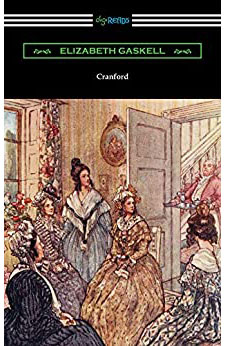
Cranford
6/10
A humorous collection of vignettes that, ultimately, take shape to illustrate the absurdity of class and snobbery and the benefits of acceptance and togetherness.
This book hit the ground running with an excellent and engaging introduction of “Captain and the Miss Browns”. However, rather than building on this momentum, it soon becomes, what appears to be, a series of seemingly unrelated vignettes that take too long to form a coherent narrative, in my view. Miss Matty and her relationships form the emotional core of the story, particularly that with her brother and Mr. Holbrook, the love that might have been. When she is re-reading and, where deemed necessary, destroying old letters, one cannot help empathising with her and respond to the “tears stealing down the well-worn furrows” on her cheeks. Further, her goodness and humanity, which is allowed to thrive following her sister’s death, adds additional heart to the story, such as when she pays the gentlemen in the shop for his now useless Town and County Bank note. Her brother Peter is a major source of comedy, but is totally off the rails. He pranks their father by dressing as a lady who is interested in the latter’s Napoleon Buonaparte sermons and later causes major offense with his fake baby mischief. I am sure that you have heard of the dramatic rule, Chekhov’s gun. It stipulates that irrelevant elements of a story should be removed for the purposes of keeping it streamlined. Consequently, when Peter is described as missing/dead, I was looking forward to meeting him later in the book. My personal view is that this is hack writing. In the same way that Gaskell brings back Margaret’s brother Frederick in North and South, she can’t resist the siren’s song of Peter’s ‘dramatic’ return. Essentially, any idiot could see a mile out that Aga Jenkyns would be Peter and that he would make an appearance. I understand that this was due to her own life circumstances, where her brother John went missing while in the merchant navy, but loyal readers of Gaskell must be sick of unsurprising missing brother plotlines. Probably the only surprising thing in the book was that Lady Glenmire agreed to marry Mr. Hoggins, though, on reflection, if you are reading a book underpinned by egalitarian views, these can be easily illustrated by this plot point and may have been more obvious to someone smarter than I. My main criticisms are that the narrator, Mary Smith, whose name is revealed very late into the text, isn’t really a character at all, raising questions about why she was necessary instead of using the third-person narrator approach; and that the ending was just a little too neat and tidy, to the point where it was overly satisfying in way that felt to me like the world of the story existed exclusively within the story and had no life of its own beyond it.