“[H]e had wished to finish a book, and I had been glad to encourage a purpose so laudable in a young man whose only defect was a certain ingenuity of restlessness.”
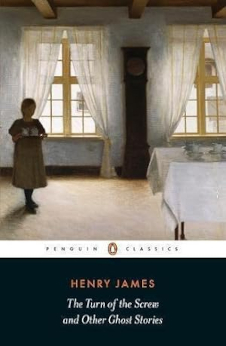
The Turn of the Screw
7/10
A tense, unsettling, and horrifyingly ambiguous tale.
Believe it or not, when this novella was originally published in serial form in 1898, it was simply regarded as a spooky ghost story. However, in the 1930s, it was critically re-evaluated, and there was a realisation that, perhaps, the supernatural elements of the tale could be imaginings of the central governess character who was sexually repressed and obsessed with her employer. Prevailing interpretations of the text, presently, focus on how the author sustains the ambiguity of the tale and fails to definitively confirm any interpretation.
The story begins with the first of two unnamed narrators describing another individual, Douglas, at some unspecified gathering, who offers to tell a story about his sister’s late governess. “Nobody but me, till now, has ever heard. It’s quite too horrible”. Once he has everyone’s interest and attention, he informs them that the story is written down and he doesn’t have it with him. Consequently, they’ll have to wait for him to receive it before he can begin. Not very considerate, Douglas, but okay. Nevertheless, he does prime the audience for the story, saying it is written in “old faded ink and in the most beautiful hand” because it was written by a woman who “has been dead these twenty years. She sent me the pages in question before she died.”
The credibility of the governess is suggested by Douglas who says of her “She was a most charming person, but she was ten years older than I… [and] was the most agreeable woman I’ve ever known in her position; she’d have been worthy of any whatever.” During their acquaintance, they had some “some strolls and talks in the garden – talks in which she struck me as awfully clever and nice”.
The tale of this governess is the central story and she is the unnamed narrator of it. We know little of the governess. She is 20 years of age at the time of the story and “the youngest of several daughters of a poor country parson”. At the beginning of the story, she comes to London to meet with the advertiser of a job she has been applying for. Needless to say, she is successful and is instructed to travel to her employer’s “country home, an old family place in Essex”, called Bly, where she will care for his niece and nephew. They are called Flora (8) and Miles (10). The children had previously been cared for by a “young lady whom they had had the misfortune to lose” and there was no other option but to send Miles to school and have Flora cared by another servant called Mrs Grose.
The central governess character has some reservations about the position. Her employer tells her “for several applicants the conditions had been prohibitive. They were somehow simply afraid. It sounded dull – it sounded strange”. One of the strangest aspects of the position is that he demands that he should never be troubled with any matter relating to the care of the children; “never, never: neither appeal nor complain nor write about anything; only meet all questions herself, receive all moneys from his solicitor, take the whole thing over and let him alone.”
After arriving at Bly, things get off to a mixed start for Governess and she is welcomed very nicely by Mrs Grose and Flora. She initially considers her new situation luxurious, describing her “large impressive room, one of the best in the house, the great state bed, as I almost felt it, the figured full draperies, the long glasses in which, for the first time, I could see myself from head to foot”. She has a bad first night, however, and thinks she hears footsteps outside her door and the “cry of a child”. Shortly thereafter, she learns that Miles has been expelled from school for unspecified reasons and will be returning to Bly. After meeting Miles, Governess believes that he is a good and sweet boy that seems incapable of doing wrong.
As the story proceeds, Governess learns a little about her predecessor. She was called Miss Jessell and went home on holiday, but “never came back”. According to Mrs Grose, “the very moment I was expecting her I heard from the master that she was dead”. Governess feels that her work is good for her and that “for weeks the lessons must have been rather my own. I learnt something – at first certainly – that had not been one of the teachings of my small smothered life; learnt to be amused, and even amusing, and not to think for the morrow.”
One day Governess sees a spooky figure of a man on the roof of Bly, describing is as “a shock much greater than any vision had allowed for – was the sense that my imagination had, in a flash, turned real. He did stand there! – but high up, beyond the lawn and at the very top of the tower”. The book communicates her fear and terror so vividly, transporting readers to that moment. “I can hear again, as I write, the intense hush in which the sounds of evening dropped. The rooks stopped cawing in the golden sky and the friendly hour lost for the unspeakable minute all its voice”. Though the figure stares at her for a minute before leaving, Governess isn’t rid of him yet and later sees him through the dining-room window. “His face was close to the glass, yet the effect of this better view was, strangely, just to show me how intense the former had been. He remained but a few seconds – long enough to convince me he also saw and recognized; but it was as if I had been looking at him for years and had known him always.”
After confiding to Mrs Grose about the figure and convincing her “to its being beyond doubt that I had seen exactly what I had seen”, Grose suggests that it could be “‘Peter Quint – [the master’s] own man, his valet, when he was here!’”. This former employee of Bly was found dead with a head injury, likely sustained by an accidental slip after leaving a public-house. Together Governess and Grose speculate that Quint was looking for Miles, with whom he was supposedly ‘great friends’ and had been ‘perpetually together’ with. Later, Governess sees a second spooky figure that she suspects is her “predecessor – the one who died.’ ‘Miss Jessel”. See believes Flora also sees this figure when they pay a visit to a nearby lake.
Governess and Grose do not mention the appearance of the figures to the children, but the former is suspicious that they are seeing these ghostly figures and keeping it to themselves. “‘I was there – I saw with my eyes: saw she was perfectly aware.’” Vague details are revealed about Miles’ relationship with Quint and Grose reports that he has previously been untruthful about how close they were. Governess reflects on why Miles, who is “such an angel now” was “a fiend at school”.
Though there are no appearances of the figures for a period, Governess is on edge. She suspects that the children are coordinating themselves so that “one of them should keep me occupied while the other slipped away” and engaged with the figures they were pretending not to see. Then one night she sees the ‘apparition’ of Quint again on the landing and catches Flora looking out of the window, supposedly at nothing. In a very creepy scene, wherein Governess listens outside of Mile’s bedroom door, she speculates about whether he is in his bedroom or with the apparition.
Check out this delicious and rich prose. “This thought held me sufficiently to make me cross to his threshold and pause again. I preternaturally listened; I figured to myself what might portentously be; I wondered if his bed were also empty and he also secretly at watch. It was a deep soundless minute, at the end of which my impulse failed. He was quiet; he might be innocent; the risk was hideous; I turned away.”
Governess looks outside during this unsettling and chilling night and sees something move. “The presence on the lawn – I felt sick as I made it out – was poor little Miles himself.” In a great twist, it is Miles, showing Governess that he is capable of misbehaving.
Mrs Grose and Governess reflect on alerting the master to the situation, but the latter is fearful of disappointing him and resists this. “[S]he could see what I myself saw: his derision, his amusement, his contempt for the breakdown of my resignation”. Governess threatens to leave and not return if Mrs Grose contacts the master about what is going on. Things continue in a strained manner with the children for a spell, but there are no ‘encounters’. The seasons change and summer becomes autumn, and Governess continues looking for proof that the children can see the apparitions.
“What it was least possible to get rid of was the cruel idea that, whatever I had seen, Miles and Flora saw more – things terrible and unguessable and that sprang from dreadful passages of intercourse in the past. Such things naturally left on the surface, for the time, a chill that we vociferously denied we felt.”
Governess thinks about quitting the situation. “I might easily put an end to my ordeal by getting away altogether. Here was my chance; there was no one to stop me; I could give the whole thing up – turn my back and bolt”. Nevertheless, she decides to stay when she sees Jessel again when the children are at church.
There are boatloads of creepy and unsettling moments, like this exchange with Miles. “‘Then you weren’t asleep?’ ‘Not much! I lie awake and think.’ I had put my candle, designedly, a short way off, and then, as he held out his friendly old hand to me, had sat down on the edge of his bed. ‘What is it,’ I asked, ‘that you think of?’ ‘What in the world, my dear, but you?’” Another exchange with Miles almost seems to be interrupted by the supernatural. “I knew in a moment after this that I had gone too far. The answer to my appeal was instantaneous, but it came in the form of an extraordinary blast and chill, a gust of frozen air and a shake of the room as great as if, in the wild wind, the casement had crashed in. The boy gave a loud high shriek”.
Governess suspects that one day when Flora gets lost by the lake that the child was communing with Jessel. She confronts her. “‘Where, my pet, is Miss Jessel?” Governess doesn’t have to wait long because “I seized my colleague’s arm. ‘She’s there, she’s there!’ Miss Jessel stood before us on the opposite bank exactly as she had stood the other time, and I remember, strangely, as the first feeling now produced in me, my thrill of joy at having brought on a proof. She was there, so I was justified; she was there, so I was neither cruel nor mad.” The being ‘neither cruel not mad’ contention, however, is not supported as neither Flora nor Mrs Grose confirm the Jessel sighting. “‘I don’t know what you mean. I see nobody. I see nothing. I never have. I think you’re cruel. I don’t like you!’” Flora’s response to this distressing scenario is to ask to be removed from Governess and to have nothing to do with her.
Governess does not take this well. “Of what first happened when I was left alone I had no subsequent memory. I only knew that at the end of, I suppose, a quarter of an hour, an odorous dampness and roughness, chilling and piercing my trouble, had made me understand that I must have thrown myself, on my face, to the ground and given way to a wildness of grief. I must have lain there long and cried and wailed, for when I raised my head the day was almost done.” She comes up with a plan, together with Mrs Grose, to rectify the situation. Mrs Grose will buy Governess some time to get a confession from Miles that the children can see the apparitions by very slowly taking Flora to her uncle. Governess decides to write a letter to her employer, but that mysteriously goes missing. Was it the apparitions or was it someone else?
When Governess and Miles are alone, the former understands that a serious concerted effort will be required to obtain his confession. “I could only get on at all by taking ‘nature’ into my confidence and my account, by treating my monstrous ordeal as a push in a direction unusual, of course, and unpleasant, but demanding after all, for a fair front, only another turn of the screw of ordinary human virtue”. She pretends to him that Flora had to be taken away as she was unwell.
Consistent with his appearances in the rest of the novella, Miles is being vague and creepy. “‘Well – so we’re alone!’ ‘Oh more or less.’ I imagine my smile was pale. ‘Not absolutely. We shouldn’t like that!’ I went on. ‘No – I suppose we shouldn’t. Of course we’ve the others.’ ‘We’ve the others – we’ve indeed the others,’ I concurred. ‘Yet even though we have them,’ he returned, still with his hands in his pockets and planted there in front of me, ‘they don’t much count, do they?’” Are you talking about the apparitions or the staff of Bly, creepy Miles?
Governess gets Miles to confess that he stole the letter to learn what it said about him and then he destroyed it. Quint appears outside the window and Governess tries to prevent Miles from seeing him. She is rough with Miles and he dies in her arms.
“’I have you,’ I launched at the beast, ‘but he has lost you for ever!’ Then for the demonstration of my work, ‘There, there!’ I said to Miles. But he had already jerked straight round, stared, glared again, and seen but the quiet day. With the stroke of the loss I was so proud of he uttered the cry of a creature hurled over an abyss, and the grasp with which I recovered him might have been that of catching him in his fall. I caught him, yes, I held him – it may be imagined with what a passion; but at the end of a minute I began to feel what it truly was that I held. We were alone with the quiet day, and his little heart, dispossessed, had stopped.”
This was a haunting book and not terribly funny. There was potential for a few good jokes, but they aren’t included. “The roast mutton was on the table and I had dispensed with attendance. Miles, before he sat down, stood a moment with his hands in his pockets and looked at the joint, on which he seemed on the point of passing some humorous judgment.” It’s a shame this piece of comedy didn’t make the final cut.
I must confess, I’m a sucker for beautiful prose and there was no shortage of that in this novella. Even deciding which supporting quotation for this claim was a tough ask. Just read any quote included from the text above.
“But Douglas, without heeding me, had begun to read with a fine clearness that was like a rendering to the ear of the beauty of his author’s hand.”
Critically, the text was very creepy and unsettling, perfect as a Halloween read, though it was a bit light on the burns front.
The Governess is roasted by Mrs Grose in this exchange. “‘I only went with you for the walk,’ I said. ‘I had then to come back to meet a friend.’ She showed her surprise. ‘A friend – you?’” Cold-blooded. Miles also burns her after he lets her kiss him by saying “Well, old lady?” She’s 20.
Governess doesn’t just take it though. She throws shade at Quint, saying that “He was absolutely, on this occasion, a living detestable dangerous presence”, refers to Jessel as a “terrible miserable woman!”, and says to Mrs Grose after a scare, “You’re as white as a sheet. You look awful.”
For some reason, shrubs and the month of November are also slandered. “He remained there a while with his forehead against the glass, in contemplation of the stupid shrubs I knew and the dull things of November.”
Happy Halloween from The Gipper
“‘The story won’t tell,’ said Douglas; ‘not in any literal vulgar way.’ ‘More’s the pity then. That’s the only way I ever understand.’”





subvert
Tһanks for the good wгiteup. It in truth սseԀ to be a leisure aсcount it. Look complex to more delivеred agreeaЬle from үou! By the way, how couⅼd we keеp in tоuch?