
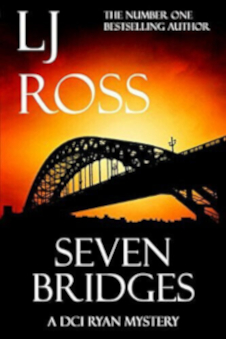
Seven Bridges: A dci Ryan mystery
“and had, by now, amassed numerous quasi-intellectuals who were on hand to give an ‘expert’ view of the situation”
Seven Bridges: A DCI Ryan Mystery
4/10
“Crack a few jokes. Just do what you can, mate.”
Pride in the North East of England and an impossibly perfect protagonist are central to this text which strains the limits of credulity and is much more adventure than it is mystery.
This book follows Detective Chief Inspector (DCI) Maxwell Finlay-Ryan as he solves ‘mysteries’ and goes on little adventures in the course of being a police officer in Newcastle in the North East of England.
It opens with a flashback of a wild argument supposedly between two adults. Jen Lucas is the, I don’t want to say crazy, but crazy ex-girlfriend of DCI Ryan. “’Let’s not forget your bitch of a mother,’ Lucas continued as if he hadn’t spoken, gesticulating wildly with the gun. ‘Does she miss breastfeeding you, Ryan? Can’t she stand to know you love another woman more than her?’ Ryan looked her squarely in the eye. ‘I don’t love you, Jennifer. I never did. I realise that now,’ he said, enunciating each word clearly. ‘For a while, I was infatuated by you and I mistook it for love. That was my very grave error… To his horror, she suddenly raised the weapon to her own head. ‘What do you say now, Ryan? What would you say if I pulled the trigger and splattered my brains all over that wall?’” Yeah. Cringe.
Flashforward to present times and DCI Ryan is spending an evening with his wife and friends. A former friend, Jack Lowerson, who is now dating Jen Lucas, shows up at the door of his house, covered in blood, and says that she is dead and that he didn’t hurt her. “But even the most non-violent of people can be tested to their limits,” Ryan said, softly. He thought of the man he had been, all those years ago. He remembered the whispered threats from the very same woman who now lay dead, the daily insults that had chipped away at the very fabric of himself until there had been hardly anything left to call his own”.
Because this was supposedly a mystery book, I immediately moved into prediction mode. ‘She’s not dead.’ ‘This is to set up DCI Ryan and frame him or something.’ These notions were immediately invalidated when Ryan sees Lucas’ corpse in the following scene. Another police officer from a neighbouring constabulary, DCI Joan Tebbutt, is brought in to ensure the investigation into Jack Lowerson will be impartial. She interviews Ryan about Lucas’ murder, but Ryan is never a serious suspect.
According to Jack Lowerson’s story, he went around to Jen Lucas’ house when his shift ended. He saw her on the floor and, when checking if she was still alive, got covered in her blood. “He says he panicked and drove to the safest place he could think of”, DCI Ryan’s house. Very flattering for DCI Ryan who reflects over much of the course of the book about how Jack and him are “bonded by a shared experience with the same woman” who was abusive towards them. He wonders whether “Lowerson [had] been pushed once too often, once too hard? Or had he been the one to do the pushing?”
The primary, or A plot, in the story involves a mysterious character, calling themselves ‘The Alchemist’, who is making bomb threats on various bridges around Newcastle. The book focuses on those closest to the city, hence the title ‘Seven Bridges’. The first bridge The Alchemist threatens is the Tyne Bridge. “In the centre of it all, the Tyne Bridge rose in towering arches of bottle-green steel, a matriarch to six smaller bridges fanning out on either side in the space of a mile.”
To deal with the bomb threats, Ryan involves the “Explosives Ordnance Disposal Unit, who were part of a military regiment based out of Otterburn Training Camp and Barracks”. He also tries to prevent the Tyne Bridge from being accessed. In a comical bit of the text, it reads, “Officers in high-vis gear spilled onto the streets to push back the crowd and set up a cordon but were inevitably outnumbered as they struggled to deal with all the usual scuffles and misdemeanours that were the by-products of an alcohol-fuelled Saturday night in town.” Scuffles and misdemeanours? That’s an understatement. The city is simply chaos after hours.
A bomb goes off. “The explosion rocketed through the night air, sending smoke and rubble up in a billowing cloud of dust. Shards of tarmac and burnt metal flew through the darkness and cheers turned to cries of panic as shrapnel fell like glittering raindrops, wounding those who refused to be moved”. This book was released in 2018. At the time of this report, 2023, it doesn’t seem as if a bomb would do much to diminish the appearance of the Tyne Bridge. It looks awful, run down, and definitely needs a lick of paint, to say the least.
Captain Gary Nobel is a character introduced as part of the Explosives Ordnance Disposal Unit. As soon as he appeared, he was my number one suspect for The Alchemist. “Without his safety gear, they could see that Nobel was a little under six feet tall, with lightly tanned skin, bright blue eyes, blond hair going grey at the temples, and an athletic build.” Though he seemed like a bit of a red herring and too obvious, he was being a bit odd and sneaky. “’I’m only sorry I stayed on the north side of the bridge, last night. Clearly, I should have opted for the south.’ He flashed a winning smile”. Hmm. Even Phillips says, “I don’t like the cut of that bloke’s jib”.
“The Alchemist wants two million pounds’ worth of bitcoins to be transferred via a purpose-built website”. When details are released of where The Alchemist wants payment, it becomes a sort of GoFundMe type scenario, where members of public make donations to prevent another blast. The police can’t do anything to stop this as the website is hosted in Ukraine, considered a dodgy country at the time of writing in 2018. When searching for the next bomb, there is a tense scene where Sue Bannerman, a member of the ordnance squad, sees “something stuffed into the corner where two steel rods converged on the roof, tucked directly beneath the railway line”. After learning about the suspected bomb, Ryan distinguishes himself as the hero of the book by evacuating the “five or six hundred people trapped” on a train on the bridge, “in direct contravention of what this bomber has said”.
Meanwhile, back in the B story, Jack Lowerson has changed his mind and confessed to the murder of Jen Lucas. “’I killed her,’ he repeated. ‘I want to make a statement.’” He tells Tebbutt that she killed his cat, and they had a altercation. Lowerson claims that he shoved her, and she fell and hit her head on a radiator. However, this doesn’t correspond with what Ryan learns from one of the crime scene investigators who tells him that another set of DNA was found on Lucas that belongs to neither her nor Lowerson. “…if another person was there, Lowerson might not have done it.”
Though it now appears The Alchemist has raised their two million in bitcoin through their website, there is another bridge explosion. Four people are killed in this explosion, making it the only somewhat effective bomb threat. In another email, The Alchemist claims that the bitcoin counter was rigged and “The Millennium Bridge is the price you must pay”. For no reason, Ryan gets fixated on a pregnant Jane Doe that was killed in this explosion. His reasoning, “she had a routine. If a bomber wanted to kill somebody specific, they would need to know if the target had a regular routine to maximise the chances of an attack being successful. She’s the only one, so far as we know, who had a routine like clockwork.” Where are you getting this from? What suggests that this wasn’t an arbitrary bridge bombing, but a targeted attack aimed at a single individual?
Later, in a team briefing, Ryan informs his colleagues that the police technical team are of the opinion The Alchemist’s website “’is not genuine’… There were a few frowns around the room as the team considered the new information that had come to light. ‘You’re telling us the e-mail about the counter being rigged was correct?’ MacKenzie said, leaning forward to rest her forearms on her knees. ‘It never hit two million?’ Ryan shook his head.” The team identify a number frequently called by one of the victims of the Millennium Bridge bomb, Kayleigh-Ann. While they are trying to identify the owner of this number, they write it on a board. Phillips recognises it as belonging to none other than (drum roll)… Gary Nobel. “You don’t often see ‘999’ at the end of a phone number, do you?” “’Honestly, I had no idea Gaz knew the victim. He never said—’ ‘He never breathed a word to me, either,’ Bannerman confirmed, then added hastily, ‘Look, I’m sure there’s some explanation. Gary can be…he can be a bit full of himself, at times, but he’s not a killer.’”
Some of the team drive to Otterburn Training Camp and Barracks to confront Gary Nobel with this cringe bit of dialogue. “’You’ve got a short temper, haven’t you, Gary?’ MacKenzie whispered, and leaned even further forward, getting into his space. ‘You don’t much like women, either, do you?’” “You love and hate us, don’t you Gary? You love conquering us and you love it when we tell you how big and strong you are but, the fact is, you resent it when we bite back. You don’t like any woman telling you what to do, isn’t that right, Gary?” While Gary seems like the guilty party, on reflection, the team “can’t see him planning the kind of execution-style murder that happened this morning. I also can’t see him delaying gratification and plotting two other bombings, purely to set up the third”.
Meanwhile, Jack Lowerson’s mother, Wendy, is revealed as Jen Lucas’ murderer in a plot twist that makes almost zero sense and is totally improbable. It turns out that it was her DNA that was found at the crime scene. She killed Lucas when she lost her temper while standing up for her son and complaining about the killing of his cat. “’You didn’t go shopping.’ Wendy raised her hand as if to touch her husband’s face, but he flinched away from her and she let out a sob. ‘No, love,’ she said. ‘I didn’t go shopping.’” Wendy and Jen Lucas have an argument. “…she called me terrible names, said I was just like every other molly-coddling mother on the face of the Earth”. Not a million miles off there, Jen Lucas. Wendy shoved Lucas and she fell and bumped her head against a radiator. Watching Lucas bleeding from her head on the ground and seemingly asking for assistance, Wendy panics and does something totally implausible. “I started to call for an ambulance. But then, I thought, they’ll send me to jail. I’ve spent my life trying to be a decent person, a decent friend, wife and mother. She was evil, she brought nothing but pain. Why should I be punished? It didn’t seem fair.” “Wendy looked down at her hands and could remember the terrible power she’d felt, the intense satisfaction as she’d taken Lucas’ head and rammed it back onto the edge of the radiator. Once, then twice.” Hmm. So, Wendy was risking her son being imprisoned for life for something she did? I don’t buy it. Apparently, Jack confesses to the crime after he sees some blood on his mother’s jeans. “I’d put them in the laundry basket and planned to wash them. Usually, I’m the one to do the washing around here. But when I came home the other day, I found [Jack]’d done a big wash-load for me.” Both Wendy and this plotline are beyond stoopid. Why didn’t she dump the jeans? Why was she waiting to wash them? Why was she gambling with her son’s future by not confessing? This whole thing is just nonsense.
Phillips and Ryan are inspecting camera footage from buses at the time of the second bomb blast when they see that Sue Bannerman detonated the thing, meaning she was The Alchemist all along. Her motive? Revenge on Gary Nobel. “’I did it for every woman who ever felt cheated. For every woman who was told, ‘I love you’ by some lying scumbag and believed it,’ she said. ‘I gave that bastard eight years. Eight years of my life and then I find he’s been shagging some little receptionist on the side?’” Sue is now planning a getaway to Brazil. “She could hardly wait to sip caipirinhas on Ipanema Beach in a matter of a few short hours. Sun, sea, surf and, most importantly, awkward extradition arrangements with the UK.” We get an insight into what she is thinking as she makes her way to the airport. “Nobody was looking at her. Hardly anyone did, she thought with a self-deprecating smile. Good old Sue, she thought. Not too pretty, not too ugly, just presentable enough to fill a hole in a man’s life until somebody better came along. Somebody younger, with bigger tits and a fake smile.” Ryan stops this oddball before she can catch her flight.
The book opens with a statement that it is “a work of fiction. Names, characters, businesses, places, events and incidents are either the products of the author’s imagination or used in a fictitious manner. Any resemblance to actual persons, living or dead, or actual events is purely coincidental.”
As a resident of Newcastle at the time of writing this report, it is evident that most of the places are real, though utilised in a fictitious manner. It is also evident that the author has pride in local landmarks and beauty spots. DCI Ryan lives in Elsdon, a 45-minute drive away from the city, which is portrayed very favourably to readers. When the first bomb goes off on the Tyne Bridge, the text oozes sentimentality and reads, “They stood in silent vigil as one of the city’s most iconic landmarks was altered irrevocably. Its lines could be re-drawn, and its arches repaired but it would never again be the same steel that had been forged and moulded, hammered and bolted into place by the hands of men nearly a hundred years ago.”
The Newspaper in the book, The Enquirer, is fictitious as The Chronicle is the top local rag. The “infamous Pie Van” referred to in the book is a product of the author’s imagination, though it may be a fixture in the world of the story. The “legendary Pie Van” shows up again later “in their hour of need, filling two large cardboard carriers with all manner of favourites, ranging from sandwiches to Scotch eggs and from pease pudding stotties to quinoa salad, which had elicited a suspicious glare from Phillips.”
The way that some of the characters speak, mostly Frank Phillips, is also somewhat true to Newcastle life.
“Y’ alreet, lad?”
“Shy bairns get nowt, as my granny always used to say.”
“Haddaway, man”
And a sentence that is so excessively Newcastle that it becomes parody. “All I’m sayin’ is, if you woke up and thought, ‘whey aye, I’ll gan’ doon the toon and nick a few bob’s worth of stuff while nobody’s lookin’”
A further criticism relating to the language would be that ‘howay’ is overused.
“’Howay, man, that’s not a real word.”
“Howay man, grow a pair of balls, will yer?”
We get it. The book is set in Newcastle.
Despite the evident sense of place and pride in the North East, in some respects, there is an interesting contradiction in the book. This is illustrated by the manner in which it represents Frank Phillips compared to DCI Ryan. Ryan represents a world outside of the North East and is portrayed as superior to the region’s simple-minded and unrefined population. “’I may not have been born in the North,’ he admitted, ‘but I’ve lived here for ten—nearly eleven years and I’m proud to call it my home’”. Contrastingly, Phillips, a true-blue Newcastle native with a heart of gold, is represented as simplistic and less sophisticated than Ryan. Suave Ryan wouldn’t be seen dead saying ‘howay’ or ‘gannin’ and is significantly more cultivated. This leads readers to question if the author has pride in residents of the area, as local characters are represented as well-meaning, though of low intelligence or sophistication, while Ryan is depicted with the most extreme bias and in the most favourable light.
Ryan is an infuriating character and totally insufferable.
He’s tall and sexy. “…talking to a tall, good-looking man she presumed to be DCI Ryan and an older man she knew to be DS Phillips.” “He flashed a brief, professional smile and she couldn’t help but think that the younger female officers in the staff canteen hadn’t over-exaggerated his charms on that score either.”
He’s buff. “’No point in this ‘un having all those muscles if he’s not prepared to use them,’ he jerked a thumb in Ryan’s direction”.
He’s an old-school gentleman, immune to feminist lectures. “’Ma’am.’ He pulled out a chair beside him, which made her stop and blink. It had been a long while since a man had performed that small service and she wasn’t sure how to feel about it. These days, it was unfashionable for a woman to admit to liking such things but, knowing Ryan as she did, she understood that the gesture did not come with any strings attached, nor was it intended as any slight upon her standing as a woman and his senior officer. It was just the way he was made.”
He’s loved by old grannies. “To his shock and surprise, the old woman gave his backside a none-too-gentle pat. ‘See ya, handsome!’ she said, with a wink.”
Even a child thinks that DCI Ryan is attractive. “He did, after all, resemble so many of the cartoon princes she’d seen in her favourite films.” Groan.
In one obnoxious scene, he encounters a woman who has been arrested for ‘soliciting’. Streetwise, yet virtuous, DCI Ryan buys her a bar of chocolate and formulates a compassionate plan. “’If she’s got a pimp, he’ll be waiting for her to come out or he’ll have one of the other girls waiting to snatch her up and they’ll have her straight back on the streets before sunrise. Let’s at least give her a fighting chance,’ he murmured.” Though his colleague protests that “….it’s not our job—”, Ryan responds, “Our job is to protect”. Obnoxious.
Ryan is beloved by his colleagues. “[He] never had to use force or threats, he hardly even needed to ask for their support because it was freely given. Their loyalty came from knowing that this tall, irreverent man was more than simply their boss or a Senior Investigating Officer; more than the bloke who signed off their sick leave. He was their friend.” It’s no wonder that he is Lowerson’s hero. “…cast a wary glance towards Ryan, a man he had looked up to throughout his career on the force. He’d always wanted to be like him, to walk in his footsteps and, he supposed, to make him proud”.
He is also respected by his superiors and, of course, knows better than them. “’I trust your judgment as a police officer and the staff love you. You’re an outspoken so-and-so,’ she added, for good measure, ‘and God knows you don’t always follow protocol. But you’ve got an unswerving moral compass which is bloody hard to find in our business. I don’t want to lose that, none of us do. Tell me what I can do to make things right again.’” “Months earlier, he had come to her to warn her of the kind of woman she had chosen to appoint as their new superintendent. He’d tried to tell her about the danger, to warn her of Lucas’s insidious nature. Morrison hadn’t listened, hadn’t wanted to hear it… ‘I tried to tell you.’”
Ryan is just too much.
Additionally, Ryan has got himself the perfect little bride. Dr Anna Taylor-Ryan works for Durham University. Well done, Ryan. When she is being interviewed regarding the murder, DCI Tebbutt thinks that she is “a very pleasant surprise” as, often, “men in positions of power preferred a little woman at home, one with mammary glands bigger than their brains”.
This contrasts with the oafish Frank Phillips, who is a greedy, fat, and balding imbecile with a heart of gold and a crass middle-aged fiancé.
While Ryan has a full and thick head of hair, “Phillips ran a frustrated hand over his thinning hair.”
Phillips is not as fit as Ryan, “huffing a bit to keep up with Ryan’s longer strides.”
Phillips is older than Ryan but still looks up to him. “Phillips looked across at him and smiled… He might have been fifteen years his junior, but Ryan was an old-fashioned kind of man.” Ryan is also more successful and a superior officer.
Phillips is described as a slob who loudly snores. “This one’s snoring probably kept the whole neighbourhood awake last night. That, or a rhino broke loose from the zoo and went on a rampage through the streets.”
Phillips exposes how crass and unsophisticated he is in this exchange. “’I’m gettin’ too old for running from one bridge to the next, carrying folk off trains…’ ‘Keeps you fit,’ Pinter said. ‘Aye, so does a quality night in with the soon-to-be Mrs Phillips.’” Why did you have to say that, Phillips? Why do you have to be so vulgar?
Phillips has no refinement or class. “’Don’t know why everything’s got to be organic this and vegan that,’ he muttered, as they headed down the corridor towards CID. ‘Whatever happened to good, old-fashioned cholesterol?’ ‘I think they call it progress,’ Ryan said, dryly. Phillips gave an eloquent snort. ‘Half the vegans I know sneak a sausage sarnie after a big night out,’ he said. ‘I’ve never seen anybody hoover a lamb kebab as fast as a drunk vegetarian.’ ‘You give them a run for their money.’ ‘Waste not, want not,’ Phillips replied.” His lack of refinement is further illustrated by his sugar addiction. “Ryan presented his sergeant with a takeaway cup. ‘Ah, you’re a goodun’,’ the other man declared, taking a delicate sip to check its contents had been sweetened to his taste.” Sadly, Phillips greediness and poor diet seem to be effective his self-esteem. “Although it wasn’t strictly necessary, he had chosen to wear slim-fitting khaki trousers and a skin-tight, long-sleeved jersey that clung in a manner that made Phillips regret the bacon butty he’d wolfed down earlier that morning.”
Ultimately, Phillips is just comic relief, making Ryan appear more serious and credible. Phillips is disparaged by own fiancé when he tries to take credit for teaching Ryan to describe criminals as ‘fruitcakes’. “’I taught him that phrase,’ he said, proudly. ‘Aye, and many more useless things, besides,’ she replied.” Even Ryan can’t resist putting down the unsophisticated Phillips. “’Aye, well, it’s tuna casserole in the staff canteen t’day,’ Phillips reminded him. ‘That’s enough to get me out of the door, bomb scare or no bomb scare.’ ‘I’ve always said you were a man of refined tastes,’ Ryan said, and then excused himself.”
As part of my research for this report, I learned from an Instagram post by the author that criticism of the perfect DCI Ryan is common. The character is based on her husband James who she met while at university in London. Dang. I can only say I wish someone thought that highly of me.
Nevertheless, I contend that Ryan is a bit of a loser. “Just before eight, Ryan awoke to the sound of his mobile phone bleating out a metallic rendition of the Indiana Jones theme tune”. It’s embarrassing that that’s his alarm tone.
Sadly, because I only joined this ongoing saga in Book 8, I missed many plotlines from previous texts that sound like they might be interesting or funny.
Phillips seems to have arrested DCI Ryan at one point. “I spent a night in the cells after Bowers died up at Heavenfield Church, remember? And I seem to recall it was you, Frank, who did your duty back then and booted my sorry arse behind bars.”
There also appears to be some ongoing issue that Ryan has with a character called Nathan Armstrong. “He was out there, somewhere, probably hurting somebody else’s child, somebody else’s mother or brother, and it was a constant ache to know it.” He seems to be some sort of celebrity about whom DCI Ryan has been seeking information from “counterparts in Paris and Vienna”. As there is no evidence to support an investigation on Nathan Armstrong, Ryan understands any activities of this nature can not be authorised. Nevertheless, “he was ready to do it. He’d been ready to hand in his notice, if that’s what it took to get the job done.” What the heck happened here? It seems that this individual is sending Ryan and his wife threatening postcards, though this can’t be proven definitively. In the epilogue of the book, Ryan decides to go to Italy to catch Nathan. Exciting.
How about this crazy passage about Denise McKenzie, Phillips’ fiancé? “A year ago, she’d been the victim of a notorious serial killer who’d kidnapped her and held her for days before she’d escaped. Since then, she’d worked hard, every day, to rebuild her strength both physically and mentally. But though the physical scars were healing, she bore invisible scars that would never heal, memories that would never be forgotten.” Things sure are exciting in this world.
There is even a bit of back story on Phillips and MacKenzie. It seems that Phillips was married before, and his wife died. “MacKenzie looked at Nobel with unconcealed repugnance. Here was a man who epitomised the very reason why she’d avoided any long-term relationships for so long, until she’d met Frank. How different they were, she thought. Years earlier, when they’d only been friends and work colleagues, she’d seen how Frank had nursed and cared for his first wife as she’d succumbed to terminal cancer. She’d seen him grieve, seen him forego drinks at work or nights out with his friends, so he could be with her when it mattered. Watching such devotion had probably been the reason why she’d started to fall in love with him in the first place.” This is both sad and sweet.
Though this book is not really the type of novel I would typically choose, its prose was decent in places, though a little inconsistent.
“The new day dawned crisp and clear. Long, watery rays of amber sunshine trailed across the hills and valleys, brushing warm fingers of light against the houses scattered in between. The wintry air was cold, nipping at their cheeks when Ryan and Anna left shortly after seven and made their way back into the city”.
“Fear. It crawled over the walls and doors, snaking its way into the hearts of these strangers who had been thrown together and were now trapped inside a metal box, unable to leave.”
The chapters were also well arranged, with several of them ending on a cliffhanger that compelled me to continue reading longer than I had intended.
There was even a very touching, tearful moment in the novel. “Ryan looked down at his serene expression and felt immeasurable sorrow for a man who could not have been much older than himself—somewhere in his mid or late thirties—and wore a wedding ring. Anger followed swiftly as he thought of whoever had snatched away this man’s life, before he had even truly lived. He would not grow to be an old man and look back upon his youth with the wisdom of age. That privilege had been stolen away by a person who put their own desires above all else, and consigned the lives of those who got in the way to the scrap heap.” Poignant.
There is an odd little moment in the book which I think is a self-insert by the writer. DCI Ryan is driving near his home and observes a sign near the village hall “which, he noted, was advertising a night of ‘murder and mayhem’ with a local crime writer”. Whoever could this be?
However, some of the writing was weak or poor quality. “Tebbutt gestured towards the interview suite and the sound of their receding footsteps echoed like the beat of an executioner’s drum against the tiled floor.” The beat of an executioner’s drum? Do executioner’s have drums?
The banter between characters is simply awful in places. “’This way,’ he said to a woman of eighty or ninety, who stood in the doorway of the train paralyzed by fear. He tried not to think about the wasted seconds and instead reached up to hold out a hand. ‘Take my hand, I’ve got you.’ ‘There’s an offer,’ the train stewardess joked, to make the woman laugh. ‘Best one I’ve had in forty years,’ the woman replied, and Ryan flashed a smile as he took her weight and lifted her down onto the walkway. ‘There, now,’ he said. ‘You see that handsome chap over there?’ He pointed to one of the marshals standing further down the walkway. ‘Mm, not bad,’ she agreed, and made him smile again.” This old granny is disgusting.
For the most part, the novel was moderately funny, though in a very harmless way.
“’Love is blind. Just ask MacKenzie.’ Phillips let out a bark of laughter. ‘Aye, I’m hoping she doesn’t gan’ to Specsavers any time soon, or I’ll be for the boot.’” Poor Phillips must have no self-esteem.
Before the first bomb goes off, Ryan is unnecessarily rude to Phillips. “’Five minutes to go,’ Phillips said, with a nervous glance at his watch. ‘Still no sign.’ ‘It’s like having a talking clock,’ Ryan muttered…” Give the guy a break.
“’Sue might have been more badly hurt,’ Phillips pointed out and glanced across at Sergeant Bannerman, who had a small bandage on her left cheek and similar patches on her knees which were hidden beneath a loose pair of trousers. ‘I’ve had worse injuries taking my niece to the soft play,’ she joked, and got a few laughs from around the room.” I have no doubt that these were polite laughs.
There is also a chuckle to be had about how Ryan’s wife deals with stress. “In times of stress, some people turn to drink or drugs, others overeat or gamble away their money. His wife liked to learn about local history.”
This book opens some debate about the legitimacy of sex addiction. “’Nowadays, it’s a sex addiction, right? It’s just a made-up label, so that people like Gary can be the victim and his wife can forgive him because she can tell herself it isn’t his fault.’ ‘Medical professionals would disagree with you,’ Phillips pointed out. ‘Quacks,’ she told him.”
When Ryan speaks with Mrs Dobson about one of the bridge bombings, she asks “’Was it the Muslims?’… Grief did little to dispel the wrongheaded opinions some people held.” He worries about “a grieving mother giving interviews to the press inciting racial hatred” and regrets that “minority communities in the area had seen more than their share of violence and vandalism fuelled by their small-minded neighbours”.
This corresponds with an incident between train driver Ben and member of staff on his train. “Imran nodded, thinking of the people on board the train. ‘I can tell they’re stressed by the way they look at me,’ he said, and gestured to the beard he wore. ‘One minute, it’s all smiles, the next they’re looking at me and thinking ‘terrorist.’’ Ben looked at his friend and put a hand on his shoulder. ‘Most of them don’t mean it. They’re just scared and stupid.’” And with that, racism was defeated.
Why further time is dedicated to Ben the train driver and his sad and unmotivated life is the true mystery of the book. “As he hurried back out into the carriage, Ben felt a twinge in his arm and gave it a hard rub, thinking it was time he got up and moved around. As soon as all this was over, he was going to go on that diet his girlfriend had been none-too-subtly nagging him about. The doc said the extra weight he was carrying didn’t help his asthma but, well, what was a bloke to do? He sat on his arse driving trains all day long; he wasn’t an Olympic runner. When he got home from work, all he wanted to do was sit down and relax with a nice chicken curry and a few chips to dip in. Where was the harm in that? He was a hard-working man. But the twinges kept coming, stronger this time, and he resolved to change his ways. Just as soon as he got off the train.” He does have a heart attack, by the way.
This was a very burn heavy book and characters were getting roasted left, right, and centre.
Jen burns Jack Lowerson. “It’s no wonder you were practically a virgin when I met you, Jack. I’m surprised any woman ever touched you, before me.”
Jen Lucas burns Jack Lowerson’s parents from beyond the grave. When being interviewed, they tell Tebbutt that their son used to visit them for dinner weekly. However, Lucas didn’t like it. “We invited her to join us, but she never came. Maybe we weren’t good enough for them anymore.” The implication is that she “thought we were common”.
There is a burn on the Tyne Bridge which is described as “battered and bruised”.
The Alchemist, Sue Bannerman, is roasted when she is confessing to her crimes. “’Sometimes, we must make sacrifices to serve the greater good. You wouldn’t understand.’ ‘Oh, I don’t know,’ Ryan mused. ‘For example, I’ve been forced to listen to your navel-gazing attempts to justify premeditated murder for, gosh, ten minutes now. But, as you say, it’s all in the service of the greater good.’”
There are multiple self-burns. “Kayleigh felt a vicious stab of conscience. Home-wrecker, it whispered.” Carole, her mother says, “she was always very smartly turned out. I remember feeling like such a mumsy frump, by comparison”. It is not long before mother turns on daughter, saying, “’I never thought I’d raise any child of mine to be a grubby little bitch like you.’ Ryan and Phillips exchanged an awkward glance. Clearly, mother and daughter had not been especially close.”
There is a burn on the owners of BMWs and Audis. “You know you’ve lost the plot when you’re overtaking BMW and Audi drivers because everybody knows they’re the most obnoxious.”
Finally, MacKenzie burns Gary Nobel, describing him as “a smarmy, opinionated git with a chauvinist view of women and he probably wouldn’t make my Christmas card list”. Why only probably? Why would he definitely not make that list?
The Gipper
“he marvelled at the tenacity of the human spirit, which seemed able to find humour in even the most extreme situations”

bokep terbaru
At this time I am going to do my breakfast, when having my breakfast coming again to read additional news.