Tomorrow, and tomorrow, and tomorrow
“Reading is a chore, but I have heard told there is much money to be made in amusements.”
Tomorrow, and Tomorrow, and Tomorrow
4/10
An overrated, melodramatic, and unfocused novel that’s confused about what point it’s trying to make.
Tomorrow, and Tomorrow, and Tomorrow follows the relationship of two characters, Sadie Green and Sam(son) Masur. Though they were friendly for 14 months (“609 hours, plus the 4 hours of the first day, which had not been part of the tally”) when they were children, they fell out when Sam learned that Sadie was clocking up ‘community service’ hours for visiting him in hospital. During this time, where Sam was recovering from injuries due to a car accident, they played video games. Years later, when they randomly meet at a train station while attending university, they decide to make video games together, managed by Sam’s housemate, Marx. Sadie is studying game development at MIT and having an affair with a lecturer, Dov, who is in the process of getting divorced. Sam is studying mathematics at Harvard.
The story is told non-linearly and is intercut with background details on many elements of character’s histories, including why Sam and his single mother move from New York to California.
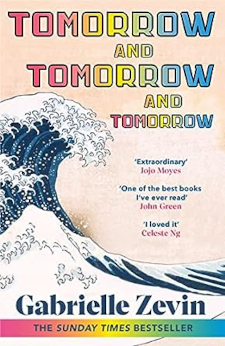
Sam and Sadie’s first game is called ‘Ichigo: A Child of the Sea’ and it is designed to look like Hokusai’s art. This is the reason for the cover of the book being ‘The Great Wave Off Kanagawa’. Dov is involved as a producer after he allows his game engine to be used for the project. I was a little confused what Sam was doing at the start as it seemed like he was only involved in the artwork, while Sadie was doing everything else. However, it is claimed that he is “a largely self-taught programmer”, meaning, I guess, he is actually making some contribution to creating the games.
‘Ichigo’ is well-received and the core characters receive two distinct offers that cause some debate and conflict between them. They found a company called Unfair Games. A year later they release the poorly named and contractually required, ‘Ichigo II: Go, Ichigo’. There is some debate about what their next project will be and Sam’s health deteriorates, where his foot bleeds though his socks, he begins using a cane, and is, ultimately recommended an amputation by doctors.
He gets this amputation when they move to a new office in California and release their next offering called ‘Both Sides’. It is critically panned. “[W]hy did I hate it so much? Because it’s pretentious, it’s boring, and it’s not that fun.” In response to this harsh feedback, Unfair Games reboot the game as a massive(ly) multiplayer online role-playing game called “Both Sides: The Mapleworld Experience, or Mapleworld for short”. Marx and Sadie begin a romantic relationship and Sam realises that he is love with Sadie, despite little evidence of any interest in her beyond friendship and collaboration for all of the preceding text. “How do I go on when the person I love most in the world is in love with someone else? Someone tell me the solution, he thought, so I don’t have to play this losing game all the way through.”
There’s quite a boring stretch of the book, where Sam gets a dog who looks like a coyote, that I wish had ended up on the cutting room floor. Sadie and Marx’s relationship is getting serious, where they’re “even thinking of buying a house together”. Sam isn’t happy with this and changes his image. Meanwhile, Unfair Games plan their next release, ‘Master of the Revels’, a murder mystery theatre game, and Sam causes some controversy by performing same-sex weddings in the virtual Mapleworld. “[F]ifty thousand people canceled their Mapleworld accounts. An additional two hundred thousand joined. The hate mail began immediately. Death threats—emailed and paper—for Sam mainly. A convincing bomb threat that forced everyone to evacuate Unfair for an afternoon. Boycotts from various anti-equality organizations that felt Mapleworld was being needlessly political.” Even though this part of the book is set in the recent past, it still seems very dated and tired. This level of backlash to virtual gay marriage in 2005? It just doesn’t make sense for the time the story is set in or for Venice, California, a very left-leaning and progressive spot.
Because Marx is a secondary character that the book doesn’t know what to do with, it kills him off. Two gunmen show up to Unfair Games’ offices when neither Sam nor Sadie are there. They have a very thin motive. “’His wife got married to a woman in Mapleworld, and now she left him for the woman she married, and…’…’I blame Mazer. And I will have my vengeance’”. The gun man who does the shooting then kills himself. At about the same time, Sadie realises that she is pregnant with Marx’s child. She really should have taken more care with contraception as she doesn’t want a child, and this is her second unwanted pregnancy in the book. After lots of bickering between Sam and Sadie about the future of Unfair Games, they stop speaking to each other.
Sadie has her baby and names it, Naomi Watanabe Green. The novel then describes what is clearly Sadie playing some multiplayer game as a character called Emily Marks, though it is trying to be deceptive and vague about it. Her character has frequent interactions, that grow in friendliness, with another character, called Dr Edna Daedalus who is revealed to be Sam all along. What a twist (not). “EMILYBMARXX: Cut the crap. Samson, is it you? Be honest, for once in your life. DAEDALUS84: ……… Yes. EMILYBMARXX: How did you find me? DAEDALUS84: Find you? I built this place for you. Pioneers is a period extension of Mapleworld. I made it look like Oregon Trail because I knew you would like it.” He is also every other player in the game that Sadie interacts with. She quits playing the game in anger.
Sadie then meets the now twice divorced Dov, who praises Sam as a romantic for going through so much effort to win Sadie’s affection. “’To build a world for someone seems a romantic thing from where I stand.’ Dov shook his head. ‘Sam Masur, that fucked-up, romantic kid.’” She moves on with her life and begins teaching game development at MIT. Five years pass and she learns of the death of Sam’s grandfather and attends his funeral. Sadie and Sam come together and agree to let another company develop a sequel to their Ichigo games. The characters are in their late thirties towards the close of the book, Sam being 37. They resume friendly relations, and it concludes with the suggestion that they will collaborate again on a new game.
Though, overall, I didn’t enjoy this book and found parts very boring and melodramatic, there are some good things about it. Early in the text, information about the characters and their relationship is revealed gradually and there are some pleasant discoveries for readers. For instance, learning that Sadie’s sister told Sam that Sadie was visiting him for community service; the non-linear narrative reveal that a future falling out between them was coming; interesting insights into Sam’s relationship with his mysterious father, George; details of the car accident that injured Sam so badly as a child and killed his mother; the twist that Sam knew Sadie and Dov were acquainted and used her to access Dov’s game engine; and that Marx proposed to Sadie before he died, though she declined.
There are also some nice tender moments in the novel. “There are people like you and like me. We have bad things happen to us, and we survive them. We are sturdy. But with people like your friend, you must be exceptionally gentle, or they may break.” I definitely belong in the former category. Unbreakable. In a good flashback scene, Sam asks his grandmother how they managed to look after him when he was injured, grieve his mother who died in the same car accident, and all while running their business. “’How did we get through?’ Bong Cha had been baffled by Sam’s question. ‘We got up in the morning,’ she said finally. ‘We went to work. We went to the hospital. We came home. We went to sleep. We did it again.’”
Additionally, the novel, in places, provides some strong explorations of the differences between the characters. “It is worth noting that greatness for Sam and Sadie meant different things. To oversimplify: For Sam, greatness meant popular. For Sadie, art.” Thanks for spelling that out.
Towards the close of the text, the book ties its political colours to the mast, exposing a ‘liberal agenda’ similar to the “liberal agenda of game companies”. It describes the virtual world of Mapletown, run by Sam’s avatar ‘Mayor Mazer’, as a utopia. “Guns are verboten; socialism rules; gameplay rewards conservation (try chopping down too many maple trees without replanting); same-sex marriage was legal in M-town way before it was in the U.S.” This is a shame, as making such a point of the politics dilutes the potential impact of other interesting themes.
That being said, there are numerous awful plotlines, revelations, and cringey or melodramatic writing.
Principal amongst these questionable plotlines is the bombshell that Sadie had an abortion after her relationship with Dov ended originally. “’Ichigo is about a boy who has been lost at sea, but it’s also about a mother who has lost her child. I never had a child, but I might have …’ She turned away from him. She hadn’t told anyone about the abortion…’”.
There are also parts of the text that sound like they were written by a teenager. “Generally, obsessively, licking her wounds. What a funny turn of phrase, she thought. Licking your wounds would only make them worse, no? The mouth was filled with so much bacteria. But Sadie knew it was easy to get addicted to the taste of your own carnage.”
What about this horrendous comparison of sex and video games by Sadie? She meditates that both have “certain objectives that needed to be met. There were certain rules that shouldn’t be broken. There was a correct combination of movements—button mashes, joystick pivots, keystrokes, commands—that made the whole thing work or not work. There was a pleasure to knowing you had played the game correctly and a release that came when you reached the next level. To be good at sex was to be good at the game of sex.” Awful.
One of my criticisms just relates to poor grammar. “Emily was perpetually at two or less hearts, but she was able to make a living.” Surely this should be ‘Two or fewer hearts’?
There are parts where I wondered if the book was trying to do something really intelligent and I was just too stoopid to understand it. For instance, the game engine that Dov developed is called ‘Ulysses’. His son is named ‘Telemachus’, though Dov calls him ‘Telly’, which is criminal. Later, when a character called Dr Edna Daedalus appears in the virtual world and begins getting friendly with Sadie’s character, one would assume that it was Dov, in keeping with everything related to him being Ulysses/The Odyssey related. However, it is Sam. Am I dumb or does this make no sense?
One of the most confusing aspects of the book is the nature of the relationship between Sam and Sadie. “’I hope this isn’t weird that I’m asking this—is it romantic? Or has it ever been romantic?’ ‘No,’ Sam said. ‘We’ve never … It’s more than romantic. It’s better than romance. It’s friendship.’ Sam laughed. ‘Who cares about romance anyway?’” It is said of Sam that “He could not imagine wanting to have sex with, for instance, Sadie or Marx, people he adored.”
If this is true, why is it contradicted later in the text? “He would know that if he hadn’t been the person he was, terrified and cowardly and petty and insecure and sexually panicked and broken, Sadie might have been his. It wouldn’t have even been a question. He would have leaned across a desk and kissed her, and she would have led him to a soft surface somewhere, and they would have made love. Maybe the sex wouldn’t have been exceptional, but it wouldn’t have mattered.” When jealously confronting Marx about his relationship with Sadie, Sam questions “’What’s so great about marriage? What’s so great about sex? What’s so great about making babies or playing house? Why can’t you belong to the person with whom you share your work?’ ‘Because there is life, and there is work,’ you say. ‘And they aren’t the same.’ ‘They’re the same for me.’
While ambiguous, the features of the novel’s central relationship are that they get a lot of pleasure from playing or inventing together and care for one another deeply. “’I might have loved you once,’ Sam said. ‘And I’ll always care for you in my way, but we wouldn’t work together. I’ve known that for years.’ ‘Yes,’ she agreed. ‘If you and I were going to be a couple, one of us would have done something about it by now, don’t you think?’” Sadie says to Sam that she “loved working with you better than I liked the idea of making love to you. Because true collaborators in this life are rare.”
The weakest aspects of the novel are the cringe writing, dialogue, and unrelenting melodrama.
A key example of cringe writing was “’If it’s so easy, you try building a fucking storm!’ Sadie went into her room and she slammed the door, and then once she was alone, she effortlessly made a storm with her eyes.” Awful.
In one scene, Sam and Sadie are outside looking up at the sky. “It was a deep, blue velvet night, and the moon hung heavy and supernaturally spherical in the sky. ‘I wonder who built this engine,’ Sadie said. ‘It’s good work,’ Sam said. ‘The God rays are nicely done, but the moon is almost too beautiful. The scale seems off.’ ‘How is it so large and low? And it needs more texture. A bit of Perlin noise. It should look a little rougher, otherwise it doesn’t seem real.’” Amazing. Nature can be as beautiful as video game.
Some of the writing sounds like it was composed by a teenager. “You get that this is a story about you, right? That’s why you lost your mind at a dog park. You’re Tuesday [dog’s name]. You’re the incredibly special dog that no one can classify.” And, “’I have a pain that exists only in my head,’ she said, once some of her vitality had been restored. ‘I have had it my whole life. But when I feel that pain, I am incapacitated by it, and I am certain that I can’t go on.’”
However, the worst part of the text is the endless pointless bickering and arguing.
When Sam learns that Sadie was banking community service hours for visiting him in the hospital, the following exchange occurs. “’Were we friends, or did you just feel bad for me, or was I a homework assignment, or what, Sadie? What was it? I need to know.’ ‘Friends. How can you think otherwise? You’re my best friend.’ Sadie was near tears. ‘I don’t believe you,’ Sam said. ‘You were never my friend. You’re some rich asshole volunteer from Beverly Hills, and I’m a mentally ill poor kid, with a screwed-up leg.’”
When arguing after the release of ‘Both Sides’. “’If you’d thought it was any good, you would have been front and center, wouldn’t you?’ Sam looked at Sadie. ‘Wait. What?’ She glared at him. ‘If you’d thought the game was good, you would have taken all the credit.’ She paused. ‘Like you always do.’”
“’Stop calling me crazy. I thought you were my friend, but—’ ‘Sadie, I am your friend. You’re my best friend. Or I was until you decided two years ago that I wasn’t.’ ‘I thought you were my friend, but you’re a liar and a manipulator.’ That isn’t true.’…’Do I regret that we got rich, and we get to make basically whatever we want now, even ill-conceived, pretentious art games like Both Sides?’”
There are also some very hollow and empty lines that are framed as if they are supposed to be deep or meaningful.
“Life is very long, she thought, unless it is not.”
“Sadie thought. People once made glass sculptures of decay, and they put these sculptures in museums. How strange and beautiful human beings are. And how fragile.”
Another example of dialogue pretending that it is profound when it is truly awful occurs when young Sam is playing Ms. Pacman with his mother. “’You can watch if you want. I’m going to play until the end of this life.’ ‘That’s a good philosophy.’”
At one point in the book there is this weird moment where the narrator makes themselves known to readers. It only happens a single time and feels really out of place. “’Never ever ever sleep with Marx. Whatever you do, don’t do it,’ Midori warned. ‘At some point, he’ll look at you with those eyes and that hair, and you’ll think he’s harmless. He’s hot. I should sleep with him.’ ‘I’ve known him for six years,’ Sadie said. ‘I doubt that’s going to happen.’ Ah, but Sadie Green was a gamer! In a game, if a sign warns you not to open a certain door, you will definitely open that door. If it doesn’t work out, you can always go back to the save point and start again.” Hello, Gabrielle.
The characters in the book are now overviewed.
Sam is a pathetic specimen, constantly in need of a major medical intervention. He is described as “Enormous coat, badly cut curly hair, glasses, limp. A collection of flaws and infirmities.” When him and Sadie were working on their first game, the text reads that they “programmed Ichigo, nonstop, until their fingers bled. Literally, in Sam’s case. His fingertips grew so dry and blistered that he had to put Band-Aids on them to stop blood from getting on his keyboard”. How delicate and fragile must you be for that to happen? In one scene, Sam is happy and starts skipping. “which is why he took a less than careful step off the curb. His foot slipped out from under him. Sam was so used to pain. He barely felt it, really. He passed out, for the second time that winter.” Not long before Sam’s foot is amputated, this gross episode takes place. “He took a shower, but when he got out of the shower, he found that his foot would not stop bleeding. One of the seven metal rods that made up the structure of his foot had gotten out of alignment again and it was, inconveniently, poking through his flesh.” Sam is a fairly boring character until he learns that Sadie is dating Marx, at which point he goes crazy and reinvents himself. He shaves his head and “had gotten braces and had started wearing contact lenses. For the first time in his life, he was working out with weights, and he became thick with muscle, like a wrestler. He got a tattoo on his right upper arm: umma (in hangul; Korean for mom), accompanied by the round yellow head and pink bow of Ms. Pac-Man.” Cringe new tattoo and look, but he was experiencing emotional turmoil.
Not a lot of detail is provided about Sadie’s appearance. “The petite, pretty brunette with the thick eyebrows and the whimsically crooked nose”. She can be disagreeable and has some inconsistent views. Specifically, she doesn’t believe in marriage and describes it as “antiquated institution that oppressed women”, despite the fact that “her parents have been happily married for thirty-seven years; her grandparents for longer than that.” She aborts one unborn baby in the course of the novel and considers aborting the second, referring to it as a ‘parasite’. Eventually, she experiences some personal growth and grows to care for her child. “Sadie was not a natural mother, though this was not a confession one was allowed to make. She craved solitude and personal space too much. But she loved this girl nonetheless. She was trying hard not to romanticize her daughter’s personality”.
Dov sounds absolutely awful and his description is very off-putting. “the leather pants, the tight black T-shirt, the heavy silver jewelry, the immaculate goatee, the eyebrows permanently in the shape of circumflexes, the topknot.” Later in the story he is revealed as a degenerate and into S&M. “He looked at her. ‘Take off your clothes.’ ‘I don’t want to,’ she said. ‘Dov, it’s freezing in here.’ ‘Take. Off. Your. Clothes. You know what happens when you disobey.’” “He had peed on her once, but when she told him to stop, he had, and he’d never done it again.” “Dov also liked to be hit, which was not something she was at all into doing.” I don’t know what this brings up for Dov, but he reacts to it very strangely. “Once she’d hit him hard enough, his eyes would tear and then, russet-faced, he would phone his son, back in Israel. She could hear him speaking tenderly to the boy, in lilting Hebrew that reminded her of birdsong”. He’s definitely re-evaluating his decisions and life choices. Two years into his relationship with Sadie, he still hasn’t divorced his wife. He does inform Sadie that he is getting a divorce eventually, though this is to marry “Tiburon… a former student, a young woman a few classes behind Sadie at MIT.”
Marx borders on being one-dimensional. He’s a ladies’ man that formerly wanted to be an actor and now dedicates much of his energy to caring for Sam.
One of the worst and most annoying characters in the novel is Zoe, the hippy dippy free spirit character. She is Marx’s girlfriend for a portion of the book. “Zoe was sitting in the living room, cross-legged on an ikat-patterned cushion and playing the pan flute, which she was currently learning. Her Titian hair fell past her breasts and she wore only underwear. Zoe always kept the heat turned up in her apartment so that she could wear as little clothing as possible. She liked feeling the vibrations of her instruments, she said. She liked feeling the vibrations of the earth underneath her and the air around her. There was a secret music, she claimed, that she could only hear when there was nothing between her and the universe. (By ‘nothing,’ she meant ‘clothing.’) Zoe joked—or maybe it wasn’t a joke—that her first sexual experience had been with her cello.” She initiates one of the worst and most out of place scenes in the novel. “Without warning, Zoe kissed Sadie on the mouth. ‘Is this okay?’ she asked. Zoe ran her fingers through Sadie’s hair. Sadie looked at Marx. ‘Is it okay with you?’ Marx nodded, and Zoe said, ‘We don’t believe in ownership.’ Zoe kissed Sadie again. ‘Your lips are so soft. Marx you have to feel Sadie’s lips.’ Marx shook his head. ‘I’ll watch,’ he said, with a sly grin. ‘My favorite two people on the planet,’ Zoe said. ‘I’m so in love with both of you right now.’ Zoe pulled Marx to her, and she held each of her friends’ heads in her hands, and then she pushed the two of them together like dolls, and then she made the dolls kiss. The kiss lasted seven seconds, though it seemed longer to Sadie.” Where did this come from? It wasn’t signposted anywhere and seems incongruent with Marx and Sadie’s previous behaviour. One doesn’t go from being an upstanding individual to a degenerate so quickly. I was glad when Marx and Zoe’s relationship ended. “’You don’t love me,’ she said. ‘Zoe, of course I love you.’ ‘But you don’t love me enough,’ she said.”
So, what was the point of the novel?
“’Tomorrow, and tomorrow, and tomorrow,
Creeps in this petty pace from day to day,
To the last syllable of recorded time;
And all our yesterdays have lighted fools
The way to dusty death.
Out, out, brief candle!
Life’s but a walking shadow, a poor player,
That struts and frets his hour upon the stage,
And then is heard no more.
It is a tale Told by an idiot, full of sound and fury,
Signifying nothing.’
‘That’s bleak,’ Sadie said. ‘Why start a game company? Let’s go kill ourselves,’ Sam joked. ‘Also,’ Sadie said, ‘What does any of that have to do with games?’ ‘Isn’t it obvious?’ Marx said. It was not obvious to Sam or to Sadie. ‘What is a game?’ Marx said. ‘It’s tomorrow, and tomorrow, and tomorrow. It’s the possibility of infinite rebirth, infinite redemption. The idea that if you keep playing, you could win. No loss is permanent, because nothing is permanent, ever.’
Okay, book. I kind of see where you were going with this. Infinite attempts and infinite redemptions. Sadie and Sam’s relationship falls apart, they try again, it falls apart, they try again, etc. If they keep trying, there is chance that things between them could be stable and successful.
Towards the end of the story, when Sadie and Sam are on speaking terms again, the following exchange happens. “‘Still, I’d like to make a game with you again, if you ever find the time.’ ‘Is that a good idea?’ ‘Probably not,’ Sam said, laughing. ‘But I want to do it anyway. I don’t know how to stop myself from wanting to do it. Every time I run into you for the rest of our lives, I’ll ask you to make a game with me. There’s some groove in my brain that insists it is a good idea.’ ‘Isn’t that the definition of insanity? Doing the same thing over and over but expecting a different result.’ ‘That’s a game character’s life, too,’ Sam said. ‘The world of infinite restarts. Start again at the beginning, this time you might win. And it’s not as if all our results were bad. I love the things we made. We were a great team.’”
So, the novel is making a moderately clever point. The only thing is that it doesn’t stand up to much scrutiny. Sam and Sadie don’t have infinite restarts and goes round. Sam is 37 at the close of the novel and Sadie has a child to care for. Their remaining time for developing video games together is limited and each failure in their relationship was a major disruptive factor with huge consequences that wasted their time and energy.
Is the book feminist? Interesting question.
On one hand, Sadie thinks some of the games that she is exposed to are “sexist and strange”. On the other hand, she was “conditioned to ignore the sexist generally, not just in gaming—it wasn’t cool to point such things out. If you wanted to play with the boys, they couldn’t be afraid of saying things around you. If someone said the sound effect in your game sounded like a queef, it was your job to laugh’. She doesn’t really seem to be banding together with her sisters in gaming either. “You would think women would want to stick together when there weren’t that many of them, but they never did. It was as if being a woman was a disease that you didn’t wish to catch. As long as you didn’t associate with the other women, you could imply to the majority, the men: I’m not like those other ones.”
When Sam’s mother’s acting career fails, she thinks about other options. “…learn to program computers, or sell real estate, or style hair, or become an interior decorator, or teach aerobics, or write screenplays, or find a rich husband—whatever it was ex-actors in Los Angeles did”. I have a real problem with the finding a rich husband option. Is this book feminist or not?
There was one passage in the text that may or may not have been anti-Semitic. “’Sadie can be cold,’ Sam conceded. ‘She’s an introvert.’ ‘I remember that she had great hair, though,’ Lola said. ‘That shiny Beverly Hills blowout that all the Jewish Westside girls get.’ Sam wasn’t sure if this comment was anti-Semitic or not.” I’m not sure either, Sam.
When reading, I noticed a significant contrast between two of the minor characters. One was Chip Willingham, the host of a television show called ‘Press That Button!’ that Sam’s mother worked on. He is described as “super old-school, right? He’s not a bad guy, but he’s not into, as he puts it, any women’s lib stuff—he’s fine with women, but he doesn’t want to hear about it”. Chip is clearly based and red-pilled. The character he contrasts with is called Abe Rocket who “was the lead singer and second guitar player of Failure to Communicate”. He sounds like a beta simp, with classic lines like “Sadie, may I put my hand on your breast?”
There were a selection of funny moments in the novel.
The author tries to convince us that Sam is highly intelligent, despite little evidence of this in the text. Hence, the topic of a project that he is working on for the university is “Alternative Approaches to the Banach-Tarski Paradox in the Absence of the Axiom of Choice”. Well, I’m convinced Sam is an intellectual now that I’ve read some words that I don’t understand.
When Sam’s mother sees a woman slowly dying after attempting suicide, she says “Why did you … Do you mind my asking? I apologize if this is rude.” Nah. Not rude at all to ask why I jumped off a building.
Sadie has a moment where she becomes the greatest woman in history. “She told herself that no matter what Dov said, she wouldn’t argue, cry, or complain.”
Another funny moment was when Sam sees coyotes, “loping down the streets of Silver Lake and Echo Park, sometimes in couples or in families, sorting through the trash outside the vegan place on Sunset”. It’s going to be slim pickings from that trash, coyotes.
Then there was this line, which I was trying to work out whether or not it was a joke. “The Venice office was on Abbot Kinney, which in 1999 didn’t have a single high-end chain store to its credit (or deficit, depending on your point of view).” Not sure whether to laugh at this one.
With all the melodrama and conflict, this was a burn heavy book.
When Marx meets Dov for the first time, he calls him the “The poor man’s Chris Cornell”.
Because Sadie “an avid reader (of fiction and nonfiction)”, never reads the newspaper, “Dov often said she was bourgeois. He meant it as an insult, but she knew that she probably was.”
Sadie burns children. “’I hate kids,’ Sadie said. ‘I’m never having them.’”
There is a burn on Joan Didion (RIP). “At the doctor’s office, Marx waited in the reception area and passed the time reading Joan Didion’s White Album, which was not entirely pleasure reading.” Your book was not entirely pleasure reading either, Gabrielle Zevin.
Sam receives hate mail that opens, “Dear Chink Jew Faggot Lover.”
There is this burn on Anna (Sam’s mother) by her mother after her image is used on a billboard advertising beer. “’The most beautiful woman in Koreatown,’ Dong Hyun said with reverence. ‘It’s an ad guy, trying to sell beer,’ Anna said. ‘I’m not the most beautiful woman in Koreatown.’ ‘She isn’t,’ Bong Cha said. ‘There are many beautiful women in Koreatown.’”
Marx is roasted by Sam and described as boring and “an NPC”. “That’s why he’s always dating someone new. He gets bored with people, but it’s not about them, it’s because he’s boring.”
The gunmen who infiltrate Unfair Games burn Gordon the receptionist. “’You guys sure like shooters.’ ‘No one asked for your opinion, fat-ass,’ Red Bandanna says.”
“’I’m still laughing,’ he said. ‘But it hurts when I laugh.’ ‘I promise not to say anything funny ever again, then,’ Sadie said, in an odd, emotionless voice.”
The Gipper