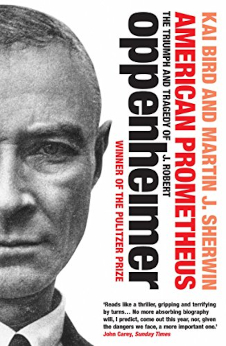
American Prometheus: The Triumph and Tragedy of J.Robert Oppenheimer
“’You have to take the whole story,’ Rabi insisted. ‘That is what novels are about. There is a dramatic moment and the history of the man, what made him act, what he did, and what sort of person he was. That is what you are really doing here. You are writing a man’s life.’”
American Prometheus: The Triumph and Tragedy of J. Robert Oppenheimer
8/10
Despite being meticulously researched and very well written, this text on the life of J. Robert Oppenheimer is horribly biased in favour of him. In fact, it is more of a hagiography than it is a biography as it is blatantly Team Oppenheimer, constantly praising his intelligence, personality, fashion sense (including his stoopid pork pie hat), and appearance, claiming numerous times that all the ladies were after him. Conversely, very little criticism is made of his poor decision making, philandering, and neglect as a parent.
It is claimed that at piano/violin recitals for physicists, Oppenheimer, “wearing one of his tweedy suits”, would be “the center of attraction”. “He was great at a party and women simply loved him”. “He really was a man of women”. Apparently, his empathy was “the secret of his attraction…it felt almost that he could read their [women’s] minds”.
A key example of the undeserved and disproportionate veneration of the book’s subject are descriptions of his time coordinating things at Los Alamos during the development of the ‘gadget’ or atomic bomb. The text says that everyone could ‘sense his presence’ and, even though he didn’t contribute that many ideas or suggestions, his “intense presence… produced a sense of direct participation” from staff. He achieved this by randomly “dropping in unannounced on one of the laboratory’s scattered offices” and chain-smoking at the back of the room while discussions were taking place.
Whoever was responsible for casting Cillian Murphy as Oppenheimer in the movie did a bang-up job and deserves a pay rise. Descriptions of young Oppenheimer in the book suggest that Cillian closely resembles him. Specifically, “Robert was an oddly handsome young man. Every feature of his body was of an extreme. His fine pale skin was drawn taut across high cheekbones. His eyes were the brightest pale blue, but his eyebrows were glossy black. He wore his coarse, kinky black hair long on top, but short at the sides… His straight Roman nose, thin lips and large, almost pointed ears accentuated an image of exaggerated delicacy.” Well played.
When Robert is a young man, riding horses in New Mexico, he makes what is probably the worst mistake of his life. “One night on the trail Robert found himself out of food, and someone offered him a pipe to quell the pangs of hunger. Pipe tobacco and cigarettes quickly became thereafter a lifelong addiction.” And boy did Oppenheimer ever go in for the tobacco. As the narrative advances, his deterioration and decline from tobacco and cigarettes is clear. From descriptions of “His long bony fingers… stained a deep yellow from nicotine” to his “smoker’s cough, the result of a four- or five-pack-a-day” habit, ultimately becoming “uncontrolled, protracted spasms of coughing” during which “his face would sometimes flush purple”.
In the mid-sixties, Oppenheimer recovers from a bad case of pneumonia and gives up cigarettes, but he still smokes his pipe. He goes to the doctor and receives a clean bill of health, joking, “I am going to outlive every one of you”. This turns out to be an L-take as his cough became worse and his throat was giving him a lot of pain. Brilliant man that he is, Oppenheimer concludes “Maybe I’m smoking too much”. He deserves a second PhD for that one. Another doctor’s visit confirmed that “Robert ha[d] cancer… Four decades of heavy tobacco smoke had taken its toll on his throat.” “…he underwent a painful and inconclusive operation on his larynx—and then he began receiving cobalt radiation therapy at the Sloan-Kettering Institute in New York.” He died in his sleep on “Saturday, February 18, 1967. He was only sixty-two years old.”
But what about the life of this historical figure?
He had a very privileged upbringing and was unusual, to say the least. As a young man, he wrote questionable poetry and had a very strange view of women. I’m not quite sure how to respond to his poetry that goes a little something like this:
“Tonight she wears a sealskin cape glistening black diamonds where the water swathes her thighs and noxious glints conspire to surprise a pulse condoning eagerness with rape.”
As a young man, Oppenheimer described an episode on a train to one of his acquaintances that suggested he was “losing control emotionally”. While attempting to read about thermodynamics, he could not concentrate due to “a man and woman who were making love [kissing and perhaps fondling each other, we assume]”. Oppenheimer claimed to his friend that when the man left, he kissed the woman, but “was at once overcome with remorse, fell on his knees, his feet sprawling, and with many tears, begged her pardon… His reflections were so bitter that, on the way out of the station, when they were going downstairs, and he saw the woman below him, he was inspired to drop his suitcase on her head. Fortunately, he missed.” The authors of the book doubt the truthfulness of this story, though they recognise that the ‘fantastic tale’ was an “expression of his distress.” After Oppenheimer attempts to strangle that same friend with a trunk strap after they announce their engagement, he is diagnosed by a psychiatrist as “suffering a ‘crise morale’ associated with sexual frustration”.
However, instead of addressing this ‘sexual frustration’ head on, Oppenheimer initially stays clear of women and devotes himself to his work. He even cautions his brother Frank that a “young woman’s ‘profession [is] to make you waste your time with her; it is your profession to keep clear” and that dating is “only important for people who have time to waste. For you, and for me, it isn’t.”
When in Leiden, The Netherlands, during his doctoral studies, Oppenheimer is given a nickname after he astonishes “his peers by giving a lecture in Dutch”, which he taught himself. They called him ‘Opje’, “an affectionate contraction of his last name”, and he later encourages his students to call him this and signs letters in this way. Gradually, the nickname became anglicised as ‘Oppie’, and his lifelong nickname.
The text notes Oppie’s ability “to speak in complete, grammatically correct English sentences, without notes” during his lectures. “The relentless patter of his voice was interrupted only by puffs on his cigarette. Every so often, he would twirl toward the blackboard and write out an equation.” One student remarked, “We were always expecting him… to write on the board with it [the cigarette] and smoke the chalk, but I don’t think he ever did.”
While teaching at University of California, Berkeley, things seem to be going well for Oppenheimer. He’s doing normal people things and going on dates with ladies. During this time, he meets both of the truly significant women in his life, both of whom were completely crazy and awful.
The first of these was called Jean Tatlock. She was Oppie’s “fiancée for four years… and a Communist Party member, although with reservations.” They had a tumultuous relationship, with plenty of blazing rows. She roped Oppie into associating with various “communist front organizations”, that would get him into trouble later in his life, such as the American Civil Liberties Union, Friends of the Chinese People, American Committee for Democracy and Intellectual Freedom, and “a group that publicized the plight of German intellectuals.”
After things end with Jean, Oppie meets Kitty, whom he finds “irresistible”. The only problem is that she is already married. After carrying on together for a while, Oppie is forced to phone Kitty’s husband “Dr. Harrison to tell him that his wife was pregnant”. Whoopsie. Oppie agrees to marry Kitty and they start their life together.
Kitty sounds like a nightmare to be honest. First of all, she is a klutz and is constantly having misadventures. “A few days earlier, Kitty had had another one of her accidents. This time, she had fallen down the stairs and her leg was in a cast.” Second, she has problems with booze. “When he hung up, he turned to Bernstein, someone he had barely met, and said casually, ‘It’s Kitty. She has been drinking again.’” Third, she just can’t be trusted. One instance in the book is described where Oppie is sick in bed and Kitty entertains one of his friends. The friend recalls, “She was trying to flirt with me”. Fourth, she is violent. When staying with their friends, the Gibneys, Oppie and Kitty used to stay up all night drinking and smoking in bed. After confronting Kitty about making so much noise when retrieving ice for her drink, Kitty hits Nancy Gibney with a flashlight. Fifth, she is a horrible parent, which will be elaborated on shortly. “She was the great trouble in his life… and she knew it.”
Perhaps these issues were the reason that Oppie “continued to see Jean Tatlock”, despite his marriage to Kitty. They ran into each other at parties, Oppie visited her “at her apartment and in her office at the children’s hospital where she was employed as a psychiatrist”. According to the text, “the emotional bonds between them were unbroken” and Jean regretted not marrying Oppie, saying she would have, “had she not been so mixed up.” Later, when he is working at Los Alamos, Oppie, while under surveillance, takes Jean for dinner, they kiss, and walk arm in arm together, before “Jean drove them back to her top-floor apartment at 1405 Montgomery Street in San Francisco. At 11:30 p.m. the lights were extinguished, and Oppenheimer was not observed until 8:30 a.m. next day, when he and Jean Tatlock left the building together”. I don’t want to draw any conclusions from this, but the FBI report did note that “the relationship of Oppenheimer and Tatlock appears to be very affectionate and intimate.” Oppie claimed that the reason for this meeting was that Jean wanted to tell him she was still in love with him.
Sadly, Jean was not long for this world. One day, when paying her a visit, her father discovers her body “lying on a pile of pillows at the end of the bathtub, with her head submerged in the partly filled tub.” She had left an unsigned suicide note on the back of an envelope that read: “I am disgusted with everything. . . . To those who loved me and helped me, all love and courage. I wanted to live and to give and I got paralyzed somehow. I tried like hell to understand and couldn’t. . . . I think I would have been a liability all my life—at least I could take away the burden of a paralyzed soul from a fighting world.” RIP, Jean. Unfortunately, daddy is also crazy and instead of phoning the police he lays Jean’s body on the living room sofa and destroys some of her documents before contacting the police. Had the internet existed, I’m sure he would have deleted her search history, too.
It is an understatement to say that the construction of the nuclear bomb was a big project. It required Oppie to transform from a man of “pure science” into the director of a large-scale industrial enterprise. “When Los Alamos opened in March 1943, a hundred scientists, engineers and support staff converged on the new community; within six months there were a thousand and a year later there were 3,500 people living on the mesa. By the summer of 1945, Oppenheimer’s wilderness outpost had grown into a small town of at least 4,000 civilians and 2,000 men in uniform. They lived in 300 apartment buildings, fifty-two dormitories and some 200 trailers.”
Having so many people and their families working on a long project with free medical care meant that many younger couples decided to have babies. “[S]ome eighty births were recorded the first year, and about ten a month thereafter”. The Oppenheimers were part of this group and Kitty gave birth to their second child on December 7, 1944, “a daughter, Katherine [Toni], whom they nicknamed ‘Tyke.’”
Both Kitty and Robert were horrible parents. After Tyke is born, Oppie only came around to visit her twice a week. I understand that you’re busy, man, but come on. One day he even asked a family friend who had lost their child to Sudden Infant Death Syndrome, without Kitty’s permission, whether they would like to adopt Tyke. He said this was because “I can’t love her” and “I’m not an attached kind of person”.
One of Oppie’s acquaintances, David Lilienthal, lamented the “contradiction between Oppenheimer’s brilliant mind and his awkward personality” saying that he ruined his children’s lives. His son Peter was intelligent, shy, and sensitive, but Oppie could not protect him from Kitty’s volatile moods. Oppie and Kitty left him behind in boarding school when they moved with Tyke to Paris for a semester-long visiting professorship. “Robert’s personal secretary, Verna Hobson, disapproved: ‘What a slap to leave him behind. He [Peter] was enormously sensitive. I felt tremendously on his side.’”
Needless to say, neither Peter nor Toni/Tyke had great outcomes in their adult lives. Peter moved to New Mexico and worked as a contractor and carpenter. He was divorced twice and never advertised his familial connections. However, things were much worse for Toni. “Kitty managed her life so much that Toni never became independent”. She also ended up getting divorced twice. Toni was unable to pursue her chosen career as a translator for the United Nations as she couldn’t get security clearance from the FBI due to old charges about her father. She was depressed and saw a psychiatrist about this and her “resentment toward her parents from the way she had been treated as a young child”. She moved to the island of Saint John and “On a Sunday afternoon in January 1977, she hanged herself in the beach cottage Robert had built on Hawksnest Bay.” Grim stuff.
After the successful development of the atomic bomb, a conspiracy to end Oppie’s influence on nuclear policy is brewing behind the scenes. Based on “evidence of Oppenheimer’s communist associations” and his recommendations against the creation of more powerful nuclear weapons, the accusation is made that “more probably than not J. Robert Oppenheimer is an agent of the Soviet Union.”
At the conclusion of the book, Oppenheimer defends himself against these claims. He returns to teaching and spends more time at his home in the Virgin Islands. Oppie enjoys sailing his boat (people who enjoy this are referred to as “rag people”) and walking on the beach. “Robert would invite anyone he met to come over for drinks” or dinner, reciting poetry to them. However, he is ageing very badly, and it won’t be too long until he pays the ultimate price for his nicotine addiction.
I really enjoyed this book and thought that it blended biography well with an exploration of interesting ideas. It was fascinating to think that the original purpose of the bomb was to defeat the Germans, but that it was eventually used on the Japanese, who were close to surrendering anyway.
Even while it was being developed, Niels Bohr was already thinking about the future of the bomb. He cautions all those involved in the project that “its invention would inspire a deadly nuclear arms race between the West and the Soviet Union. To prevent this, he insisted, it was imperative that the Russians be told about the existence of the bomb project, and be assured that it was no threat to them.” Hindsight confirms that he was correct in this assertion. From the original three bombs developed under Oppie’s supervision, “The U.S. stockpile of atomic weapons—which in June 1948 stood at about 50 bombs—would rise rapidly to some 300 such weapons by June 1950”.
Attention is then devoted to the development of the ‘Super’, a thermonuclear weapon, also known as H-bomb, that was thousands of times more destructive than the original bombs. “By the end of the decade, America’s stockpile of nuclear weapons would leap from some 300 warheads to nearly 18,000 nuclear weapons. Over the next five decades, the United States would produce more than 70,000 nuclear weapons and spend a staggering $5.5 trillion on nuclear weapons programs.” Despite recommendations from Oppie and others that there should be a moratorium on the testing of the H-bomb, in 1952 “the United States exploded a 10.4-megaton thermonuclear bomb in the Pacific, vaporizing the island of Elugelab.”
As for Oppie’s famous line that he is supposed to have said after the successful test of the first nuclear bomb, “Now I am become death, the destroyer of worlds“, it is very unlikely that this happened. In fact, it is only in a 1965 NBC television documentary, 20 years after the Trinity test, that he says that “the unearthly mushroom cloud soaring into the heavens above Point Zero” made him recall this line from the Bhagavad-Gita. Even one of Oppie’s friends, Abraham Pais, suggested that the quote sounded like one of his “priestly exaggerations.”
Overall, the book wasn’t terribly funny and didn’t have many comedy moments or characters. Albert Einstein, when dissing the Atomic Energy Commission (AEC), quips that their acronym should stand for the “Atomic Extermination Conspiracy.” Stick to the theoretical physics, Einstein. Also, Oppie’s aunt, Hedwig Oppenheimer Stern, may have been an owl.
It was a decent book for burns.
Oppie roasts Leslie Groves, the original director of the Manhattan Project. “Gruff and plainspoken, he had no time for the subtleties of diplomacy. ‘Oh yes,’ Oppenheimer once remarked, ‘Groves is a bastard, but he’s a straightforward one!’”
The wife of a physicist employed at Los Alamos can’t resist commenting on Oppie’s appearance when he is sick with chickenpox and feverish. “Our thin, ascetic Director… looked like a 15th century portrait of a saint with his fever-stricken eyes peering out from a face checkered with red patches and covered by a straggling beard.” Oppie is also subjected to verbal abuse from Nancy Gibney, the woman Kitty bashed with the flashlight, who thought that he looked “astoundingly like Pinocchio, and he moved as jerkily as a marionette on strings.” However, she pulls back from completely nuking this wooden puppet by adding, “But there was nothing wooden about his manner: he exuded warmth and sympathy and courtesy along with the fumes of his famous pipe.”
Finally, there is a burn on communism. “It is a cruel and humorless sort of pun that so powerful a present form of modern tyranny should call itself by the very name of a belief in community”. Got ‘em.
The Gipper
“I have expressed strong opinions many times, and I intend to do so. They have been unpopular opinions at times. When a man is pilloried for doing that, this country is in a severe state”.