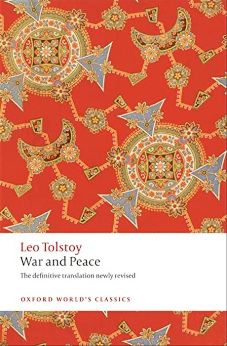
War and Peace
“He read without understanding half of it, read only to forget, if but for a moment, what he had too long been thinking of so painfully to the exclusion of all else.”
War and Peace
4/10
War and Peace? More like Snore N’ Sleep.
Whatever else I do in my life, I can say that I read War and Peace cover to cover. An important text crossed off my ‘to be read’ list and one that I am unlikely to ever revisit. I would say that War and Peace has been the longest novel that I ever read, but the introduction to the Oxford World’s Classics version that I read quotes Tolstoy saying that “It is not a novel, even less is it an epic poem, and still less an historical chronicle”. What is it then?
It could be argued that it is a bloated, meandering, and unfulfilling literary experiment with an inadequate payoff for your time and attention. In fact, its length was so excessive, that I sporadically lost attention and interest in it as I progressed through it. I’m with Henry James (from the Oxford World’s Classic introduction) when he refers to it as “a loose, baggy monster”. Typically, literary critics understand this text as having three components, “a philosophical essay, a family chronicle, and a historical novel about the Napoleonic wars”. How well these aspects of the story work together to create a coherent and cohesive whole is a matter of opinion. My opinion is based on 449 notes I made while slowly reading this tome over many months.
Often the narrative of the story is interrupted by totally skippable “extended essayistic passages in which [Tolstoy] forges his unorthodox philosophy of history”. These many soapbox-style lecture type passages are tedious to the extreme and tough going. The text is also criticised for its “confusion of artistic designs”, failure to unite the various narratives, for the many “incidents and characters described in great detail” which then “vanish from the… novel”, or that sections are needlessly long to fill up instalments of the work when it was published originally.
While there is some debate about the quality of the text, there can be none about its length. There are more than 600 characters in War and Peace, prompting the translators of this version to include foot notes to guide and support readers. Indeed, this translation, the Maude translation, “has long been considered the best English version of Tolstoy’s masterpiece” and “has quite justly acquired the status of a classic in its own right”, even if it does say so itself. Among the features that the copy compliments itself for are its “helpful apparatus”, likely referring to the footnotes and translations of French passages. I found the information about the historical context to be helpful and often interesting. With regard to the French passages, I don’t speak a word, and would have been lost without them. Approximately 2% of this massive work is in French.
Though the text is incredibly well-researched, the pedantic notes alert readers that it is not perfect. Wherein, “probably by inadvertence, Tolstoy gives the date according to the Gregorian or New Style calendar. In the next sentence he reverts to the Old Style, which he elsewhere employs throughout the novel. The error makes it appear that Napoleon spent only twelve days (19 May to 10 June) on his way from Dresden via Posen, Thorn, Danzig, and Königsberg to the Russian frontier. He actually took twice as long.” Tolstoy makes another mistake with dates later, confusing Alexander’s birthday with his name day. Whoops.
It is hard to say as you are progressing through the book who the main characters are, though this becomes clear towards the end. For instance, what happened to Boris? He was a major player for a good chunk of the book, and I couldn’t tell you what happened to him. Prince Vasili? He just dropped off the map. Same thing for Anna Mikhailovna.
Ultimately, the true central characters are:
Pierre, the overweight, illegitimate son of the wealthy Count Bezukhov. There is a plotline that goes nowhere about who will inherit the Count’s estate when he dies and some tension between other candidates, like Prince Vasili and Anna Mikhailovna, but Pierre is the beneficiary. He is tricked into marrying Vasili’s daughter, Hélène, for a bit, but after a brief and difficult marriage, that ends, and she dies and it’s all meaningless and doesn’t even really contribute to his character development. He is a freemason for a while and takes up the cause of serf liberation but, by the conclusion of the book, there is no evidence or trace that this ever happened. He goes crazy for a bit and plans to assassinate Napoleon, too. The closest we come to character development is when Pierre is taken captive and experiences “almost the extreme limits of privation a man can endure”. As a result of this, he obtains “the tranquillity and ease of mind he had formerly striven in vain to reach” and he had previously sought “in philanthropy, in Freemasonry, in the dissipations of town life, in wine, in heroic feats of self-sacrifice, and in romantic love for Natasha; he had sought it by reasoning—and all these quests and experiments had failed him. And now without thinking about it, he had found that peace and inner harmony only through the horror of death, through privation”. Mission accomplished, I guess.
Nikolai is another of the most prominent characters. He has some drama with his father about joining the army, has a will they/won’t they flirtation with Sonya, and eventually decides to get with Princess Marya. His main love for most of the book is the Tsar. “He really was in love with the Tsar and the glory of the Russian arms and the hope of future triumph”. At one point, he loses 43,000 roubles to Dolokhov. This contributes toward driving his family into debt, but doesn’t seem to have major, meaningful, or tangible implications for the comfort with which the family live their lives.
Natasha, who begins the story as a girl of sixteen, is proposed to by Denisov, propositioned by Anatole, and engaged to Andrei. After she breaks things off with the latter and regrets it, she is ill for a while and becomes religious. In a major story contrivance, as her family begin to evacuate Moscow, Andrei shows up again totally out of nowhere and is badly wounded. Together with his sister, she cares for him until his death, becomes best friends with Marya, and then marries Pierre.
The aforementioned Princess Marya is another of the primary characters that appears consistently throughout the book. She is described as either plain or ugly, depending on the observer. Anatole and Prince Vasili pay her a visit during a portion of the book with an eye to arranging a wedding, but Anatole is badly behaved and rude during this visit; flirting, embracing, and playing footise with her French companion, Mademoiselle Bourienne, under the clavichord that Marya is playing; and nothing comes of it. She also considers becoming a religious pilgrim, but nothing comes of that either and, after she buries her father, she starts a relationship with Nikolai.
Though Prince Andrei doesn’t survive the story, he is definitely one of the primary characters. He’s portrayed in an unfavourable light towards the beginning, arguing with his pregnant wife and generally being obnoxious. Later, he grows an appreciation for what he has by finding God, is rescued by Napoleon following a battle, but his wife dies giving birth to his son Nikolai. He later proposes to Natasha, who tries to leave him for Anatole, and eventually he dies following a previous, and very obvious, fake out death for him.
My most hated character has got to be Platon Karataev, the “little falcon”. He is a minor character that was quite honestly insufferable. Every time he spoke, I wanted to put the book down and do something else.
Though much of the characterisation was weak and superficial for much of this text, some are given really interesting and thought provoking moments. “Rostov went on ahead to fulfil the request, and to his great surprise learned that Dolokhov the brawler, Dolokhov the bully, lived in Moscow with an old mother and a hunchback sister, and was the most affectionate of sons and brothers.” There was almost something interesting there.
There were some odd or unexpected characters in the text. I noted the GenZ soldier with “a bleeding head and no cap [that] was being dragged along by two soldiers”. I also spotted that Prince Bolkonsky was another GenZ character. “‘Fr … fr …’ [he] snorted”.
Or the incredible, magic dog. “The French dragoon was a young Alsatian who spoke French with a German accent.”
The Dark Knight also makes an appearance. “Having left that soldier who was evidently drunk, Rostov stopped the horse of a batman or groom of some important personage and began to question him.”
What was the point of War and Peace then?
“To Pierre all men seemed like those soldiers, seeking refuge from life: some in ambition, some in cards, some in framing laws, some in women, some in toys, some in horses, some in politics, some in sport, some in wine, and some in governmental affairs. ‘Nothing is trivial, and nothing is important, it’s all the same—only to save oneself from it as best one can,’ thought Pierre. ‘Only not to see it, that dreadful it!’”
Okay, so war is a metaphor for hiding or escaping reality?
“The staging of human activity and the parallel between theatres of war and peace is underscored in descriptions of evening parties and soirées, so that Pierre ‘enters his wife’s evening party as if it were a theatre’, Denisov appears in the Rostovs’ drawing-room ‘dressed as for battle’, Dolokhov and Nikolai Rostov ‘do battle’ at cards, Boris courts Julie by ‘laying siege’ to her”.
The following passage also implies that love is the real battlefield or at least a parallel battlefield. “Vera at the same time was smiling with a sense of superiority over her good, conscientious husband, who all the same understood life wrongly as, according to Vera, all men did. Berg, judging by his wife, thought all women weak and foolish. Vera, judging only by her husband and generalizing from that observation, supposed that all men, though they understand nothing and are conceited and selfish, ascribe common sense to themselves alone.”
Generally, I preferred the society/peace bits. Among my least favourite aspects of the plot were when Pierre rescues a child from a burning Moscow house. It’s pointless, ridiculous, and unclear why Pierre was commissioned to rescue the child when the family could have easily done it themselves if they had made any effort. They were just standing around on the street.
On love as a parallel battlefield, at the opening of the text, there is trouble in paradise between Andrei and his wife, Lise. “[H]er pretty face all at once distorted by a tearful grimace. ‘I have long wanted to ask you, Andrei, why you have changed so to me? What have I done to you? You are going to the war and have no pity for me.’”
In fact, it seemed the book was exclusively comparing war to navigating romantic relationships for a while. “Never, never marry, my dear fellow! That’s my advice: never marry till you can say to yourself that you have done all you are capable of, and until you have ceased to love the woman of your choice and have seen her plainly as she is, or else you will make a cruel and irrevocable mistake. Marry when you are old and good for nothing—or all that is good and noble in you will be lost. It will all be wasted on trifles”. “Bonaparte when he worked went step by step towards his goal. He was free, he had nothing but his aim to consider, and he reached it. But tie yourself up with a woman, and like a chained convict you lose all freedom! And all you have of hope and strength merely weighs you down and torments you with regret.”
One of the major themes in the book is Lise’s ‘downy lip’. It is mentioned so many times. “The little princess talked incessantly, her short downy upper lip continually and rapidly touching her rosy nether lip when necessary and drawing up again next moment when her face broke into a smile of glittering teeth and sparkling eyes.”
This woman gets no dang respect. This is how she is described before she is informed that her husband, Price Andrei (who is not dead) is dead. “Her eyes were smiling expectantly, her downy lip rose, and remained lifted in child-like happiness.” “Ma bonne amie,’ said the little princess after breakfast on the morning of the 19th of March, and her downy little lip rose from old habit, but as sorrow was manifest in every smile”. Even after she dies during childbirth, Tolstoy can’t resist the siren’s song of commenting on her lip. “She was lying dead, in the same position he had seen her in five minutes before, and despite the fixed eyes and the pallor of the cheeks, the same expression was on her charming childlike face with its upper lip covered with tiny black hair.”
Taches were definitely in at the time of the story as Nikolai decides to grow one, too. “Remember, don’t forget to put out my new coat,’ added Rostov, fingering his new moustache.”
The plotline with Anatole seducing Natasha is a simple one. Anatole is a deadbeat and is hiding an existing marriage to the daughter of a Polish landowner. He is a womaniser and a party animal and runs up huge debts, expecting his father to bail him out. Anatole organises an elopement with Natasha which is scuppered by Sonya and others. Despite its simplicity, Tolstoy regarded this storyline to be ‘the crux’ of the work. “It is tempting to read these episodes allegorically, picturing this quintessentially Russian heroine as representing her homeland, while her conquest by the immoral and deceptively elegant continental rake could be interpreted as symbolically describing the fall of Russia to the French.” For ‘the crux’ of the work, this has very few implications and is forgotten quickly by most of the characters.
Many parts of the plot were almost putting me to sleep. In the war, the stealing of Telyanin’s purse has got to be one of the most boring storylines ever penned.
Despite all the long-winded, boredom-inducing, and tiresome aspects of the book, there were some really interesting and creative ideas. Towards the end, when young Nikolenka/Nikolushka (son of Andrei) is inspired by a conversation about a potential revolution and unconsciously breaks up sealing-wax and pens on a desk. This represents him claiming an unscripted future for himself and his generation that is not dictated by the previous generation’s narratives. While this is a pleasing idea, readers are aware for the forthcoming Decembrist revolutionaries and their tragic fate.
Another interesting idea describes a violent and bloody battle on precisely the same spot as a peaceful and tranquil moment. “On the narrow Augesd dam where for so many years the old miller had been accustomed to sit in his tasselled cap peacefully angling, while his grandson, with shirtsleeves rolled up, handled the floundering silvery fish in the watering-can”. Very poignant.
It was great, too, to see a shout out to the much-maligned Tories. “William Pitt the Younger (1759–1806), British Tory Prime Minister, was instrumental in abolishing the slave trade in England through a productive political collaboration with William Wilberforce” They don’t get enough credit for their historic achievements.
Though the text was able to communicate interesting ideas and values at times, it was often done in a confusing or inconsistent way.
For example, when describing what Prince Nikolai Andreevich is all about, it reads “He used to say that there are only two sources of human vice—idleness and superstition, and only two virtues—activity and intelligence”. Wonderful. Great ideas and a respectable way of looking at the world. However, he is later framed as an awful person that is horrible and cruel to his daughter for no reason. Why would readers empathise or want to emulate such an objectionable character?
Another approach the novel takes to communicate its values is a switch to full-on preaching mode. Here Tolstoy will take to the pulpit, announcing himself to readers outside the world of the story and ramble on at significant length about his views.
“War is not courtesy but the most horrible thing in life; and we ought to understand that, and not play at war. We ought to accept this terrible necessity sternly and seriously. It all lies in that: get rid of falsehood and let war be war and not a game. As it is now, war is the favourite pastime of the idle and frivolous. The military calling is the most highly honoured.” Hang on. War is a bad thing? Thanks for the hot take, Tolstoy.
I also spotted some very poor, laboured, long-winded, and not relatable metaphors. “Pierre dropped his eyes, lifted them again, and wished once more to see her as a distant beauty far removed from him, as he had seen her every day until then, but he could no longer do it. He could not, any more than a man who has been looking at a tuft of steppe grass through the mist and taking it for a tree, can again take it for a tree after he has once recognized it to be a tuft of grass”. Okay.
Another example of an absolutely atrocious metaphor is: “The aim of each man when he left Moscow was no longer, as it had been, to conquer, but merely to keep what he had acquired. Like a monkey which puts its paw into the narrow neck of a jug, and having seized a handful of nuts will not open its fist for fear of losing what it holds, and therefore perishes, the French when they left Moscow had inevitably to perish because they carried their loot with them, yet to abandon what they had stolen was as impossible for them as it is for the monkey to open its paw and let go of its nuts.”
I suppose I should spotlight some of the better writing, too. “Without changing his careless attitude Pierre looked at them over his spectacles unable to understand what they wanted or how they could go on living without having solved the problems that so absorbed him. He had been engrossed by the same thoughts ever since the day he returned from Sokolniki after the duel and had spent that first agonizing, sleepless night. But now in the solitude of the journey they seized him with special force. No matter what he thought about, he always returned to these same questions which he could not solve and yet could not cease to ask himself. It was as if the thread of the chief screw which held his life together were stripped, so that the screw could not get in or out, but went on turning uselessly in the same place.” Dark night of the soul stuff there.
There were a couple of notable things that I caught in the text.
“The large table covered with books and plans, the tall glass-fronted bookcase with keys in the locks, the high desk for writing while standing up, on which lay an open exercise-book”. Prince Nikolai Andreevich was hundreds of years ahead of his time for having a standing desk. He knew that sitting was the new smoking.
Then there was the ‘buffoon’, Nastasya Ivanovna. I didn’t have a clue what was happening here. This is a cross-dressing fool that lives with Rostovs, seemingly paying his way by being a source of comedy. “This person was a grey-bearded old man in a woman’s cloak with a tall peaked cap on his head. He was the buffoon, who went by a woman’s name, Nastasya Ivanovna. ‘Well, Nastasya Ivanovna!’ whispered the count, winking at him.”
There were other peculiar things in the text. For instance, why did the doctor kiss Andrei here? “When he came to himself the splintered portions of his thigh-bone had been extracted, the torn flesh cut away, and the wound bandaged. Water was being sprinkled on his face. As soon as Prince Andrei opened his eyes, the doctor bent over, kissed him silently on the lips, and hurried away”. Huh?
“No nineteenth-century author had ever probed as intimately into the psychology of marital relations as Tolstoy does in the concluding domestic scenes of the ‘Epilogue’ to War and Peace: the wife and husband consulting over the best way to discipline their children and servants; the exchange of glances between husband and wife endorsing their private critique of friends and relations in order to bolster and secure their shared beliefs; the absorption of husbands and wives in the details of breastfeeding and changing their babies. Narrowing the focus from the wide canvas of war with its hundreds of thousands of soldiers crossing continents and dying on the field of battle in order to home in on the colicky burp of a baby seems like a progression from the sublime to the quotidian, and yet this concluding vision of new life in its most earthy and tender beginnings is the fresh grass that covers the graves of heroes and rejoices the heart of the poet.”
The epilogue is among the most boring things I have ever read. It’s hours of lecturing and pontificating from a soapbox. It describes where the main characters are 7 years following the events of the text. Some marriage problems are evident, particularly between Marya and Nikolai, but they have some sweet moments, too. It addresses questions like: “(1) What is power? (2) What force produces the movement of the nations?”. Exactly what you want when escaping into a fantasy world. That said, there are some interesting ideas about whether free will exists, a phenomenon that continues to be contentiously debated.
The book is quite burn heavy and Tolstoy dedicates a whole paragraph to burning Helene’s brother Hippolyte.
“Le charmant Hippolyte was surprising by his extraordinary resemblance to his beautiful sister, but yet more by the fact that in spite of this resemblance he was exceedingly ugly. His features were like his sister’s, but while in her case everything was lit up by a joyous, self-satisfied, youthful, and constant smile of animation, and by the wonderful classic beauty of her figure, his face on the contrary was dulled by imbecility and a constant expression of sullen self-confidence, while his body was thin and weak. His eyes, nose, and mouth all seemed puckered into a vacant, wearied grimace, and his arms and legs always fell into unnatural positions”.
Prince Andrei says to his sister “she was still the same pleurnicheuse as ever” [snivelling crybaby].
There is a burn on the Germans. “Since the world began everybody has beaten the Germans. They beat no one—except one another.”
There is a burn by the infantry on clean, smart hussars. “‘Fancy boys! Only fit for the Podnovinsky fairgrounds!’ said one. ‘What good are they? They lead them around just for show!’”
Prince Andrei burns the Russian army. “‘This is a mob of scoundrels and not an army,”
I noted a passing burn on Princess Kurgagina. Go easy on her. She’s celebrating her name day. “The visitors were seated at supper. Princess Kuragina, a portly imposing woman who had once been handsome, was sitting at the head of the table.”
Marya burns women in general. “…they began dressing her with perfect sincerity, and with the naive and firm conviction women have that dress can make a face pretty”.
Old Bolkonsky burns Prince Vasili and Anatole. “What are Prince Vasili and that son of his to me? Prince Vasili is a shallow braggart and his son, no doubt, is a fine specimen,’ he grumbled to himself.”
The worst burns were those in the poor repartee between the children. “‘Petya, you’re a stupid!’ said Natasha. ‘Not more stupid than you, madam,’ said the nine-year-old Petya, with the air of an old brigadier.” Classic.
Did I have a few chuckles when I was reading the book? Sort of.
This was an interesting passage. Vasili confronts Pierre about arguing with his wife, saying “Why have you quarrelled with Lyolya, mon cher? You are under a delusion,’ said Prince Vasili as he entered. ‘I know all about it, and I can tell you positively that Hélène is as innocent before you as Christ was before the Jews.’ Pierre was about to reply but Prince Vasili interrupted him.” My question is, what was Pierre about to say? ‘And you know how that worked out?’ or some such piece of comedy?
Perhaps it is not unexpected that this text was a little light on comedy. Notable amusing moments included Anna Pavlovna forcing visitors to her party to greet an old aunt “whom not one of them knew, not one of them wanted to know, and not one of them cared about”. After they go through formalities about “their health and her own, and the health of her Majesty”, not one guest returns to her for the whole evening. Not exactly kneecap-slapping stuff.
The rowdy crew with Dolokhov and Anatole that Pierre orbits were somewhat amusing also. They are out of control with their drinking and bear-related activities. At one of their parties, they are drunkenly dancing with a bear and an episode is recounted wherein they “got hold of a bear somewhere, put it in a carriage, and set off with it to visit some actresses”. When the police intervene, “They tied a policeman and the bear back to back and put the bear into the Moika Canal. And there was the bear swimming about with the policeman on his back!”
There’s young love and then there’s young love. I definitely wasn’t comfortable with this line from Nikolai’s mother. “‘Isn’t she too young? I have heard that it harms the voice to train it at that age.’ ‘Oh no, not at all too young!’ replied the count. ‘Why, our mothers used to be married at twelve or thirteen.’”
I wonder why Tolstoy wanted to have a laugh at the expense of the spoon player in this passage? “…the spoon player in spite of the burden of his equipment rushed out to the front and walking backwards before the company jerked his shoulders and flourished his spoons as if threatening someone”.
When Old Boloknsky’s staff clear the snow on the roads for a minister he says, “‘What? A minister? What minister? Who gave orders?’… ‘The road is not swept for the princess, my daughter, but for a minister!… Rascals! Blackguards! … I’ll teach you to think!’ Throw the snow back on the road!’”
Prince Andrei recalling the ‘all the best moments of his life’ is actually quite depressing. “Prince Andrei, and all at once he was seized by an unreasoning spring-time feeling of joy and renewal. All the best moments of his life suddenly rose to his memory. Austerlitz with the lofty heavens, his wife’s dead reproachful face, Pierre at the ferry, that girl thrilled by the beauty of the night, and that night itself and the moon, and … all this rushed suddenly to his mind.”
Then there is this crazy story. “And do you remember,’ Natasha asked with a pensive smile, ‘how once, long long ago, when we were quite little, Uncle called us into the study—that was in the old house—and it was dark—we went in and suddenly there stood …’ ‘A negro,’ chimed in Nikolai with a smile of delight. ‘Of course I remember. Even now I don’t know whether there really was a negro, or if we only dreamt it or were told about him.’ ‘He was grey, you remember, and had white teeth, and stood and looked at us…’ ‘Sonya, do you remember?’ asked Nikolai. ‘Yes, yes, I do remember something too,’ Sonya answered timidly. ‘You know I have asked Papa and Mama about that negro,’ said Natasha, ‘and they say there was no negro at all. But you see, you remember!’” What is going on?
Another funny part of the text is when Nikolai is praying that god help him when he wants to marry Marya, but has already promised Sonya that he will marry her. One second later, he receives a letter from Sonya “to release him from his promise and set him completely free”. Great timing.
Marya’s parenting style is hilarious. “He was naughty and obstinate. I tried threats, but he only grew angrier. Then I took the matter in hand: I left him alone and began with nanny’s help to get the other children up, telling him that I did not love him.” Textbook parenting move.
Like me, when the book tried to be funny, it was at its least amusing.
“By this time they were all approaching Tushin’s battery, and a ball struck the ground in front of them. ‘What’s that that has fallen?’ asked the accountant with a naive smile. ‘A French pancake,’ answered Zherkov.” Miss. The joke that is, not the cannon-ball.
“To the infantry!’ added another with loud laughter, seeing the shell fly past and fall into the ranks of the supports. ‘Bowing to a friend of yours, eh?’ remarked another, teasing a peasant who ducked low as a cannon-ball flew over.” The peasant’s reaction isn’t included.
There were also several instances of casual sexism.
“‘Just to flutter the nuns a bit. They say there are Italian girls among them. On my word I’d give five years of my life for it!’ ‘They must be bored, too,’ said one of the bolder officers, laughing.” Not cool, bro.
“‘There now! It’s true that all you women are cry-babies,’ remarked Petya, pacing the room with large, resolute strides… ‘You are all blubberers and understand nothing.’”
I’m not sure if this is casual sexism or simply a traditional and conservative view being expressed. “Only the old countess, with her maternal instinct, had realized that all Natasha’s outbursts had been due to her need of children and a husband”. With lines like this, it’s probably safe to assume that it’s the latter as the book explicitly says elsewhere that “the purpose of marriage is the family”.
There were very few tearful moments in the text. Though, when many characters were killed off, I felt nothing, I did find the scene when Countess Rostov gives Anna Mikhailovna 700 roubles to be quite moving. “Anna Mikhailovna was already embracing her and weeping. The countess wept too. They wept because they were friends, and because they were kind-hearted, and because they—friends from childhood—had to think about such a base thing as money, and because their youth was over … But those tears were pleasant to them both”
There were also some tearful moments with Marya. “Princess Marya was left alone. She did not comply with Liza’s request, she not only left her hair as it was but did not even look in her glass. Letting her arms fall helplessly she sat with downcast eyes and pondered. A husband, a man, a strong dominant and strangely attractive being rose in her imagination, and carried her into a totally different happy world of his own. She fancied a child, her own—such as she had seen the day before in the arms of her nanny’s daughter—at her own breast, the husband standing by and gazing tenderly at her and the child. ‘But no, it is impossible, I am too ugly,’ she thought.” This poor woman’s self-esteem levels are critical. As old Prince Bolkonksy is dying, he has a heartwarming scene with his daughter and this is genuinely emotional, too.
The text tries to have a tearful moment with the death of young Petya, aged 15. “His horse, having galloped up to a camp-fire that was smouldering in the morning light, stopped suddenly, and Petya fell heavily on to the wet ground… Dolokhov dismounted and went up to Petya, who lay motionless with outstretched arms. ‘Finished!’ he said with a frown, and went to the gate to meet Denisov who was riding towards him. ‘Killed?’ cried Denisov, recognizing from a distance the unmistakably lifeless attitude—very familiar to him—in which Petya’s body was lying”. I felt nothing.
When enjoying a text, I often reflect on which characters remind me of myself. There were some notable examples.
I think of Nikolai Rostov when he is at the battle of Schön Grabern and his incomprehension when the enemies try to shoot him. He thinks, “‘Who are they? Why are they running? Can they be coming at me? And why? To kill me? Me who everybody loves?’”. I think of one of Count Bezhukov’s nieces that is of the same proportions as me “The length of her body was strikingly out of proportion to her short legs”. Genetics can cruel. I also resonated with Bilibin, the diplomat, as I also share a passion for report writing. “What the diplomatic matter might be he did not care, but it gave him great pleasure to prepare a circular, memorandum, or report, skilfully, pointedly and elegantly.”
The Gipper
“The clerk glanced round, evidently hoping that his joke would be appreciated. Some people began to laugh, others continued to watch in dismay.”