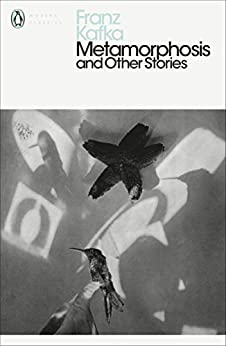
The Metamorphosis
Dear Family Book Club,
In another brief report of a short text, I weave together my own opinions with insights from the professionals; Nabokov and Sparky Sweets, PhD.
The Metamorphosis
5/10
On this strange little text, Nabokov says, that if it “strikes anyone as something more than an entomological fantasy, then I congratulate him on having joined the ranks of good and great readers”. Now, I was certainly of the view that the text was something more than a ‘entomological fantasy’ (making me either a good or great reader!), but I couldn’t specify any concrete meaning for the story that made sense.
The best I could do was interpreting the story as a metaphor for caring for a person with a long-term illness. I support this theory by pointing out Grete’s initial kindness and effort in caring for Gregor. However, time elapses, her life must continue, and things become more difficult for the family financially. Added to this, she must persist in caring for somebody that she no longer recognises as her brother.
With regard to a definite meaning to this story, Nabokov offers none.
Sparky Sweets says the book explores “what it means to be human in a capitalist society”. He illustrates this point with how the family gladly take the money that Gregor earns but offer very little warmth or love in return. This makes Gregor a “little less human every day”. Gregor, in his view, is considered as no more than a cash machine and illustrative of “a cold ass society that can turn even the hardest hoods into insects”. Sparky Sweets, PhD, concludes that, ultimately Gregor does the only good thing a bug can do, curl up into a ball and die.
Indeed, poor Gregor comes across in the short story as a sympathetic character. It is noted by Nabokov “how kind, how good our poor little monster is. His beetlehood, while distorting and degrading his body, seems to bring out in him all his human sweetness. His utter unselfishness, his constant preoccupation with the needs of others—this, against the backdrop of his hideous plight comes out in strong relief. Kafka’s art consists in accumulating on the one hand, Gregor’s insect features, all the sad detail of his insect disguise, and on the other hand, in keeping vivid and limpid before the reader’s eyes Gregor’s sweet and subtle human nature”.
I was surprised by how simple and easy to comprehend the language in the story was. The introduction to my version of the book was substantiated in its claims that Kafka is “not someone for the experts” and that “no training [is required] to prepare for him”. It continues by stating readers do not “even need to have a particularly literary disposition”.
I would describe the writing as utilitarian. Indeed, this is the first text in the ‘Family Book Club’ reading list for which I had no notes on excellent writing. Nabokov says “You will mark Kafka’s style. Its clarity, its precise and formal intonation in such striking contrast to the nightmare matter of his tale. No poetical metaphors ornament his stark black-and-white story. The limpidity of his style stresses the dark richness of his fantasy. Contrast and unity, style and matter, manner and plot are most perfectly integrated”.
This novel was written in German originally, meaning our English versions are translations. While discussing its translation, my copy of the book explains some of the limitations of German and praises the English language. “The genius of English – with so much more in the way of vocabulary, so much less in the way of grammar – is to me always warmer, more individual, cajoling, cluttered, relaxed, ambiguous”.
Not a critic afraid of getting hung up on details, Nabokov poses the question, what type of insect did Gregor metamorphose into? My version of the book, Penguin Modern Classics, maintains that it was a type of cockroach. However, this view is disputed by Nabokov who says it “does not make sense. A cockroach is an insect that is flat in shape with large legs, and Gregor is anything but flat: he is convex on both sides, belly and back, and his legs are small. He approaches a cockroach in only one respect: his coloration is brown. That is all. Apart from this he has a tremendous convex belly divided into segments and a hard rounded back suggestive of wing cases. In beetles these cases conceal flimsy little wings that can be expanded and then may carry the beetle for miles and miles in a blundering flight”.
He continues, describing Kafka as “the greatest German writer of our time”. It can be reasoned that this time is ongoing as I haven’t heard of any German writers of greater renown since his view was published in 1980.
Despite its short length, there were a couple instances where sensible chuckles could be had. I thought of a famous family story, cutting the lawn in a suit, during this humorous passage. “With an odd stubbornness, his father now refused to take off his uniform coat when he was at home; and while his dressing gown hung uselessly on its hook, his fully dressed father dozed in his chair, as though ready at all times to be of service, waiting, even here, for the voice of his superior. As a result, the uniform, which even to begin with had not been new, in spite of all the precautions of mother and sister, rapidly lost its cleanliness, and Gregor often spent whole evenings staring at this comprehensively stained suit, with its invariably gleaming gold buttons, in which the old man slept so calmly and uncomfortably”.
It was very amusing that, after having woken up in insect form, that Gregor’s first thoughts are about going to work and fulfilling routine obligations.
This book was very light on burns.
In fact, I only made a note of two instances. The first, was when the old charwoman says to Gregor, “Come here, you old dung-beetle!” However, this may be the type of insect that she genuinely believed Gregor was.
The second was by Gregor’s father on his wife and daughter, “Wasn’t I always telling you, but you women never listen”.
To supplement this section, I will draw on an opinion that Nabokov presents in his chapter on this text, where he burns music. “Without wishing to antagonize lovers of music, I do wish to point out that taken in a general sense music, as perceived by its consumers, belongs to a more primitive, more animal form in the scale of arts than literature or painting. I am taking music as a whole, not in terms of individual creation, imagination, and composition, all of which of course rival the art of literature and painting, but in terms of the impact music has on the average listener. A great composer, a great writer, a great painter are brothers. But I think that the impact music in a generalized and primitive form has on the listener is of a more lowly quality than the impact of an average book or an average picture. What I especially have in mind is the soothing, lulling, dulling influence of music on some people, such as of the radio or records”.
All the Best
T