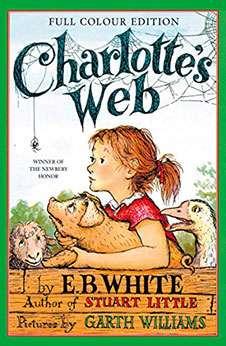
Charlotte’s Web
Dear Both,
It’s wonderful at the end of a challenging days’ work, extracting key themes from literature and summarising and synthesising my reading, to do something completely different.
“‘Salutations are greetings,’ said the voice. ‘When I say ‘salutations’, it’s just my fancy way of saying hello or good morning. Actually, it’s a silly expression, and I am surprised that I used it at all’”.
Charlotte’s Web
6/10
“‘I’m not inventing,’ said Fern. ‘I’m just telling you the facts’”.
This book is too sad. Its central premise is that animals and humans experience the same complex emotions and perceive the world in identical ways. This ontology is evident right from the beginning when, after piglet Wilbur is born, Fern uses a hypothetical scenario to expose inequity in his treatment.
“‘But it’s unfair,’ cried Fern. ‘The pig couldn’t help being born small, could it? If I had been very small at birth, would you have killed me?’ Mr Arable smiled. ‘Certainly not,’ he said, looking down at his daughter with love. ‘But this is different. A little girl is one thing, a little runty pig is another.’ ‘I see no difference,’ replied Fern, still hanging on to the axe. ‘This is the most terrible case of injustice I ever heard of’.”
In the world of the story, it appears that Fern is the only character who can understand the animals talking and embraces their ‘humanity’. Dr. Dorian posits that this may be because the adults’ ears “ears aren’t as sharp as Fern’s”, but none of the other children described in the book (Avery and Henry) regard animals in the same way as her.
Wilbur’s complex emotions are evident throughout the text, where he weeps when Fern fails to visit him, alternating thereafter between elation and depression. One of the most complex emotions implied by the text is schadenfreude, defined by the Oxford English Dictionary as ‘a feeling of pleasure at the bad things that happen to other people’. This is evident in a passage that reads, “This was almost more than Wilbur could stand: on this dreary, rainy day to see his breakfast being eaten by somebody else. He knew Templeton was getting soaked, out there in the pouring rain, but even that didn’t comfort him”. However, it could be argued that this book is emotionally manipulating readers, superimposing a joyful, childlike personality onto a pig where attention is devoted to his pleasant dreams or homesickness.
Notably, despite being, on the surface, a book for children, this novel deals with some dark and adult themes. One of these is Wilbur’s depression and very low self-esteem. His restlessness is first described early in book with, “he walked indoors, climbed to the top of the manure pile, and sat down. He didn’t feel like going to sleep, he didn’t feel like digging, he was tired of standing still, tired of lying down. ‘I’m less than two months old and I’m tired of living,’ he said”. He considers himself to be “lonely and friendless” and cries one rainy afternoon. On another occasion, he thinks that a day is the worst of his life and questions “whether he could endure the awful loneliness any more”. Later, a goose asks him why he isn’t asleep. “‘Too many things on my mind’” is not an anticipated response from an animal in a children’s book.
Dark themes are explored further when Charlotte is described as drinking the blood of spiders and when it is said of Wilbur that “‘There are a lot of things [he] doesn’t know about life… ‘He’s really a very innocent little pig. He doesn’t even know what’s going to happen to him around Christmastime; he has no idea that Mr Zuckerman and Lurvy are plotting to kill him’.” In fact, an old sheep just comes right out and says it to Wilbur. “‘You know why they’re fattening you up, don’t you?’ ‘No,’ said Wilbur. ‘Well, I don’t like to spread bad news,’ said the sheep, ‘but they’re fattening you up because they’re going to kill you, that’s why.’ ‘They’re going to what?’ screamed Wilbur. Fern grew rigid on her stool. ‘Kill you. Turn you into smoked bacon and ham,’ continued the old sheep”. Later Wilbur screams out, “‘Stop!… I don’t want to die! Save me, somebody! Save me!’”. Later again, “‘I don’t want to die” he moans, “‘I want to stay alive, right here in my comfortable manure pile with all my friends. I want to breathe the beautiful air and lie in the beautiful sun’”.
This passage, too, seems out of place in a book for children. “Charlotte stopped. A moment later a tear came to Wilbur’s eye. ‘Oh, Charlotte,’ he said. ‘To think that when I first met you I thought you were cruel and bloodthirsty!’ When he recovered from his emotion, he spoke again. ‘Why did you do all this for me?’ he asked. ‘I don’t deserve it. I’ve never done anything for you.’ ‘You have been my friend,’ replied Charlotte. ‘That in itself is a tremendous thing. I wove my webs for you because I liked you. After all, what’s a life, anyway? We’re born, we live a little while, we die. A spider’s life can’t help being something of a mess, with all this trapping and eating flies. By helping you, perhaps I was trying to lift up my life a trifle. Heaven knows anyone’s life can stand a little of that’.”
Many of these themes serve to illustrate the complexities and interdependencies that exist in the animal kingdom. A sheep explains to Wilbur that he is dependent on humans for his food and to Templeton that he is dependent on Wilbur’s leftovers for his. He says that “Wilbur’s destiny and [Templeton’s] destiny are closely linked” and this mirrors an earlier symbiosis described between Charlotte eating flies and protecting Wilbur from them.
Another of the largest themes in the book, was taking the time to appreciate small things. In the same way that a tiny, miniscule spider becomes a hero and is of value, it is contended in the text that we should appreciate and reflect on little things. This is illustrated in below exchange where Mrs. Arable can’t see the wonder in the phenomenon of a spider’s web that the doctor can.
“‘Do you understand how there could be any writing in a spider’s web?’ ‘Oh, no,’ said Dr Dorian. ‘I don’t understand it. But for that matter I don’t understand how a spider learned to spin a web in the first place. When the words appeared, everyone said they were a miracle. But nobody pointed out that the web itself is a miracle.’ ‘What’s miraculous about a spider’s web?’ said Mrs Arable. ‘I don’t see why you say a web is a miracle – it’s just a web’.”
Transition and new beginnings are also huge themes in the novel. From death comes new life. From the security of the barn, to seeking adventure elsewhere by the 511 (we hope) spider babies. From its opening in spring, the novel circles back around to spring again. “The snows melted and ran away. The streams and ditches bubbled and chattered with rushing water. A sparrow with a streaky breast arrived and sang. The light strengthened, the mornings came sooner. Almost every morning there was another new lamb in the sheepfold. The goose was sitting on nine eggs. The sky seemed wider and a warm wind blew”.
Further, transition is illustrated by that from childhood to adulthood by Fern, who begins spending less time with the animals in favour of her new very wholesome love interest, Henry Fussy. On this, she says to Avery, “‘The most fun there is… is when the Ferris wheel stops and Henry and I are in the top car and Henry makes the car swing and we can see everything for miles and miles and miles’”. Ultimately, she does not go “regularly to the barn any more. She was growing up, and was careful to avoid childish things, like sitting on a milk stool near a pigpen”.
While Charlotte’s death is flagged at several points throughout the text, I was hoping it wouldn’t happen. It starts with her complaining of being tired and lacking energy and she is described as listless. Indeed, she says she “feel[s] like the end of a long day”. Prior to spinning her web at the fair, she says, “It is the last word I shall ever write”. She later says that she no longer has any pep and relates her sadness that she will never see her 514 children.
Soon, it’s time to turn on the waterworks.
“‘I’m done for,’ she replied. ‘In a day or two I’ll be dead. I haven’t even strength enough to climb down into the crate. I doubt if I have enough silk in my spinneret to lower me to the ground.’ Hearing this, Wilbur threw himself down in an agony of pain and sorrow. Great sobs racked his body. He heaved and grunted with desolation. ‘Charlotte,’ he moaned. ‘Charlotte! My true friend!’… But as he was being shoved into the crate, he looked up at Charlotte and gave her a wink. She knew he was saying goodbye in the only way he could. And she knew her children were safe. ‘Goodbye!’ she whispered. Then she summoned all her strength and waved one of her front legs at him. She never moved again”.
RIP Charlotte. ‘Unfortunately… I don’t have words. Perhaps you will forgive me if I turn from my own feelings to the words of another splendid bugger’ *Breaks out volume of W. H. Auden poetry*.
Surprisingly, parts of the text are very tense. During one scene, Avery spots Charlotte and says, “‘That’s a fine spider and I’m going to capture it’”. As he prepares to put her in a box, this heart stopping moment is, thankfully, interrupted allowing Charlotte to escape. Later, readers are on the edge of their seat when Charlotte and Templeton are almost discovered hiding in the crate that’s being taken to the fair.
Much of this text is simply cuteness overload. Descriptions of Wilbur’s eyelashes or his joy in licking the trough after eating are, quite simply, too much.
No report on this book would be complete without saying that Charlotte gets almost no acknowledgement or appreciation. She has a beautiful personality, is helpful, loyal, kind, self-sacrificing, and truly is the hero of this tale.
Thankfully, all the comedy in the book offered sufficient time for the drying of one’s eyes.
The below passage made my think of all the people self-isolating due to Coronavirus.
“’I’m glad I’m a sedentary spider.’ ‘What does sedentary mean?’ asked Wilbur. ‘Means I sit still a good part of the time and don’t go wandering all over creation. I know a good thing when I see it, and my web is a good thing. I stay put and wait for what comes. Gives me a chance to think.’ ‘Well, I’m sort of sedentary myself, I guess,’ said the pig. ‘I have to hang around here whether I want to or not”.
One of the funniest moments in the text relates to Wilbur’s generosity. “Wilbur ate heartily. He planned to leave half a noodle and a few drops of milk for Templeton. Then he remembered that the rat had been useful in saving Charlotte’s life, and that Charlotte was trying to save his life. So he left a whole noodle, instead of a half”.
The exchange between Charlotte and the monster pig, Uncle, is also very funny. “‘What is the date of your birth? Are you a spring pig?’ ‘Sure I’m a spring pig,’ replied Uncle. ‘What did you think I was, a spring chicken? Haw, haw – that’s a good one, eh, Sister?’ ‘Mildly funny,’ said Charlotte. ‘I’ve heard funnier ones though”. Charlotte couldn’t even be bothered engaging with this howling unfunny hog.
One moment in the book, took me out of the story a little. “And now one of the judges climbed into the ring with the prizes. He handed Mr Zuckerman two ten-dollar bills and a five-dollar bill. Then he tied the medal around Wilbur’s neck”. At this point, I said, ‘huh, what year was this written in?’ 1952, in case you’re wondering.
When reading, it is not unusual to come across characters or passages that remind you of yourself or that you strongly relate to. For instance, “one of the pigs is a runt. It’s very small and weak, and it will never amount to anything”. I related to Mr. Zuckerman’s description of Fern as a, “rather queer child – full of notions” and whoever was using the loudspeaker to say “’SPECIAL announcement!’… in a pompous voice”.
In one exchange, where a lamb says that pigs mean less than nothing to it, Wilbur puts on his pedant hat and responds with the following:
“‘What do you mean, less than nothing?’ replied Wilbur. ‘I don’t think there is any such thing as less than nothing. Nothing is absolutely the limit of nothingness. It’s the lowest you can go. It’s the end of the line. How can something be less than nothing? If there were something that was less than nothing, then nothing would not be nothing, it would be something – even though it’s just a very little bit of something. But if nothing is nothing, then nothing has nothing that is less than it is’.”
The lamb, hating the pedantry, but realising it had spoken in error, could only respond, “‘Oh, be quiet!’”.
Nevertheless, the character that I related to most strongly was Templeton the rat.
“‘Play?’ said Templeton, twirling his whiskers. ‘Play? I hardly know the meaning of the word.’ ‘Well,’ said Wilbur, ‘it means to have fun, to frolic, to run and skip and make merry.’ ‘I never do those things if I can avoid them,’ replied the rat, sourly”.
Not only does Templeton have a seriously elite name, he is described as “a crafty rat… [that] had things pretty much his own way” and a creature of great “skill and cunning” that is “not well liked, not trusted”. Later, the goose and gander are described as being worried about him as he “had no morals, no conscience, no scruples, no consideration, no decency, no milk of rodent kindness, no compunctions, no higher feeling, no friendliness, no anything”. Charlotte says of him, “You know how he is – always looking out for himself, never thinking of the other fellow”. “Never a kind word for old Templeton, only abuse and wisecracks and side remarks. Never a kind word for a rat’”.
Additionally, there was one ‘oldest sheep’ character that strongly reminded me of Mother. “‘Stop your nonsense, Wilbur!’ said the oldest sheep. ‘If you have a new friend here, you are probably disturbing his rest; and the quickest way to spoil a friendship is to wake somebody up in the morning before he is ready. How can you be sure your friend is an early riser?’”.
Despite all its tearful moments, this text is still one that is rich in burns.
For instance, when Avery says, ‘You call that miserable thing a pig? That’s a fine specimen of a pig – it’s no bigger than a white rat’. It is said of Templeton, “Talking with [him] was not the most interesting occupation in the world but it was better than nothing”.
This isn’t so much as burn as bluntness or rudeness from Wilbur. “‘You have awfully hairy legs, Charlotte,’ said Wilbur, as the spider busily worked at her task”.
Not even people manage to escape the conflagrations dispensed throughout the novel. “If I can fool a bug,’ thought Charlotte, ‘I can surely fool a man. People are not as smart as bugs’”.
Completing an earlier point made about Charlotte’s dislike for Uncle, when she is away from him and is recounting their exchange, she says, “‘He claims he’s a spring pig… and perhaps he is. One thing is certain, he has a most unattractive personality. He is too familiar, too noisy, and he cracks weak jokes”.
Finally, Homer Zuckerman had to call a vet with a specialism in burns to his farm after this one:
“You know where I’d really like to be this evening?’ ‘Where?’ ‘In a forest looking for beech nuts and truffles and delectable roots, pushing leaves aside with my wonderful strong nose, searching and sniffing along the ground, smelling, smelling, smelling …’ ‘You smell just the way you are,’ remarked a lamb who had just walked in. ‘I can smell you from here. You’re the smelliest creature in the place’.”
“‘None of us do,’ said Dr Dorian, sighing. ‘I’m a doctor. Doctors are supposed to understand everything. But I don’t understand everything, and I don’t intend to let it worry me’.”
The Gipper