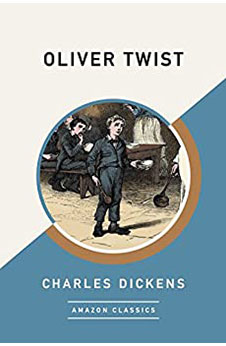
Oliver Twist
“…and who was, also, such a good young man, and wrote such dutiful letters home four times a-year, that it brought the tears into her eyes to talk about them”
Oliver Twist
7/10
“’How should you like to grow up a clever man, and write books, eh?’ ‘I think I would rather read them, sir,’ replied Oliver.”
A comedic, character-laden mystery thriller masquerading as the story of the plight of an orphan.
Poor Oliver gets off to a very bad start. After he is delivered by the parish surgeon, a doubt is even stated, regarding whether he would bear a name at all. The mystery of his background is introduced early as nobody knew where his mother was from, just that she “was a good-looking girl” and that her “shoes were worn to pieces”, suggesting that she had come some distance. Mr. Bumble, the Beadle, invents a name for Oliver, as he names the ‘foundlings’ in alphabetical order. “’The last was a S,—Swubble, I named him. This was a T,—Twist, I named him. The next one comes will be Unwin, and the next Vilkins’”. I guess things could have been worse for Oliver! The text does not specify how he devises their first names.
Nothing of note happens to Oliver for a while, until, one legendary and unforgettable day in literature, his fellow orphans nominate him to ask for more gruel at supper time. “Child as he was, he was desperate with hunger, and reckless with misery. He rose from the table; and advancing to the master, basin and spoon in hand, said: somewhat alarmed at his own temerity: ‘Please, sir, I want some more.’ The master was a fat, healthy man; but he turned very pale. He gazed in stupefied astonishment on the small rebel for some seconds, and then clung for support to the copper. The assistants were paralysed with wonder; the boys with fear. ‘What!’ said the master at length, in a faint voice. ‘Please, sir,’ replied Oliver, ‘I want some more.’ The master aimed a blow at Oliver’s head with the ladle; pinioned him in his arm; and shrieked aloud for the beadle.”
The primary consequence of this is that Oliver is apprenticed to an undertaker, where he is depressed and unhappy. Critically, he is bullied by a colleague, Noah Claypole, who one day provokes Oliver to violence with insults directed at his mother. Oliver runs away to London following this incident and meets John Dawkins, aka ‘The Artful Dodger’, who takes him out for food and a beer and introduces him to Fagin and a gang of thieves. ‘The Artful Dodger’ is not a good nickname. It takes about 30% longer to say than John’s real name. Though they attempt to train him up as one of the thieving crew, it’s not for him. Following a botched robbery, he ends up with Mr. Brownlow for a brief time, until he is reclaimed by Fagin’s gang, using Nancy. However, this is a turning point for Nancy whose conscience is stimulated by Oliver’s goodness and purity. Once they have reclaimed Oliver, Fagin and the gang attempt to indoctrinate him and make them a consistent part of the gang, “slowly instilling into his soul the poison which he hoped would blacken it, and change its hue for ever”. Meanwhile, in a major plot contrivance, Bumble learns that Oliver is in London through an advert seeking him.
Oliver is then involved in a botched burglary and is left for dead. He receives assistance from the burglarees and is brought back to health. In fact, he’s more than brought back to health. He is educated and begins to pile on the pounds, being described as having “grown stout”. Though Oliver is on the up-and-up, Rose is now dying of some mysterious illness. Thankfully, this illness that came out of nowhere is also resolved out of nowhere. The real question is why was it even included? More boring stuff then happens, like Harry Maylie pulls a move on Rose and gets kicked to the curb before a thrilling plotline takes shape involving the selling of information about Oliver’s origins to a mysterious character called Monks.
This is where the novel is at its most exciting and compelling. There are twists and turns when it is revealed that Monks knows Fagin and information is slowly revealed regarding Oliver’s origins. As the novel reaches its climax, most of the prominent characters from earlier come together and Brownlow and Grimwig assist Rose in her efforts to help Oliver, while being spied on by Noah Claypole who is now in London, too. Things get very exciting.
Sadly, the ending is overly dramatic and the weakest part of the novel. How do you tie such a sprawling mess up effectively? Monks, aka Edward Leeford, and Oliver are half-brothers. Brownlow was best pals with their father, Edwin Leeford, who later was head-over-heels for a friend’s daughter, Agnes, who was Oliver’s mother. It turns out that Rose is Agnes’ sister, meaning she is his aunt. Monks was interested in Oliver as he wanted to prevent him from getting any of the inheritance. Brownlow adopts Oliver. Monks reverts to crime and dies in prison in ‘the new world’. Fagin is captured and sentenced to death. The Bumbles lose everything and end up in the workhouse themselves. Sikes dies evading capture.
Who am I to critique Dickens? Nevertheless, I have had an issue with all of his books that I have read to date. There is so much plot and so many events in all his books, that characterisation suffers. In my view, some of the characters can be superficial and overly simplistic, caricatures, if you will, rather than characters. None of Dicken’s characters have an inner world and the author fulfils the role of a ‘biographer’ rather than getting to a deeper exploration of lived experience or emotion.
Regardless of your view on the characterisation in this text, there can be little debate that the individuals that inhabit the world of Oliver Twist are so vivid, that it could be said they are figuratively ‘jumping off the page’.
One Mr. Gamfield, was the opposite of Tommy McAinairey. “’That’s acause they damped the straw afore they lit it in the chimbley to make ’em come down again,’ said Gamfield; ‘that’s all smoke, and no blaze; vereas smoke ain’t o’ no use at all in making a boy come down, for it only sinds him to sleep, and that’s wot he likes.’”
However, what can’t be criticised in the text, is the quality of the writing. For instance, the description of ‘The Artful Dodger’ when Oliver first meets him. “The boy who addressed this inquiry to the young wayfarer, was about his own age: but one of the queerest looking boys that Oliver had even seen. He was a snub-nosed, flat-browed, common-faced boy enough; and as dirty a juvenile as one would wish to see; but he had about him all the airs and manners of a man. He was short of his age: with rather bow-legs, and little, sharp, ugly eyes. His hat was stuck on the top of his head so lightly, that it threatened to fall off every moment—and would have done so, very often, if the wearer had not had a knack of every now and then giving his head a sudden twitch, which brought it back to its old place again.”
Some passages were almost like poetry. “’Stop thief! Stop thief!’ The cry is taken up by a hundred voices, and the crowd accumulate at every turning. Away they fly, splashing through the mud, and rattling along the pavements: up go the windows, out run the people, onward bear the mob, a whole audience desert Punch in the very thickest of the plot, and, joining the rushing throng, swell the shout, and lend fresh vigour to the cry, Stop thief! Stop thief!’”
I also love this rich and vivid description of Bumble that succinctly captures everything that you need to know about him. “Mr. Bumble emerged at early morning from the workhouse-gate, and walked with portly carriage and commanding steps, up the High Street. He was in the full bloom and pride of beadlehood; his cocked hat and coat were dazzling in the morning sun; he clutched his cane with the vigorous tenacity of health and power. Mr. Bumble always carried his head high; but this morning it was higher than usual. There was an abstraction in his eye, an elevation in his air, which might have warned an observant stranger that thoughts were passing in the beadle’s mind, too great for utterance.”
I even learned a new word, ‘myrmidon’. This is an obedient follower of an unscrupulous person.
What impresses me about Dickens is how he describes social issues during his time. The detail with which he describes the conditions of the impoverished are both beautifully written and moving.
“A great many of the tenements had shop-fronts; but these were fast closed, and mouldering away; only the upper rooms being inhabited. Some houses which had become insecure from age and decay, were prevented from falling into the street, by huge beams of wood reared against the walls, and firmly planted in the road; but even these crazy dens seemed to have been selected as the nightly haunts of some houseless wretches, for many of the rough boards which supplied the place of door and window, were wrenched from their positions, to afford an aperture wide enough for the passage of a human body.”
Check out the following passage, where Dickens compares the cells of minor offenders with those of very serious criminals. “This cell was in shape and size something like an area cellar, only not so light. It was most intolerably dirty; for it was Monday morning; and it had been tenanted by six drunken people, who had been locked up, elsewhere, since Saturday night. But this is little. In our station-houses, men and women are every night confined on the most trivial charges—the word is worth noting—in dungeons, compared with which, those in Newgate, occupied by the most atrocious felons, tried, found guilty, and under sentence of death, are palaces”
Dickens distrust and criticism of the legal system seems to be extended here and permeate all aspects of enforcement and the criminal justice system. Mr Fang, the police magistrate, a harsh and vindictive individual, exemplifies much of this criticism, with his unwillingness to listen to counterarguments in favour of the accused Oliver Twist.
While I do appreciate the social commentary. The novel did stray a little into the realm of preachy for me at a couple of points. “We need be careful how we deal with those about us, when every death carries to some small circle of survivors, thoughts of so much omitted, and so little done—of so many things forgotten, and so many more which might have been repaired! There is no remorse so deep as that which is unavailing; if we would be spared its tortures, let us remember this, in time.”
There is a strange parallel in the novel in the relationship between Sikes and his dog, Bull’s Eye, and between Sikes and Nancy. Sikes is violent and abusive to both, and yet, they have such a high degree of dependence or loyalty to him, that neither is able to leave him. However, in some respects, the dog is smarter than Nancy and does not wait around to be killed by Bill. “The animal came up from the very force of habit; but as Sikes stooped to attach the handkerchief to his throat, he uttered a low growl and started back. ‘Come back!’ said the robber. The dog wagged his tail, but moved not. Sikes made a running noose and called him again. The dog advanced, retreated, paused an instant, and scoured away at his hardest speed. The man whistled again and again, and sat down and waited in the expectation that he would return. But no dog appeared, and at length he resumed his journey.” Nevertheless, Bull’s Eye is loyal to the end and he accidentally dies trying to help Bill following his dramatic rooftop death.
Bull’s Eye is treated almost like a human character who unwillingly complies with Sikes and reluctantly does what instructed. He indicates his displeasure through growls and limited disobedience. Nancy is also compliant at first, but after trapping Oliver into returning to the criminal gang, has a change of heart. “’I wish I had been struck dead in the street, or had changed places with them we passed so near to-night, before I had lent a hand in bringing him here.’” Of Sikes, she says, “’He’s a thief, a liar, a devil, all that’s bad, from this night forth.’” She exclaims to Fagin, “’I thieved for you when I was a child not half as old as this!’ pointing to Oliver. ‘I have been in the same trade, and in the same service, for twelve years since… and you’re the wretch that drove me to them long ago, and that’ll keep me there, day and night, day and night, till I die!’”
Rose and Nancy are framed as foils to one another. They are similar in age, though are from different classes and with divergent experiences. When Nancy asks Rose what she can do to help her, she replies, “’You would serve me best, lady,’ replied the girl, wringing her hands, ‘if you could take my life at once; for I have felt more grief to think of what I am, to-night, than I ever did before, and it would be something not to die in the hell in which I have lived.’” What is interesting about Nancy and her relationships to the criminals of the story is that these relationships are so complex. “Vile as those schemes were, desperate as were their originators, and bitter as were her feelings towards Fagin, who had led her, step by step, deeper and deeper down into an abyss of crime and misery, whence was no escape; still, there were times when, even towards him, she felt some relenting, lest her disclosure should bring him within the iron grasp he had so long eluded, and he should fall at last—richly as he merited such a fate—by her hand.” Nancy feels that she is “chained to my old life. I loathe and hate it now, but I cannot leave it. I must have gone too far to turn back”. Though Nancy helps Oliver’s acquaintances, providing intelligence and assistance, in a major strike against the patriarchy, she pays with her life when she is murdered by Sikes.
“She staggered and fell: nearly blinded with the blood that rained down from a deep gash in her forehead; but raising herself, with difficulty, on her knees, drew from her bosom a white handkerchief—Rose Maylie’s own— and holding it up, in her folded hands, as high towards Heaven as her feeble strength would allow, breathed one prayer for mercy to her Maker. It was a ghastly figure to look upon. The murderer staggering backward to the wall, and shutting out the sight with his hand, seized a heavy club and struck her down.”
Traumatic. RIP Nancy.
While Dickens is an enlightened individual in many ways, he is also subject the conventions and bigotry of his day. As a result, he is likely anti-Semitic. “…and standing over them, with a toasting-fork in his hand, was a very old shrivelled Jew, whose villainous-looking and repulsive face was obscured by a quantity of matted red hair”. As a result, Dickens can’t resist commenting on the size of Fagin’s nose. He says, he “followed up this remark by striking the side of his nose with his right forefinger,—a gesture which Noah attempted to imitate, though not with complete success, in consequence of his own nose not being large enough for the purpose”. When Oliver is taken in by Mr. Browlow and is given a new outfit, he sells his original rags to another Jew.
Charley Bates uses the N-word – “a pound and a half of moist sugar that the niggers didn’t work at all at.”
Dickens also uses the work ‘tinker’ to describe an individual of no-fixed-abode who was enlisted to assist in chasing the burglars at Mrs Maylie’s house.
At that same house, some sexism is also evident. “’I should have died at once, I’m sure, if it had been me,’ observed the housemaid. ‘You’re a woman,’ retorted Brittles, plucking up a little. ‘Brittles is right,’ said Mr. Giles, nodding his head, approvingly; ‘from a woman, nothing else was to be expected.’ Losberne also seems to be sexist when he says to Rose, “Bless the bright eyes of your sex! They never see, whether for good or bad, more than one side of any question; and that is, always, the one which first presents itself to them.”
Though there were some instances of what could be classified as racism in the book, the Irish scum, living in London, were represented fairly, I thought. “The sole places that seemed to prosper amid the general blight of the place, were the public-houses; and in them, the lowest orders of Irish were wrangling with might and main.” Of course, they’d be found at the bar.
I thought it interesting that Dickens included a description of female manipulation. “’It’s a lie!’ said Oliver. Mrs. Sowerberry burst into a flood of tears. This flood of tears left Mr. Sowerberry no alternative. If he had hesitated for one instant to punish Oliver most severely, it must be quite clear to every experienced reader that he would have been, according to all precedents in disputes of matrimony established, a brute, an unnatural husband, an insulting creature, a base imitation of a man, and various other agreeable characters too numerous for recital within the limits of this chapter.” Even though it can be reasoned that the treatment of women in 1837 must have been pretty terrible, Mr. Sowerberry is still guilt tripped into taking a tough stance against Oliver to please his wife. Relatedly, Fagin later says, “’It’s the worst of having to do with women,’… replacing his club; ‘but they’re clever, and we can’t get on, in our line, without ’em’. Women. Can’t live with them. Can’t live without them.
As inferred earlier in this report, this book can be very funny at times. I immediately thought of Instagram filters when Mrs. Bedwin said the following: “’…painters always make ladies out prettier than they are, or they wouldn’t get any custom, child. The man that invented the machine for taking likenesses might have known that would never succeed; it’s a deal too honest. A deal,’ said the old lady, laughing very heartily at her own acuteness.”
Other humours moments included:
“…merely pausing, for a few minutes, in the male paupers’ ward, to abuse them a little, with the view of satisfying himself that he could fill the office of workhouse-master with needful acerbity. Assured of his qualifications, Mr. Bumble left the building with a light heart, and bright visions of his future promotion.”
“The doctor seemed especially troubled by the fact of the robbery having been unexpected, and attempted in the night-time; as if it were the established custom of gentlemen in the housebreaking way to transact business at noon, and to make an appointment, by post, a day or two previous.”
As you are aware, I’m often on the look out for characters in novels that remind me of myself. For a while, there were three candidates. Brittles, described as “a lad of all-work: who, having entered her [Mrs. Maylie’s] service a mere child, was treated as a promising young boy still, though he was something past thirty”; Noah, who is described as having an “ugly face”; and Mr. Losberne, “known through a circuit of ten miles round as ‘the doctor,’ had grown fat, more from good-humour than from good living: and was as kind and hearty, and withal as eccentric an old bachelor”. I discounted the latter when I realised that he was an unapologetic perv. He says to Rose Maylie that she thinks, “everybody is disposed to be hardhearted to-day, except yourself… I only hope, for the sake of the rising male sex generally, that you may be found in as vulnerable and soft-hearted a mood by the first eligible young fellow who appeals to your compassion; and I wish I were a young fellow, that I might avail myself, on the spot, of such a favourable opportunity for doing so, as the present.” Come on, Losberne. She’s 17!
However, there was one character with whom I felt I shared a deep level of similarity, Mr. Bumble. He makes a very poor marriage. After a similar duration my own doomed marriage, he laments, “’And to-morrow two months it was done!’ said Mr. Bumble, with a sigh. ‘It seems a age.’” Later, “’To obey, ma’am,’ thundered Mr. Bumble. ‘Your late unfortunate husband should have taught it you; and then, perhaps, he might have been alive now. I wish he was, poor man!’” He is henpecked, disrespected, threatened, and even physically assaulted by Mrs. Corney (now Mrs. Bumble) “The first proof he experienced of the fact, was conveyed in a hollow sound, immediately succeeded by the sudden flying off of his hat to the opposite end of the room. This preliminary proceeding laying bare his head, the expert lady, clasping him tightly round the throat with one hand, inflicted a shower of blows (dealt with singular vigour and dexterity) upon it with the other. This done, she created a little variety by scratching his face, and tearing his hair; and, having, by this time, inflicted as much punishment as she deemed necessary for the offence, she pushed him over a chair, which was luckily well situated for the purpose: and defied him to talk about his prerogative again, if he dared.” I know what that’s like, Bumble. Living with regret and fear.
His reflections are not unlike my own in October of 2021. “He was degraded in their eyes; he had lost caste and station before the very paupers; he had fallen from all the height and pomp of beadleship, to the lowest depth of the most snubbed hen-peckery. “’All in two months!’ said Mr. Bumble, filled with dismal thoughts. ‘Two months! No more than two months ago, I was not only my own master, but everybody else’s, so far as the porochial workhouse was concerned, and now! —’” To copper fasten my status as a Mr. Bumble character, he is also a pedant. “’But I may ask you two questions, may I?’ ‘You may ask,’ said Monks, with some show of surprise; ‘but whether I answer or not is another question.’ ‘—Which makes three,’ observed Mr. Bumble, essaying a stroke of facetiousness.”
There is no confusion about which character most closely resembles granny. It’s clearly Charley Bates. “’Sitch a rabbit pie, Bill,’ exclaimed that young gentleman, disclosing to view a huge pasty; ‘sitch delicate creeturs, with sitch tender limbs, Bill, that the wery bones melt in your mouth, and there’s no occasion to pick ’em; half a pound of seven and six-penny green, so precious strong that if you mix it with biling water, it’ll go nigh to blow the lid of the tea-pot off.’”
Oliver Twist has one of the greatest examples of character growth and development in literature. Mr. Grimwig is a misanthropic sixty-one-year-old who loves to use the phrase, “eat my own head”. “This was the handsome offer with which Mr. Grimwig backed and confirmed nearly every assertion he made; and it was the more singular in his case, because, even admitting for the sake of argument, the possibility of scientific improvements being brought to that pass which will enable a gentleman to eat his own head in the event of his being so disposed, Mr. Grimwig’s head was such a particularly large one, that the most sanguine man alive could hardly entertain a hope of being able to get through it at a sitting”.
Grimwig has little confidence in Oliver and, when he leaves on an errand for Brownlow, doesn’t expect him to return. “The boy has a new suit of clothes on his back, a set of valuable books under his arm, and a five-pound note in his pocket. He’ll join his old friends the thieves, and laugh at you. If ever that boy returns to this house, sir, I’ll eat my head.” “Mr. Brownlow paced the room to and fro for some minutes; evidently so much disturbed by the beadle’s tale, that even Mr. Grimwig forbore to vex him further.”
Towards the end, a passage reads, “here was Mr. Grimwig all ready to receive them, kissing the young lady, and the old one too, when they got out of the coach, as if he were the grandfather of the whole party, all smiles and kindness, and not offering to eat his head—no, not once”. What character growth! That being said, he does have one slip up. “’I had serious thoughts of eating my head to-night,’ said Mr. Grimwig, ‘for I began to think I should get nothing else’”.
Typical of Dickens, this was a burn heavy book.
“’Juries,’ said Mr. Bumble, grasping his cane tightly, as was his wont when working into a passion: ‘juries is ineddicated, vulgar, grovelling wretches.’ ‘So they are,’ said the undertaker. ‘They haven’t no more philosophy nor political economy about ’em than that,’ said the beadle, snapping his fingers contemptuously.”
Grimwig has a burn on an acquaintance’s child. “I know a friend who has a beef-faced boy; a fine boy, they call him; with a round head, and red cheeks, and glaring eyes; a horrid boy; with a body and limbs that appear to be swelling out of the seams of his blue clothes; with the voice of a pilot, and the appetite of a wolf.”
Sikes burns Fagin with this zinger, “Give it here, you avaricious old skeleton, give it here!”
“I never saw a sharper lad. Here’s a shilling for you. If you go on, in this way, you’ll be the greatest man of the time.”
The Gipper