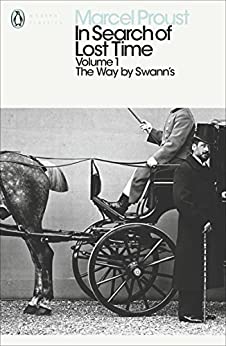
In Search of Lost Time: The Way by Swann’s/Remembrance of Things Past: The Walk by Swann’s Place (Swann’s Way)
“My dearest, my hand is trembling so badly I can hardly write”.
In Search of Lost Time: The Way by Swann’s/Remembrance of Things Past: The Walk by Swann’s Place (Swann’s Way)
7/10
While reading this novel, I found that, at times, I was appreciating it more than I was enjoying it. The introduction of my excellent translation (Penguin Modern Classics) contends that it is “best appreciated in the way it was meant to be experienced, in the full, slow reading and rereading of every word, in utter submission to Proust’s subtle psychological analyses, his precise portraits, his compassionate humour, his richly coloured and lyrical landscapes, his extended digressions, his architectonic sentences, his symphonic structures, his perfect formal designs”. As a painfully slow reader, I had no other option than to do this.
It took me quite a while to get used to the long sentences and the rhythm of the writing. With regard to reading time, though readinglength.com says it should take 10 hours 7 mins, it definitely took me three times that length. I said at the time, I couldn’t finish a chapter before I went to sleep as I’d still be at it the next morning (Kindle estimated my reading time for a chapter at 8 hours 45 mins).
Nevertheless, while enjoying the thought-provoking ideas and rich descriptions peppered throughout the book, on the whole, it felt as though it was a little light on plot and maybe a little dull in places. Nobokov says, “To a superficial reader of Proust’s work—rather a contradiction in terms since a superficial reader will get so bored, so engulfed in his own yawns, that he will never finish the book”. However, I happily completed it. Of the three sections; Combray; A Love of Swann’s; and Place-names: the Name; I enjoyed ‘A Love of Swann’s’ the most. Perhaps this is because I am a dilettante and this component of the novel was closest to the accepted and familiar structure of most modern books? Maybe it is because it contained a story in a more interesting adult world? I could be just like Odette, described as “an ignoramus with a taste for pretty things”.
‘A Love of Swann’s’ really resonated with me and I was there throughout all the ups and downs of his romance. It felt very real and sentences such as, “Of course he could find valid reasons for his resentment against her, but they would not have been enough to make him feel that resentment if he had not loved her so much”, rang true. It is in this section the following rumination on love is found: “For what we believe to be our love, our jealousy, is not one identical and continuous passion, indivisible. They are composed of an infinity of successive loves, of different jealousies, which are ephemeral but by their uninterrupted multitude give the impression of continuity, the illusion of unity”.
Towards the close of this middle section, the text reads, “And with the intermittent coarseness that reappeared in him as soon as he was no longer unhappy and the level of his morality dropped accordingly, he exclaimed to himself: ‘To think that I wasted years of my life, that I wanted to die, that I felt my deepest love, for a woman who did not appeal to me, who was not my type!’”. It really seems that things are over between Swann and Odette. However, later in the text it is revealed, in a jaw on the floor moment, that the mysterious Mme Swann was Odette all along! “Do you know who that is? Mme Swann! That means nothing to you? Odette de Crécy? – Odette de Crécy? Why in fact I was just wondering … Those sad eyes … But you know she can’t be as young as she once was!”
In some ways, I really see the appeal of Odette. She is a little charmer. This is illustrated when “Swann had forgotten his cigarette case at Odette’s”. She responds on learning this, “If you had forgotten your heart here too, I would not have let you have it back”.
It was rewarding to readers that several of themes earlier in the novel are repeated towards the conclusion. Marcel worries that he now appears ridiculous to Swann, arising from occasions where he was trying to get a goodnight kiss from Mama. The theme of memory, too, is given significant further attention.
During my time reading the novel, cracking wise about its lengthy title and its multiple translations, often inserting other nouns in corresponding locations in the title, had been a great source of amusement. Nonetheless, the carefully translated and crafted title, ‘In Search of Lost Time: The Way by Swann’s’, is meaningful on many levels. It refers not only to Swann’s house, but to the person himself and his character, nature, and worldview. This is appropriate as a large portion of the novel is concerned with how this man thinks and his life, Swann’s world.
On style, the introduction says, that Proust’s “was essentially natural and unaffected, free from preciosity, archaism and self-conscious elegance, and far plainer than one might guess from existing English versions. Yet at the same time, he used a wealth of metaphorical imagery, layer upon layer of comparisons, and had a tendency to fill a sentence to its utmost capacity”.
Nabokov summarises three distinctive elements of Proust’s style: “1. A wealth of metaphorical imagery, layer upon layer of comparisons… 2. A tendency to fill in and stretch out a sentence to its utmost breadth and length, to cram into the stocking of the sentence a miraculous number of clauses, parenthetic phrases, subordinate clauses, subsubordinate clauses. Indeed, in verbal generosity he is a veritable Santa. 3.” The merging of descriptive matter and conversational passages.
I can believe that the text in the original French is plain. The complexity of certain aspects of the novel, in my view, do not come from the language, but the length of sentences and piling idea upon idea, so one almost forgets the starting point.
Though the language may be plain, the references are very high brow. I was thankful that my version had notes that described the paintings referred to or provided more information about a theatre piece or artist.
While it may appear to readers that this is not a work of fiction but an autobiography, the experts argue otherwise. In the introduction to the Penguin Modern Classics version, it is described not as “autobiography wearing a thin disguise of fiction but, rather, the opposite – fiction in the guise of autobiography”. Despite being composed of Proust’s own life experience, the material has been “altered, recombined, shaped to create a coherent and meaningful fictional artefact, and this very crucial alchemy – art’s transformation of life – is itself one of Proust’s preoccupations and a principal subject and theme of the book”.
Nabokov weighs in, saying, “One thing should be firmly impressed upon your minds: the work is not an autobiography; the narrator is not Proust the person, and the characters never existed except in the author’s mind”. He acknowledges only that the “narrator and the author do resemble each other in various ways and move in much the same environment”, but says that the novel is a ‘fantasy’, distinguishing Proust the writer from the character Marcel.
Again, referring to the Penguin Modern Classics introduction, the major takeaway for readers is “that only in recollection does an experience become fully significant, as we arrange it in a meaningful pattern. Thus the crucial role of our intellect, our imagination, in our perception of the world and our recreation of it to suit our desires, and the importance of the role of the artist in transforming reality according to a particular inner vision: the artist escapes the tyranny of time through art”. That’s quite a moral of the story and wonderfully stimulating intellectually for readers.
While reading, I made numerous notes of examples of fascinating ideas or incredible writing. There were so many instances that not all could be included, but some are reproduced below.
In the first section, a metaphor of a sick man says, “The hope of being relieved gives him the courage to suffer”. I enjoyed this as it was so simple. The uncertainty of any ending to suffering makes things completely intolerable.
I enjoyed how sleep and death are linked by Marcel in the passage that reads, “Once in my room, I had to stop up all the exits, close the shutters, dig my own grave by undoing my covers, put on the shroud of my nightshirt. [..]before burying myself in the iron bed”.
Time and change are core themes in the novel and evident in this beautiful paragraph. “The staircase wall on which I saw the rising glimmer of his candle has long since ceased to exist. In me, too, many things have been destroyed that I thought were bound to last for ever and new ones have formed that have given birth to new sorrows and joys which I could not have foreseen then, just as the old ones have become difficult for me to understand”. The physical environment of this scene is no more and neither are the emotions or the ‘individual’ who once experienced it. It brought to mind that old expression, ‘one can never step into the same river twice’.
Marcel’s description of how his mother reads to him is wonderful. It says she “directed the sentence that was ending towards the one that was about to begin, sometimes hurrying, sometimes slowing down the pace of the syllables so as to bring them, though their quantities were different, into one uniform rhythm”. I can almost hear it.
Though people have departed, it is possible that they can live on through others. This interesting idea is explored somewhat in the novel when discussing a “piano teacher of the Faubourg Saint-Germain, a woman of genius who at the end of her life had been reduced to poverty and had returned, at the age of seventy, to giving piano lessons, to the daughters and grand-daughters of her old pupils. She was dead now. But her method, her lovely sound, came back to life sometimes under the fingers of her pupils, even those who had become in other respects ordinary people, had abandoned music and almost never opened a piano any more”. Though she has not, her particular style and technique has survived.
While reading this novel, March 2019, there were unseasonably warm days. These corresponded with this passage. “For often in one season we find a day that has strayed from another and that immediately evokes its particular pleasures, lets us experience them, makes us desire them, and interrupts the dreams we were having by placing, earlier or later than was its turn, this leaf detached from another chapter, in the interpolated calendar of Happiness”.
How about this short sentence? “…that feeling of veneration which we always have for those who wield unrestrained power to do us harm”. Brief, but powerful.
There is an important example of innovation in writing in the text too. Nabokov says that “We find Marcel actually eavesdropping on his aunt’s dream—a very singular event in the annals of literature. Eavesdropping is, of course, one of the oldest literary devices, but here the author goes to the limits of the device”. Fascinating.
One of my favourite parts of the novel was its treatment of music and its power. To me, music is something that is really alive and deserving of the attention and veneration it is given. The famous ‘phrase of music’ that Swann hears at a soirée and later at the Verdurin’s is said to “open in [him] the possibility of a sort of rejuvenation”. Later, playing piano is described as follows. “[S]he had learned to caress the phrases of Chopin with their sinuous and excessively long necks, so free, so flexible, so tactile, which begin by seeking out and exploring a place for themselves far outside and away from the direction in which they started, far beyond the point which one might have expected them to reach, and which frolic in this fantasy distance only to come back more deliberately – with a more premeditated return, with more precision, as though upon a crystal glass that resonates until you cry out – to strike you in the heart”. Any descriptions that link music and movement, especially at this standard of writing, win me over immediately.
The text says of Swann that “the love of music had, for a time at least, been born in him, revealing to him many of the riches of his own soul, Swann had regarded musical motifs as actual ideas, of another world, of another order, ideas veiled in shadows, unknown, impenetrable to the intelligence, but not for all that less perfectly distinct from one another, unequal among themselves in value and significance”.
Sadly, there are instances of racism towards Jews, where it is said by Mme de Gallardon, “Oh, I know he’s intelligent, she added, meaning he was a schemer, but still and all, a Jew in the home of the sister and sister-in-law of two archbishops!”
On this point, Nabokov says, “A friend of Marcel’s, a young man called Bloch, a somewhat pompous and extravagant young fellow in whom culture, snobbism, and a highstrung temperament are combined, is introduced; and with him comes the theme of racial intolerance. Swann is Jewish, as is Bloch, and so was Proust on his mother’s side. It follows that Proust was greatly concerned with the anti-Semitic trends in the bourgeois and noble circles of his day, trends that culminated historically in the Dreyfus affair, the main political event discussed in the later volumes”. It is clear then that this theme is explored later and not just a single mean-spirited stereotype.
Though this novel can be very serious in places, there were some instances of comedy that I extracted from the text.
It says of Aunt Leonie, “One knew everybody so well, in Combray, animals and people, that if my aunt had chanced to see a dog pass by ‘whom she did not know at all’, she would not stop thinking about it and devoting to this incomprehensible fact all her talents for induction and her hours of freedom”. Aunt Leonie is probably the most comedic character in the book, sending away guests that don’t comment on her ‘illness’ in the manner that she wants.
I thought of my own grandmother during the passage describing one of Marcel’s visits to Uncle Adolphe. “Once or twice a month, in Paris, I used to be sent to pay him a visit, as he was finishing lunch, dressed in a plain jacket, waited on by his servant dressed in a work jacket of violet-and-white-striped drill. He would complain that I had not come for a long time, grumble that we were abandoning him; he would offer me a marzipan cake or a tangerine”. This isn’t a million miles off saying, ‘hello stranger!’
Describing Marcel’s father’s basic sense of direction was quite humorous. “…instead of having us go home directly, my father, out of a love of personal glory, would take us by way of the Calvary on a long walk which my mother’s incapacity for orienting herself, or knowing what road she was on, made her consider the feat of a strategic genius”.
I thought of Michael Greger and his granny when I read the following passage. “Now, like certain confirmed invalids in whom, suddenly, a country they have arrived in, a different diet, sometimes a spontaneous and mysterious organic development seem to bring on such a regression of their ailment that they begin to envisage the unhoped-for possibility of belatedly starting a completely different life”. #PlantBasedMuscle
It says of Marcel’s mother, “she derived from this very constraint one more delicate thought, like good poets forced by the tyranny of rhyme to find their most beautiful lines”. I immediately thought of the tyranny of rhyme that once forced, ‘Connie does it for the money’.
Towards the conclusion, Marcel thinks “Could I ever have made them understand the emotion that I used to feel on winter mornings, when I met Mme Swann on foot, in a seal-skin coat, with a woollen cap from which stuck out two blade-like partridge-feathers”. I hope that emotion was to go back home and get his red paint. #SealSkinIsMurder #DidYouGetPermissionFromThosePartridges
There were some first degree burns in this book, but nothing too severe.
One burn was on Maulévrier by Saint-Simon and relayed through Marcel’s grandfather, “Never did I see in that thick bottle anything but illhumour, vulgarity and foolishness”.
Granny, too, comes in with a high class burn. “My grandmother reproached him only for speaking a little too well, a little too much like a book, for not having the same naturalness in his language as in his loosely knotted lavallière bowties”. Dang.
Swann, when fed up with the Verdurins, drops this sick burn. “I live too many leagues above the swamp in which these vermin are gabbling and wallowing to be splattered by the jokes of a Verdurin”.
Marcel’s mother says of Mme Blatin, “she’s horrible and always has been” and “She’s horrible, frightfully vulgar, and a trouble-maker into the bargain”.
Even Marcel himself does not make it out unsinged as, when he attempts to imitate Swann, “drawing my finger along my nose and in rubbing my eyes”, his father exclaims, “The child’s a perfect idiot, he’s becoming quite impossible.”
It is my hope that you enjoyed this report. If not, I’d suggest that you refer to Mme Cottard in the text when she says, “as I always say, one should never argue about novels or plays. Everyone has his own way of looking at things and what you find detestable may be the very thing I like best”.
All the Best
The Gipper