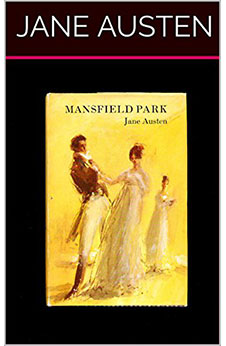
Mansfield Park
Mansplain Park OR The Fanny Price is Right
“My Dear [Family Book Club], – I take up my pen to communicate some very alarming intelligence, which I make no doubt will give you much concern”.
Mansfield Park
7/10
Right off the bat, I need to say that this book was spoiled for me by an unnamed person and this flavoured my reading of it.
Nabokov describes this novel as a fairy tale, that can only be fully enjoyed when readers adopt its “conventions, its rules, its enchanting make-believe”. However, he notes also that practical sense often combines with the fantasy, evident through the monetary accounts, appearing as early as the first chapter, “The son had a good estate in Norfolk, the daughter twenty thousand pounds”, and a recurring motif throughout.
Throughout the text, the reader gets to learn more about Fanny as she grows in confidence and overcomes her shyness. This is linked to how her appearance is judged by others, such as when Mr. Crawford says that “she is quite a different creature from what she was in the autumn. She was then merely a quiet, modest, not plain looking girl, but she is now absolutely pretty”. Earlier in the text, a girls’ being “quiet and modest” is linked with their ‘being out’. Miss Crawford claims that Fanny puzzles her in this respect, “She dined at the parsonage, with the rest of you, which seemed like being out; and yet she says so little, that I can hardly suppose she is”. Austen uses this point to bash convention at the time through Miss Crawford when she says, “That is the faulty part of the present system. One does not like to see a girl of eighteen or nineteen so immediately up to everything – and perhaps when one has seen her hardly able to speak the year before”.
Poor Fanny is an afterthought for many of the residents of Mansfield Park and is very often shafted. When planning the trip to Sotherton, Mrs. Norris suggests that Fanny will remain with Lady Bertram (“Oh no! I cannot do without Fanny”.), Maria and Mr. Crawford ditch her while waiting for Mr. Rushworth to fetch a gate key, Maria forces her to carry a basket of ‘beautiful little heath’ on their return carriage ride from Sotherton, she is not invited on Maria’s honeymoon with Julia, Lady Bertram says she “cannot spare her” when she is invited to dine at the Grant’s, and no fire is set for her in the East room until Sir Bertram intervenes. Even Edmund, usually so kind to her, gives Miss Crawford preference for using Fanny’s mare.
At about the midpoint of the novel, Fanny begins to become more assertive and stand up for herself. When interacting with Mr. Crawford about the play, Fanny exclaims that it was fortunate her uncle returned at the right time to prevent its being performed. “She had never spoken so much at once to him in her life before, and never so angrily to any one; and when her speech was over, she trembled and blushed at her own daring”.
Praise is heaped upon Fanny throughout the novel. Miss Crawford says, “There is not a better girl in the world”. Henry Crawford, at length, lists her appeal, which includes:
· Beauty of face and figure
· Grace of manner
· Goodness and warmth of heart
· Gentleness
· Modesty
· Sweetness of character
· Good temper (patience and forbearance)
· Steadiness and regularity of conduct
· Honourable
Its so funny how Crawford sees all these desirable and nuanced characteristics in her and still behaves as he does with Maria.
The book has an odd structure where we learn more about Fanny’s character as she becomes older and more confident, then we understand her further by exploring her history and family.
The unnamed individual who spoiled this book for me, added that they believed that Fanny was too good for Edmund. Comically enough, Nabokov raises this matter. “Many readers, especially feminine readers, can never forgive subtle and sensitive Fanny for loving such a dull fellow as Edmund, but I can only repeat that the worst way to read a book is childishly to mix with the characters in it as if they were living people. Actually, of course, we often hear of sensitive girls faithfully in love with bores and prigs. Yet it must be said that Edmund, after all, is a good, honest, well-mannered, kind person”. I agree. Edmund does many nice and kind things for Fanny before he considers her a love interest. Specifically, he offers to stay with Lady Bertram so Fanny may enjoy a trip to Sotherton and gives her a very thoughtful gift of chain for William’s cross.
Indeed, throughout the story, Edmund appears to infer, ‘If only I could meet a girl like you, Fanny’. However, Fanny does not have the courage to say, ‘Why not me?’ and Edmund must arrive at this conclusion himself.
Mr. Crawford is a snake in the grass and enjoys easily toying with the emotions of silly young girls. Therefore, it is argued by Nabokov, that “the challenge Fanny offers is much of the attraction”. This is supported by the novel where he says, “I never was so long in company with a girl in my life – trying to entertain her – and succeed so ill! Never met a girl who looked so grave on me! I must try to get the better of this. Her looks say, ‘I will not like you, I am determined not to like you’, and I say, she shall”. Further, with malice he says he “cannot be satisfied without… making a small hole in Fanny Price’s heart”. He gives himself two weeks to achieve his objective of having Fanny “look kindly” on him, give him “smiles as well as blushes”, keep him a chair, and be animated and interested when talking to him.
However, this ridiculous scheme backfires and, amusingly, he is overcome by Fanny’s goodness and hidden charms. Crawford later says to his sister, “You know with what idle designs I began, but this is the end of them”. He extends his stay to indefinite, pops the question, and begins to pursue her relentlessly. He confesses, “It was bad, very bad in me against such a creature, but I did not know her then”. Wisely, Fanny stays true to her intuition and wise appraisal of Mr. Crawford and does not acquiesce to the will of this, on paper anyway, very appealing prospect. She says his proposal is ‘nonsense’ and ‘all nothing’ and resists it even when he attempts sneakily backchanneling her through Sir Thomas. Readers only hope that she can hold her resolve as the “recollection of what had been done for William was always the most powerful disturber of every decision against Mr. Crawford” and Fanny’s unselfishness and desire to make others happy could surpass her gut feeling.
Later Fanny is blamed for not accepting Crawford’s proposal. Miss Crawford says to Edmund that “She would have fixed him; she would have made him happy for ever”. Thankfully Fanny, who is fully formed and dependable, avoided a ‘fixer-upper’ like Mr. Crawford.
Nabokov links the improvements of grounds in the text with Henry Crawford’s flirtations. He says that both “are functions of the idea of planning, of scheming” and points to instances relating to the improvements of Rushworth’s place, where he attempts to seduce Maria, and when he makes proposals for Thornton Lacey while planning to “conquer Edmund’s future wife, Fanny Price”.
I want to thank you both for pulling me up on a point I missed in my initial reading. If you recall, whilst in Philly’s (02.02), I mistakenly contended that Fanny had arrived at her objections to the play based on Edmund’s reservations. This was inaccurate, as during her free time Fanny took up the volume “which had been left on the table, and [began] to acquaint herself with the play of which she had heard so much. Her curiosity was all awake, and she ran through it with an eagerness which was suspended only by intervals of astonishment, that it could be chosen in the present instance – that it could be proposed and accepted in a private Theatre! Agatha and Amelia appeared to her in their different ways so totally improper for home representation – the situation of one, and the language of the other, so unfit to be expressed by any woman of modesty, that she could hardly suppose her cousins to be aware of what they were engaging in; and longed to have them roused as soon as possible by the remonstrance which Edmund would certainly make”.
Nabokov details exactly why the domestic performance of the play, ‘Lovers’ Vows’, would have been so unsuitable for the youngsters. The largest objection would have been that one of the characters, Agatha, “had loved illicitly and borne a bastard child”, meaning the part would be deemed unsuitable for unmarried girls.
Further, Nabokov confirms my suspicion that Edmund’s excuse for ultimately participating in the play, to which he was so strongly opposed earlier, was not for the reasons claimed. “He says rather lamely to Fanny that he will accept the part to restrain the publicity, to limit the exhibition, to concentrate the folly of the playacting within the family”.
When sulky Julia rushes in exclaiming, “My father is come. He is in the hall at this moment”. The first of Mansfield Park’s three volumes concludes. I was certainly glad not to have to wait around for the next part to be published to find out what happened next.
The story’s focal three sisters are a comedy trio.
Fanny’s mother, Frances, is completely useless. It is said that she spends her days in “a kind of slow bustle; always busy without getting on, always behind hand and lamenting it, without altering her ways; wishing to be an economist, without contrivance or regularity; dissatisfied with her servants, without skill to make them better, and whether helping or reprimanding, or indulging them, without any power of engaging their respect”.
Lady Bertram, too, is completely useless, but she is so funny, and the character I most enjoyed reading. Examples include; her views on exercise, “Lady Bertram holding exercise to be as unnecessary for everybody as it was unpleasant to herself”; and how overworked she is, “Sitting and calling to Pug, and trying to keep him from the flower-beds, was almost too much for me”.
In the first half of the novel, Lady Bertram is comforted to think that Fanny will remain with at Mansfield Park and maintains that she “cannot do without her”. Later, her character grows and she says she “should not think of missing [Fanny]” and says that it is her “duty to accept” an offer of marriage from “a man of such good estate as Mr. Crawford”. She continues, “And I will tell you what, Fanny, which is more than I did for Maria: the next time Pug has a litter you shall have a puppy”.
On Mrs. Norris, Nabokov describes her as “one of the most amusing and grotesque characters in the book” and “a rather vicious busy-body, a contriving woman”. She is very busy though, “promoting gaieties for her nieces, assisting their toilets, displaying their accomplishments, and looking about for their future husbands… in addition to all her own household cares, some interference in those of her sister, and Mrs. Grant’s wasteful doings to overlook”. It is surprising that she has time for anything. Compounding the comedy further, she is not at all self-aware and claims to “hate to be worrying and officious”.
Nabokov only really has one large criticism of the novel. He says that the novel shows “signs of disintegrating” when it “lapses more and more into the easy epistolary form” during Fanny’s extended visit to her parents. This refers to the information dump obtained through letters and the key information received through a newspaper article. Though he contends that this structural device is indicative of “a certain weariness on the part of the author”, he accepts that “Miss Austen would have to write practically another volume of five hundred pages if she had wished to narrate those elopements in the same direct and detailed form as she had done in relating the games and flirtations at Mansfield Park before Fanny left for Portsmouth”. He concludes that the “letter-writing business is a shortcut” that helps to “prop up the structure of the novel”, I guess meaning he deems it to be acceptable.
Conversely, of the many aspects of the novel praised by Nabokov, I found one to be particularly interesting. Specifically, “Jane Austen’s method of giving her dislikeable, or less likeable, characters some grotesque little trick of demeanour, or manner, or attitude and bringing it up every time the character appears”. He points to two obvious examples, Mrs. Norris with monetary matters, and Lady Bertram with that dang pug. It is an effective comic device and was evident too in my reading of Emma with Mrs. Elton and the barouche-landau. Similarly, Fanny’s father never quits talking about the Thrush or the docks.
As I was approaching the final parts of the story, I must confess I was fearful of a total hack ending. Upon the plot device of Tom’s illness being introduced, please bear in mind the ending was spoiled for me, I was thinking, ‘Oh no. So Tom dies. Edmund claims the riches and title due him. He lives happily ever after with Fanny’.
I was very pleased when this did not come to pass. Instead, the reader obtains a very satisfying ending, where justice is done, and many of the central characters learn important lessons. Tom gains improved health and morals. Sir Bertram identifies deficiencies in his parenting. Mr. Crawford places “a yet higher value on the sweetness of [Fanny’s] temper, the purity of her mind, and the excellence of her principles”. Mrs. Norris is an “altered creature, quieted, stupefied” and an object of sympathy.
There is some interesting things about class in the novel. For instance, Fanny grieves when reflecting on the contrast between her mother and Lady Bertram, thinking that “where nature had made so little difference, circumstances have made so much, and that her mother, as handsome as Lady Bertram, and some years her junior, should have an appearance so much more worn and faded, so comfortless, so slatternly, so shabby”.
I made notes some examples of what, in my view was exceptional writing, either in terms of prose or ideas.
“Tom walked out of the room as he said it, and Edmund was left to sit down and stir the fire in thoughtful vexation”. The imagery here is so simple and powerful with the uneasy, anxious mind through overthinking being paralleled by the disturbing of the fire and the associated sparks or flames. What efficient use of language.
On the relationship between Maria and Julia, Austen writes, “With no material fault of temper, or difference of opinion, to prevent their being very good friends while their interests were the same, the sisters, under such a trial as this, had no affection or principle enough to make them merciful or just, to give them honour or compassion”.
When describing her attempt to see Fanny, the novel says, “Miss Crawford was not the slave of opportunity. She was determined to see Fanny alone”.
When Fanny is penpals with Miss Crawford, the text reads, “compelled into a correspondence which was bringing her the addresses of the man she did not love, and obliging her to administer to the adverse passion of the man she did was cruelly mortifying”. What an unpleasant situation to be in.
In a letter from Miss Crawford, Fanny reads about a visit by Henry, “when the balmy air, the sparkling sea, and your sweet looks and conversation were altogether in the most delicious harmony, and afforded sensations which are to raise ecstasy even in retrospect”. Such rich prose.
“She [Fanny] looked at him [Edmund], but he was leaning back, sunk in a deeper gloom than ever, and with eyes closed, as if the view of cheerfulness oppressed him, and the lovely scenes of home must be shut out”. A fine example of character observation.
When lamenting his pursuit of Miss Crawford, Edmund says, “all this together most grievously convinced me that I had never understood her before, and that, as far as related to mind, it had been the creature of my own imagination, not miss Crawford, that I had been too apt to dwell on for many months past”. This is powerful writing, Edmund confessing that the person he was attracted to was purely a fantasy and something of his own creation.
Towards the end, Austen makes an appearance herself, ‘breaking the fourth wall’, so to speak, by injecting her own views into the story and letting the reader know she is in control. “Let other pens dwell on guilt and misery. I quit such odious subjects as soon as I can, impatient to restore everybody, not greatly in fault themselves, to tolerable comfort, and to have done with all the rest”.
Overall, this book was very amusing. It did not quite have the biting wit of ‘Pride and Prejudice’, but nevertheless, there were many sensible chuckles to be had. For instance, Edmund thinks of Mr. Rushworth, “If this man had not twelve thousand a year, he would be a very stupid fellow”. The argument between Fanny’s sisters about the knife is hysterical. On the topic of introducing Crawford to Fanny’s family, a passage reads, “He must soon give her up, and cease to have the smallest inclination for the match; and yet, though she had been so much wanting his affection to be cured, this was a sort of cure that would be almost as bad as the complaint; and I believe there is scarcely a young lady in the United Kingdoms who would not put up with the misfortune of being sought by a clever, agreeable man, than have him driven away by the vulgarity of her nearest relations”.
Even the Irish got a mention. Miss Crawford reveals that her and Julia were laughing all the way to Sotherton due to “some ridiculous stories of an old Irish groom” of Miss Crawford’s uncle. My feeling is this character was depicted as an idiot and possibly a drunk.
This was a burn heavy book. There was a burn on clergymen by Miss Crawford when she says, “Men love to distinguish themselves, and in either of the other lines [soldier and sailor] distinction may be gained, but not in the church. A clergyman is nothing”. Mr. Crawford throws some shade at Sotherton when he asks the others if they “do not find the place altogether worse than [they] expected”. When at Sotherton, Julia bails on the residents and says, “I have had enough of the family for one morning. Why, child [To Fanny], I have but this moment escaped from his horrible mother. Such a penance as I have been enduring while you were sitting here so composed and so happy”. Mr. Rushworth says of Mr. Crawford that “Nobody can call such an undersized man handsome. He is not five foot nine. I should not wonder if he is not more than five foot eight. I think he is an ill-looking fellow”.
– Yours, etc.