The Legend of Sleepy Hollow
“He was, moreover, esteemed by the women as a man of great erudition, for he had read several books quite through”.
The Legend of Sleepy Hollow
5/10
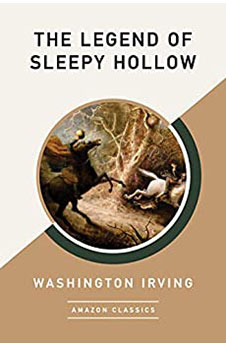
This essay (which can be read in under an hour) was first published in 1820 by American Author, Washington Irving, and introduces the enduring fictional character, the Headless Horseman. The story follows a superstitious school teacher, Ichabod Crane, who is competing for the affections of the only child of a wealthy local farmer. The farmer’s daughter is named Katrina Van Tassel and his rival for her affections is a local hero and prankster, Abraham Van Brunt, who has the badass nickname, ‘Brom Bones’. After, it appears, having his proposal of marriage rejected by Katrina following a party hosted by her father, Ichabod rides home and encounters, what he believes to be, a local legend, the ghost of a decapitated Hessian solider (a German soldier fighting with the British during the American revolution). He is chased by the Headless Horseman and, just as he believes is reaching a place of safety, the Horseman throws his head and knocks Ichabod off his horse. The next morning, the locals investigate the disappearance of Ichabod Crane and find only his horse’s saddle, his hat, and a smashed pumpkin. The implication is that prankster Brom Bones has scared poor superstitious Ichabod out of town by disguising himself as the Horseman. Brom Bones weds Katrina and locals speculate that Ichabod was spirited away by the Headless Horseman.
The story is framed as if it were a true story, written an individual called Deidrich Knickerbocker. The writer says it “is given almost in the precise words in which I heard it related, at a Corporation meeting of the ancient city of Manhattoes, at which were present many of its sagest and most illustrious burghers”. During this meeting, it is suggested that the story is “a little on the extravagant”, to which the storyteller responds, “I don’t believe one-half of it myself”.
The atmosphere of the story is created by descriptions of the drowsy and dreamy influence that is said to ‘hang over’ Sleepy Hollow and by its superstitious characters. These people are said to “walk in a continual reverie” and are “given to all kinds of marvellous beliefs; are subject to trances and visions; and frequently see strange sights, and hear music and voices in the air”. Indeed, in most instances in the story where people gather together, including the Van Tassel’s party, ‘dismal tales’ are told about “mourning cries and wailings heard and seen”.
Of all the local sprits and legends, the Headless Horseman, or “Headless Horseman of Sleepy Hollow” or the “galloping Hessian of the Hollow”, is described as the ‘commander-in-chief’. He is an “apparition of a figure on horseback without a head”, the ghost of a “Hessian trooper, whose head had been carried away by a cannon-ball”. He is said to ride forth each night in search of his head.
In the story, Ichabod Crane is the central character and is on the prowl for a woman, and preferably one that can lift him out of the poverty of the teaching profession. He accompanies children home from school who happen to “to have pretty sisters, or good housewives for mothers, noted for the comforts of the cupboard”. This is because, though he is lank, he is “a huge feeder” with the “the dilating powers of an anaconda”. He thinks that when he gets rich “how soon he’d turn his back upon the old school-house; snap his fingers in the face of… [benefactors], and every other niggardly patron, and kick any itinerant pedagogue out of doors that should dare to call him comrade!”
Though he has few possessions (“two shirts and a half; two stocks for the neck; a pair or two of worsted stockings; an old pair of corduroy small-clothes; a rusty razor”) and no wealth, he is regarded by the local agricultural workers who understand “nothing of the labor of headwork, to have a wonderfully easy life of it”. As a school-master, he is seen as “a man of some importance in the female circle of a rural neighbourhood; being considered a kind of idle, gentlemanlike personage, of vastly superior taste and accomplishments to the rough country swains, and, indeed, inferior in learning only to the parson”. He maximises his position among the females between services on Sundays by “gathering grapes for them from the wild vines that overrun the surrounding trees; reciting for their amusement all the epitaphs on the tombstones; or sauntering, with a whole bevy of them, along the banks of the adjacent mill-pond; while the more bashful country bumpkins hung sheepishly back, envying his superior elegance and address”.
Despite his perceived erudition and intelligence, Ichabod loves fantastic, extraordinary, and marvellous tales and it is said that none “was too gross or monstrous for his capacious swallow”. He just loves the spooky stuff! One of his greatest pleasures is passing winter evening with the local wives listening to “marvellous tales of ghosts and goblins, and haunted fields, and haunted brooks, and haunted bridges, and haunted houses, and particularly of the headless horseman, or galloping Hessian of the Hollow, as they sometimes called him”. As a result, he has an “excited imagination” and is easily startled, or, in other words, is a big scaredy cat. “How often did he shrink with curdling awe at the sound of his own steps on the frosty crust beneath his feet; and dread to look over his shoulder, lest he should behold some uncouth being tramping close behind him!—and how often was he thrown into complete dismay by some rushing blast, howling among the trees, in the idea that it was the Galloping Hessian on one of his nightly scourings!”
However, Ichabod is intelligent in the manner that he avoids single combat with his love rival, Brom. He knows he would lose and hears people joke that Brom would double him up and “lay him on a shelf of his own school-house”. While saving him from a beating, it does mean that Brom’s only recourse is ‘rustic waggery’ and practical jokes, including the harrying of “his hitherto peaceful domains”. Brom and his rough riders “smoked out his singing-school, by stopping up the chimney; broke into the school-house at night, in spite of its formidable fastenings of withe and window-stakes, and turned everything topsy-turvy: so that the poor school-master began to think all the witches in the country held their meetings there”. The use of supernatural phenomena to exasperate Ichabod is used right from the beginning.
The story does a poor job of making Katrina, the love interest, sound appealing to readers. She is described as “a blooming lass of fresh eighteen; plump as a partridge; ripe and melting and rosy cheeked as one of her father’s peaches, and universally famed, not merely for her beauty, but her vast expectations”.
Competing for the affections of Katrina, Ichabod’s principal rival is Brom Van Brunt. His nickname ‘Brom Bones’ was allocated to him for his “Herculean frame and great powers of limb” and he is described as the “hero of the country round, which rang with his feats of strength and hardihood. He was broad-shouldered and double-jointed, with short curly black hair, and a bluff, but not unpleasant countenance, having a mingled air of fun and arrogance”. Oh brother. Ichabod sure is up against it as people in the area looked at Brom with awe, admiration, and good-will. As if Brom Bones wasn’t a big enough badass, he has a steed, “Daredevil, a creature, like himself, full of mettle and mischief, and which no one but himself could manage”.
Sleepy Hollow sounds to me like it would be a Trump stronghold. It is described as a ‘peaceful spot’ where “population, manners, and customs, remain fixed; while the great torrent of migration and improvement, which is making such incessant changes in other parts of this restless country, sweeps by them unobserved”. The writer questions whether, though the events of the story have occurred many years earlier, he “should not still find the same trees and the same families vegetating in its sheltered bosom”.
Though certainly not high literature, there were some pleasing sentences and rich descriptions of events.
It is said that the schoolhouse sounded “like the hum of a bee-hive; interrupted now and then by the authoritative voice of the master, in the tone of menace or command; or, peradventure, by the appalling sound of the birch, as he urged some tardy loiterer along the flowery path of knowledge”.
Of reading too late, the story describes the “gathering dusk of the evening” making a “printed page a mere mist before” the reader’s eyes.
I love, too, this description of Ichabod facing challenges. “He had, however, a happy mixture of pliability and perseverance in his nature; he was in form and spirit like a supple-jack—yielding, but tough; though he bent, he never broke; and though he bowed beneath the slightest pressure, yet, the moment it was away—jerk! he was as erect, and carried his head as high as ever”.
“It was, as I have said, a fine autumnal day; the sky was clear and serene, and nature wore that rich and golden livery which we always associate with the idea of abundance”. Great how the colours and harvest time are linked together in this manner.
Though this story is short, it manages to pack in plenty of comedy. For instance, with regard to one of the locations used, Tarry Town, it is said “This name was given, we are told, in former days, by the good housewives of the adjacent country, from the inveterate propensity of their husbands to linger about the village tavern on market-days”.
The story jokes that women are worse than the supernatural in this line, “he would have passed a pleasant life of it, in despite of the devil and all his works, if his path had not been crossed by a being that causes more perplexity to mortal man than ghosts, goblins, and the whole race of witches put together, and that was—a woman”.
It was humorous to read the list of items that Ichabod had confiscated from the children in his school, “half-munched apples, popguns, whirligigs, fly-cages, and whole legions of rampant little paper game-cocks”.
The horse Ichabod borrowed to go to the Van Tassel’s party was from a “a choleric old Dutchman, of the name of Hans Van Ripper”.
As the story is set in an area colonised by Dutch, there is quite a lot about them. I chuckled reading about the foods they were eating at the Van Tassel’s party, “Such heaped-up platters of cakes of various and almost indescribable kinds, known only to experienced Dutch housewives! There was the doughty dough-nut, the tenderer oly koek, and the crisp and crumbling kruller; sweet-cakes and short-cakes, ginger-cakes and honey-cakes, and the whole family of cakes”. They better be careful, or they will all be having heart attacks.
It was funny to read exaggerated stories of the revolutionary war being recounted by residents, too. “This neighbourhood, at the time of which I am speaking, was one of those highly-favoured places which abound with chronicle and great men. The British and American line had run near it during the war; it had, therefore, been the scene of marauding, and infested with refugees, cow-boys, and all kinds of border chivalry. Just sufficient time had elapsed to enable each story-teller to dress up his tale with a little becoming fiction, and, in the indistinctness of his recollection, to make himself the hero of every exploit”.
The essay, too, was not light on burns.
For Ichabod, it is said that “The cognomen of Crane was not inapplicable to his person” as “He was tall, but exceedingly lank, with narrow shoulders, long arms and legs, hands that dangled a mile out of his sleeves, feet that might have served for shovels, and his whole frame most loosely hung together. His head was small, and flat at top, with huge ears, large green glassy eyes, and a long snipe nose, so that it looked like a weather-cock, perched upon his spindle neck, to tell which way the wind blew. To see him striding along the profile of a hill on a windy day, with his clothes bagging and fluttering about him, one might have mistaken him for the genius of famine descending upon the earth, or some scarecrow eloped from a corn-field”.
Another burn is either on guinea fowls or ill-tempered housewives. You decide based on the following line: “…guinea fowls fretting about it, like ill-tempered housewives, with their peevish discontented cry”.
Somebody call the burn unit for ducks and geese in this line: “ducks and geese are foolish things, and must be looked after, but girls can take care of themselves”.
Even the “old grayheaded negro” playing at the party doesn’t escape a burn when it is said “His instrument was as old and battered as himself”.
One of the best parts about reading older texts is learning new words. The new word that I learned on this occasion was ‘Trumpery’. It is defined as ‘attractive articles of little value or use; something showy that is worthless’. I’ll leave that one to the democrats. #NoCollusion
Though the story does not explicitly say that the whole thing was a trick on Ichabod, it is very strongly implied. While the locals think that “Ichabod had been carried off by the Galloping Hessian”, he had just experienced a major setback in his love life, had received his school teacher’s pay for a quarter of a year, and wasn’t leaving anything of value behind him by just blowing town. Further, it is said of Brom Bones, who went on to marry Katrina, he “was observed to look exceedingly knowing whenever the story of Ichabod was related, and always burst into a hearty laugh at the mention of the pumpkin”.
The Gipper